2024 NAMM Show: Casio Announces New Celviano AP Digital Piano Series


“A truly authentic playing experience” – Casio brings an immersive spatial sound system to its new Celviano digital piano range, and an automatic recorder means you’ll never lose your best performance.

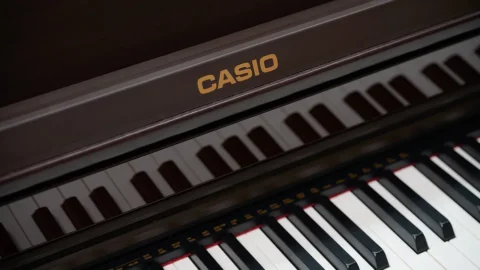
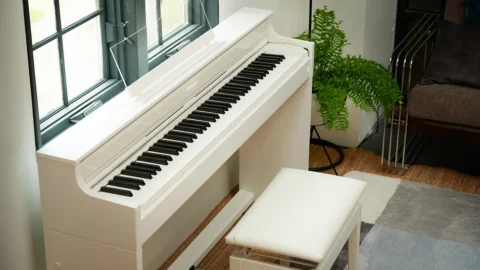
2024 NAMM Show: If you want to buy a digital piano that looks like it belongs as much in your living room as it does your studio, one of Casio’s new Celviano models might well fit the bill. These three ‘furniture pianos’ – the AP-750, AP-550 and AP-S450 – prioritise both style and sound, and come with redesigned speaker systems and a visual information bar that promises to aid your learning.

The sonic highlight here could be the new Hamburg Piano Tone, which Casio has created to “faithfully capture the natural bloom of one of the world’s most coveted and majestic pianos”. This has been matched to the new Celviano speaker system, which is designed to emulate the sound of a grand piano by creating a 3D effect that feels like it’s coming from both above and below the soundboard.

Both the AP-750 and AP-550 have a top lid that can be physically opened in order to project sound forward.

The new Visual Information Bar, can either display a pulsing metronome that will help to keep you in time, or provide feedback on your playing strength and pedal depth, giving teachers additional insight into students’ finger and pedal technique.
The Instant RePlayer feature also sounds handy – use it to return in time to a recent performance or a moment of inspiration that you might otherwise have lost. This might also help you to avoid the stress that comes with pressing the red button and knowing that you’re recording, which can hinder performance.

The AP-750 is the flagship model here, offering a Grandphonic 8 spatial sound system and 39 built-in tones. Nine of these are grand pianos; as well as the Hamburg tone, you also get a Berlin Grand that was developed in collaboration with Bechstein, and the Vienna Grand, another tone that’s based on “one of the world’s finest pianos”.

In the middle of the range, the AP-550 has a 2-channel/4-speaker system and 26 tones, six of which are grand pianos. Here, the Hamburg tone is joined by the New York Grand.

The AP-S450 is similar but more compact, and like the AP-550 is available in black, white and brown colour options. You can have the AP-750 in any colour as long as it’s black.
All three models include the Celviano edition of Casio’s Smart Hybrid Hammer Action Keyboard, a refinement of the action found in the most recent Privia models, and come with the WU-BT10 Bluetooth adapter, which supports wireless MIDI and audio. One of the many apps you can connect to is Casio’s own Music Space; available for iOS and Android, this enables you to adjust the piano’s settings, view and annotate sheet music, engage with interactive game-like lessons, work with audio files and more.

The AP-750, AP-550 and AP-S450 priced at $3,399.99/£1,999, $2,999.99/£1,749 and $1,999.99/£1,549 respectively. Find out more on the Casio website.


2023 NAMM Show: Yamaha’s new TC3 TransAcoustic pianos promise the feel of an acoustic upright and the benefits of digital technology.

Yamaha TC3 pianos introduced at The 2023 NAMM Show. Yamaha has expanded its range of TransAcoustic pianos with the launch of the TC3 uprights. Like other products in the TransAcoustic line-up, these promise to give you the sound and touch of an acoustic piano but also enable you to mute or control the volume using digital technology.

Yamaha first introduced the TransAcoustic piano concept back in 2014, but with the TC3, it’s adding the technology to its b series, JU109 and UJ1 compact upright pianos. The system works by attaching a transducer to the soundboard, and is designed for those times when you need to practise quietly.

The transducer used here has been developed specifically for uprights; it converts digital sound information into vibrations and delivers them to the soundboard. This in turn vibrates and joins the resonance of the strings to turn the entire piano into a resonator. Digital sound sources can be used to produce “natural acoustic sound” from the body of the piano, meaning it’s possible to control the volume when playing without the need for headphones.

Yamaha has also included its Articulation Sensor System. This places sensors under all 88 keys, and these communicate wirelessly with the piano to create what’s said to be a more natural playing experience.

On the sound front, Yamaha’s Grand Expression Modeling technology promises to deliver rich tonal variation by detecting the force and acceleration of the keystrokes and changing the audio output in real-time.

In another nod to modernity, the TC3 pianos also include Bluetooth audio and MIDI for syncing with apps such as the Yamaha Smart Pianist.

Prices and release dates for the TC3 pianos are still to be mentioned, but you can find out more on the Yamaha website.

Roland introduces “premier” GP Digital Grand Piano range.

Roland’s “premier” GP digital grand piano range includes a $19,000 self-playing model, but there are cheaper options, as well.

The GP-6, GP-9 and GP-9M join the super-compact GP-3

Roland Corporation today has introduced its full line-up of flagship GP digital grand pianos, which are designed to look as good as they sound. We’d already seen the ultra-compact GP-3, and this has now been joined by the GP-6, GP-9 and GP-9M.

The GP-9 and GP-9M sit at the top of the range, coming in large cabinets that are finished in either high-gloss ebony or polished white, features the ‘Piano Reality Concert modelling’ represents Roland’s latest technology and is designed to emulate every element of an acoustic piano – from the soundboard material and frame to the strings, hammers and more.

GP-9 and GP-9M offer unlimited polyphony, notes and resonances, a progressive hammer action keyboard with escapement, hybrid wood/moulded key construction with Ivory Feel, and advanced acceleration sensing technology for accurate detection of the subtlest playing nuances.

You even get haptic feedback from the keys that’s designed to emulate the physical resonances of an acoustic piano’s body, along with “high-performance” sustain, soft and sostenuto pedals with a weighted feel and damper modelling.

Careful attention has also been paid to the sound system, which promises multi-channel amplification, premium audio circuitry and advanced sonic processing to create an immersive, surround experience.

The guts of the GP-9 and GP-9M are the same, but the latter model is notable for its self-playing key function. It also comes with pro-level audio outputs and a mic input that enables you to sing along through the onboard speaker system.

The GP-6 is the mid-level piano in the range but, you still get the Piano Reality Premium modelling sound engine and keyboard and unlimited polyphony, and even though the cabinet is smaller, we’re still promised amazing sound.

GP-6 and GP-9 will be available this month priced at $6,300 and $11,000 respectively. The GP-9M will be available in May priced at $19,000, while at the other end of the scale, the GP-3 is available now at $4,000.

Find out more on the Roland website.