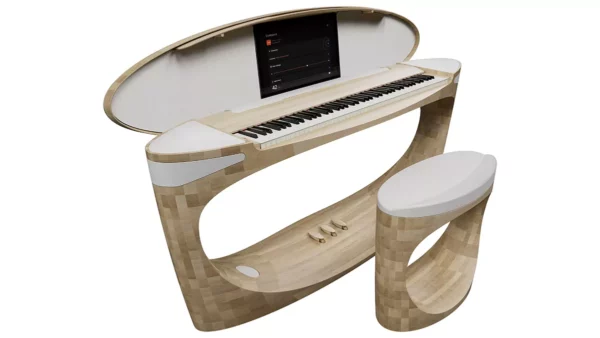
As mentioned earlier, we are in favour of digital piano manufacturers taking a few risks with their designs including Donner and Casio for their recent efforts – so we are fully onboard with what Roland has done with its new concept model.
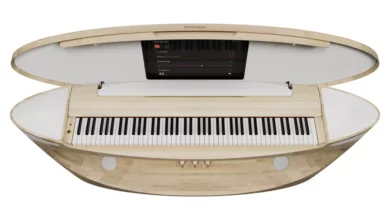
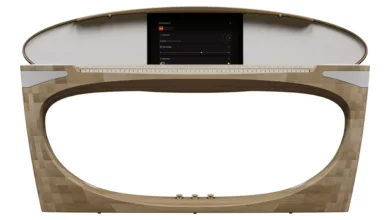
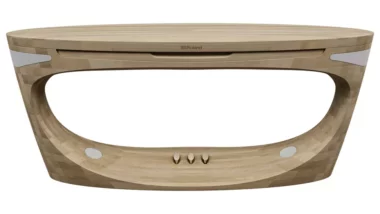
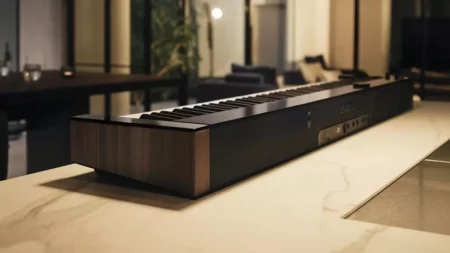
Unveiled as part of the company’s ongoing 50th anniversary celebrations, this has a one-piece wooden body that incorporates Japanese oak, and was created in collaboration with Japanese furniture designer Karimoku. There’s what appears to be a clamshell lid, which lifts up to reveal a display.
The combination of classic materials and innovative design is no coincidence, as it plays on the fusion of past and future that Roland wants to highlight during its half-centenary year. The wooden body promises to help deliver truly resonant piano tones from the speakers, which Roland says are powered by its latest technology. The company also claims to have come up with a keyboard that offers “a touch that’s more natural and responsive than ever before”.
Since the release of the company’s first electronic pianos, the EP-10 and EP-20, back in 1973, Roland has been a consistent innovator. In 1974, the EP-30 became the world’s first touch-sensitive electronic piano, while more recent breakthroughs include 2009’s V-Piano and the Facet concept grand piano from 2020.
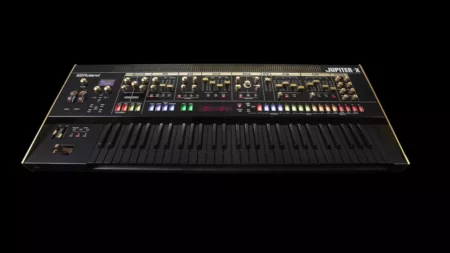
The new piano joins Roland’s Jupiter-X 50th anniversary model in its celebratory concept line-up. Announced in May and featuring a fully black keyboard with gold accents, this is based on the standard Jupiter-X synth.
There is also the D-Flux concept electronic drum set, a decades-hopping electronic drum set that bears more resemblance to Roland’s early electronic kits than the V-Drums we know and love from today
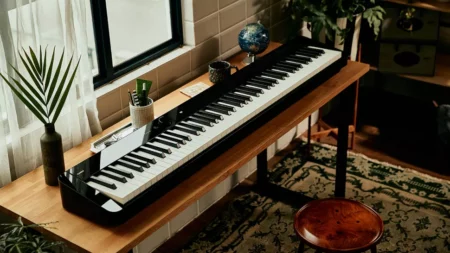
Casio’s new premium Privia digital pianos are designed to look and sound great from any angle.
Casio has introduced the Privia range, keyboards that they say are “the best-sounding, best-feeling, best-looking Privia ever made.”
We’re all in favour of digital piano manufacturers taking a few more risks with the designs of their instruments, so let’s take a moment to celebrate Casio’s new PX-S7000, PX-S6000 and PX-S5000, the latest additions to its Privia range.
With a design that’s “in harmony with modern lifestyles,” these pianos not only offer a more contemporary aesthetic, but are also intended to look great from all angles. So, there is no need to place them up against a wall if you do not want to.
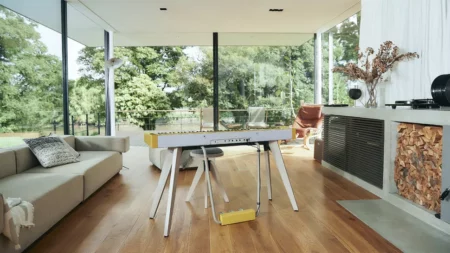
The Privia PX-S7000 is striking – looking a bit like a modern take on the iconic mid-century modern Hohner Clavinet D6 design.
The hybrid keyboard, meanwhile, is made of both resin and wood, and promises an expressive key mechanism with natural touch. The main body of the PX-S7000 can be detached from the stand and played anywhere, thanks to its optional 8xAA battery power. An optional SP-34 three-pedal unit can be connected for portable use, and the optional SC-900 carrying bag lets you take PX-S7000 anywhere.
The PX-S7000 features the sound of three of the finest pianos on Earth, dubbed Berlin, Hamburg and New York. Each piano has its own unique personality, and the Multi-Dimensional Morphing AiR Sound Source brings them to life with damper, string, and aliquot resonance, plus subtle mechanical sounds.
The keyboard features 400 Tones, including 50 electric piano Tones, and a variety of Tones inspired by the keyboard parts of well-known songs.
The PX-S7000’s features a 32-watt 4-way Spatial Sound System. The speaker system in the flagship PX-S7000 takes this into account; you can choose an acoustic setting to match where you piano is positioned (against a wall, in the centre of a room or on a table) and the sound will then be adjusted and optimised in each of the four speakers.
The PX-S7000 also boasts a transparent acrylic music stand and is offered in a striking, bang-on-trend ‘harmonious mustard’ colour scheme, which is designed to “harmonise beautifully with virtually any room’s interior”. You can also bottle it and have it in black or white, but mustard is definitely the way to go, in our humble (but correct) opinion.
You’ll find the same speaker system and keyboard in the PX-S6000, which is available exclusively in black. In fact, its specs look pretty similar to those of the PX-S7000, though it has fewer built-in sounds (350 as opposed to 400) and a slightly reduced feature set. The stand and fixed pedals aren’t included, either, though they can be purchased separately.
One thing the PX-S6000 has over the PX-S7000 is the Tone Modify function, which enables you to fine-tune your sounds in real-time. You can also do this on your mobile device using the Casio Music Space app, which syncs via the included wireless MIDI/audio Bluetooth adapter. This also enables tone editing on the PX-S7000.
We should also point out that both the PX-S7000 and PX-S6000 have pitchbend wheels – a useful feature that we wish more digital pianos had.
Finally, there’s the PX-S5000, the most affordable of the new pianos. This has the same keyboard as its pricier siblings but strips things back by having just 23 tones and fewer features. Again, the stand and pedals are sold separately for this one.
PX-S7000 Features:
400 Tones including three legendary concert grand pianos (Hamburg, New York, and Berlin)
New Smart Hybrid Hammer Action keys with spruce sides
Beautiful design in your choice of Harmonious Mustard, Black or White finishes
Matching beech stand with three fixed pedals
Illuminated touch sensor controls with assignable multi-function buttons
LED touch ring and bright, backlit LCD display for easy navigation
Illuminated pitch bend wheel and assignable buttons
Microphone input with volume control and 25 dedicated microphone effects
Includes WU-BT10 Bluetooth Audio & MIDI adapter
Dual headphone outputs plus 1/4″ L/R outputs and expression pedal input
Class-compliant USB port with no drivers or installation needed
MIDI recorder, USB audio recording and audio/MIDI file playback
Optional 8xAA battery power (AC adapter included)
Designed to work with the Casio Music Space app for iOS/Android
The Casio Privia PX-S7000HM will be available in October, in three color options, for $2,699.99/£2,249, the PX-S7000WE/BK will cost $2,499.99/£2,099, the PX-S6000 will be available for $2,399/£1,499 and the will be PX-S5000 offered at $1,199/£999. Find out more on the Casio website.
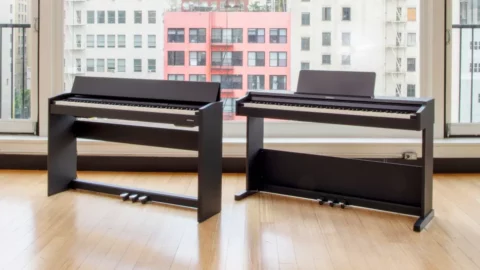
Roland’s F107 and RP107 digital pianos bring high-end sound and playability to the entry level.
The entry-level digital pianos market are highly competitive. However, Roland says that, with its new F107 and RP107 models, it’s bringing “a new level of performance” to the category.
The focus here is on the two key areas of playability and sound. Both the F107 and RP107 feature Roland SuperNATURAL Piano engine, which combines sampling and modelling to emulate a real grand piano, and an 88-note PHA-4 keyboard that’s said to deliver “true weighted response”. Sustain, soft, and sostenuto pedals are also included.
Functionally, the F107 and RP107 are the same – where they do differ is in their design. While both have slimline cabinets, the F107 is based on the look of the Roland F701 – a 2021 Red Dot Design Award winner. And is apparently the more stylish of the two. The RP107 is more traditional in its design, but that might be what you are looking for.
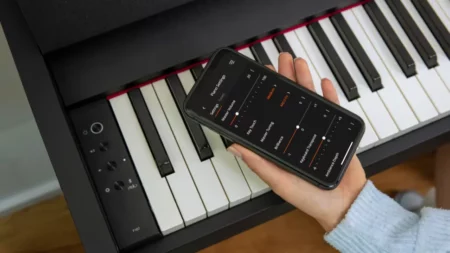
In addition, the Bluetooth connectivity is also notable; not only can you use this for transmitting MIDI and streaming audio, but it also enables connection to the redesigned Roland Piano App, which provides remote control of sound selection, metronome settings, recording and more. Lessons and auto-accompaniment features – so that you can play along with a virtual band – are also included here.
The Roland F107 and RP107 digital pianos will be available in August priced at $1,100 and $1,200 respectively.
The Roland Piano App is a free download for iOS and Android devices – if you have a Core, Pro or Ultimate membership on Roland Cloud this also gives you access to 300 pieces of sheet music.