Universal Audio Announces Free Luna DAW Gets Major Update
Universal Audio launches major update to the free Luna DAW that the company is calling its “biggest software release to date”
Universal Audio has announced the launch of Luna 3.0, a major update to the company’s DAW that introduces a raft of enhancements and new features, including AI-powered stem separation, lyric transcription and chord extraction, alongside Luna Play, a simplified recording mode designed to help you get ideas down fast.
Originally released in 2020 as a low-latency recording environment for owners of UA hardware, Luna was made available free to all Mac users in 2023 before a Windows version was launched in 2024. The software has a number of UA’s analogue emulations embedded into its mixing workflow, integrating the sound of classic channel strips, mixing consoles and tape machines directly into the recording environment.
The new Luna 3.0 is available in both free and paid tiers; the paid-for version has now been renamed Luna Studio (formerly known as Luna Pro) and includes some of the more advanced features unveiled in the update. Luna Free has also received a significant overhaul, though – let’s dig into what’s new.
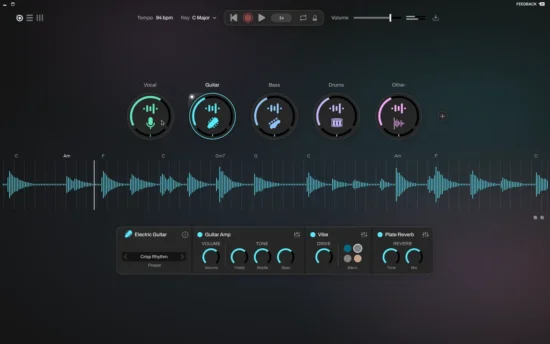
Available across both tiers, Luna Play is a new recording mode within the software that strips back the complexity of a regular DAW to offer a simpler and more streamlined workflow. Described as something like a “voice memo app” designed for “easy, immediate and focused creativity”, Play can automatically detect the instrument you’re recording and the tempo you’re playing, set appropriate levels and suggest presets from UA plugins – all you have to do is play. (Check out the video below for a demo.)
Luna Play is also equipped with the new stem separation functionality that you’ll find in both Luna Free and Luna Studio. The free tier gets 4-track separation covering Drums, Vocals, Bass and Other, while the paid-for version gives you two extra tracks: Guitar and Piano.
Also new in Luna Free are welcome improvements to a number of the DAW’s more bread-and-butter features. You get an overhauled Piano Roll that provides a dedicated MIDI editing workspace alongside the main timeline, Folder Tracks that organise tracks and route audio to folders, an Adaptive Grid on the timeline that adjusts to your zoom level, and more nice-to-haves like a Strip Silence tool, automation for clip gain and the click track, alongside rulers for chords, keys and time signatures.
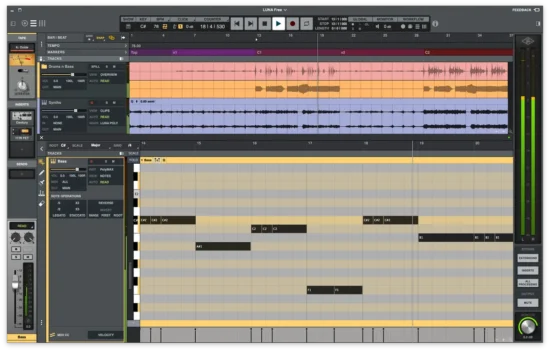
Another addition is Record FX, a workflow previously only available to Apollo owners that allows you to record directly through native plugins. Overall, that’s an impressive amount of firepower for a free piece of software, especially considering that Luna Free was already one of the more capable free DAWs available to budget-conscious music-makers.
The updates exclusive to Luna Studio include audio-to-MIDI functionality and new AI-powered lyric transcription and chord extraction tools developed by Moises. The paid-for version now comes with several plugins you won’t find in Luna Free: Topline Vocal Tune, UA’s simplified vocal pitch correction plugin, along with two third-party instruments, Celemony Tonalic Essential and Dreamtonics Synthesizer V 2 Core. Luna Studio is priced at $199.
Universal Audio has also unveiled a new subscription plan, UAD Spark Studio, priced at $149.99/year. A subscription will give you access to Luna Studio and a collection of 70 native UAD plugins, including some of the company’s most popular analogue emulations – covering classic compressors, channel trips, preamps, EQs, tape machines, delays, reverbs and amps – and seven instrument plugins.
Visit the Universal Audio website to find out more.


