Superbooth 2027 Scheduled For May 6-8


Organizers of Superbooth, the world’s biggest trade fair and festival for electronic musical instruments, have announced the dates for next year’s event.

SUPERBOOTH27 will be held May 6-8, 2027 at the FEZ Berlin. Organizers say that Superbooth 2026 attracted 9,600 visitors, 320 exhibitors, and performances from over 50 artists.

Information on ticket pre-order sales and other details related to next year’s SuperBooth is expected to be announced later this year.


MD-7 Pocket Synthesizer, Open-Source Mini-Synth With Motorized Haptic Controls That ‘Talks Back’


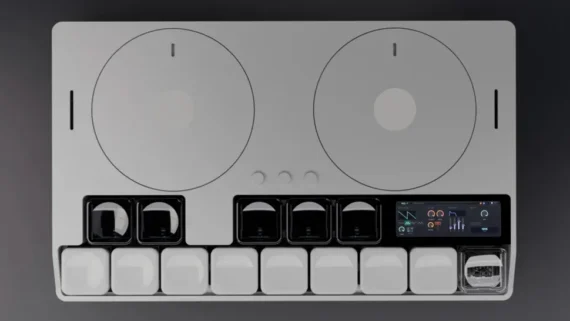
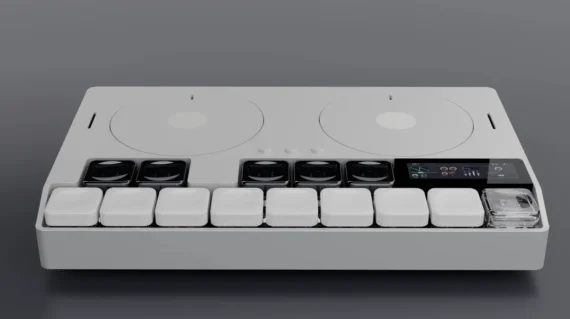
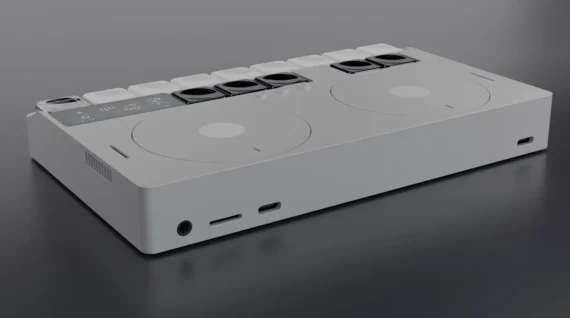
Hong Kong-based synth outfit Mach Devices has unveiled the MD-7, a stylish, innovative and open-source mini-synth controlled via motorized discs.

The MD-7’s two discs can not only be used to navigate menus, dial in parameters and scrub through sequences – as demonstrated in the Instagram video embedded below – but also provide haptic feedback that the company promises will allow users to “stop looking at the screen and start feeling the patch”. (This will be helpful, as the screen is fairly compact.)

What this means in practice is that the discs don’t merely sense rotation but also communicate information to the user through the varying response of their FOC motors. The synth will adjust the resistance of the discs’ rotation depending on the parameter that’s being tweaked, and can simulate mechanical detents that represent stepped values or even create “virtual walls” when the end of a parameter’s range is reached.

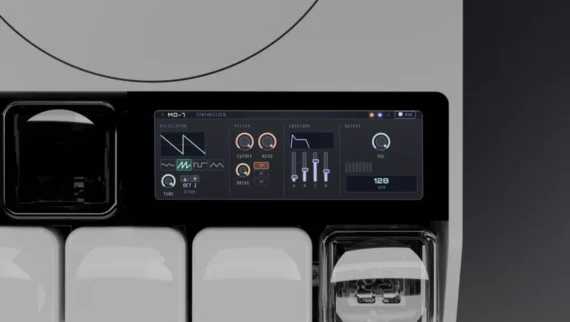
MD-7 is also equipped with a backlit keyboard comprised of 13 button keys, three smaller buttons and the aforementioned 1.65″ IPS display. In the product images, the display squeezes oscillator, filter and envelope controls for the MD-7’s synth engine into its limited real estate, which admittedly looks a little crowded. (Mach Devices notes that the UI shown is in development and subject to change.)

Speaking of the synth engine, no specifics have been provided, but the display shows a basic subtractive architecture with four oscillator waveforms, a resonant multimode filter and a standard ADSR envelope. The promo video also shows a drum looper and 16-step sequencer, its playback being controlled DJ-style by the motor discs, which is an interesting touch.

Aside from the haptic discs, the most intriguing aspect of MD-7 is its open-source software platform: Mach Devices says that the instrument’s firmware, including its DSP engine, modulation system and sequencer, will all be publicly available on GitHub, meaning that owners can customize its operation and build their own features, workflows and even new sound engines.

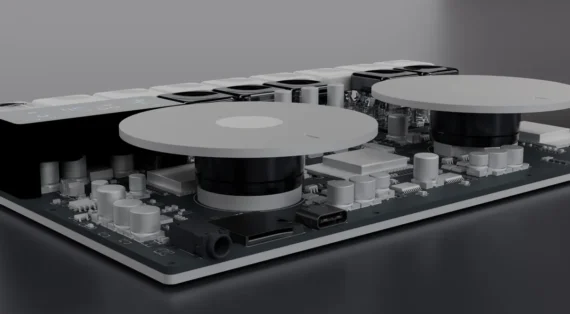
As for connectivity, MD-7 features dual USB-C ports – one for power, and the other for MIDI and audio output and mic input from compatible USB microphones. There’s also a 3.5mm headphone output and a microSD card slot for storage.

The MD-7 is generously priced at $399.


View this post on Instagram


A post shared by Mach Devices (@machdevices)

Features:

  • Compact hardware synthesizer design
  • Open-source firmware platform
  • DSP engine, modulation system, and sequencer firmware planned for public release
  • Two motorized FOC haptic control discs
  • Variable resistance feedback based on parameter values
  • Simulated detents for stepped parameters
  • Virtual walls at parameter range limits
  • 1.65-inch IPS display with 273 PPI resolution
  • Subtractive synthesis engine
  • Four oscillator waveforms
  • Resonant multimode filter
  • ADSR envelope
  • 13-button backlit keyboard
  • 16-step sequencer
  • Drum looper
  • Sequencer control through motorized discs
  • MicroSD card slot for storage

The MD-7 will be available in late September 2026.

Find out more on Mach Devices website.


Bob Moog Foundation Archives Grows With 4,489-Item Donation From inMusic


The donation includes vintage synths and prototypes as well as rare letters and schematics.

The Bob Moog Foundation has announced a major expansion to its archives, with a major donation from inMusic Brands, the parent company of Moog Music.

Among the extensive collection of test models are Moogerfooger prototypes, a Multiple Resonant Filter (MuRF) test fixture, and a Moog Phone Controller model PC-30. Also included are 16 multi-drawer cabinets filled with countless capacitors, integrated circuits, and other electronic components used in the creation and repair of Moog synthesizers.


The items donated include:

  • 4,489 items from Bob Moog’s personal office effects, including well over 500 schematics and 700 letters.
  • Vintage synthesizers and prototype models were also donated, including a Fairlight CMI, a Synton System 3000 modular synth, a bench-model Minimoog Voyager prototype, and more.
  • Hundreds of back issues of industry magazines and dozens of rare product catalogs for almost every imaginable peer company in the electronic music instrument industry from the past several decades.
  • Letters of correspondence between Bob Moog and dozens of industry luminaries, including Wendy Carlos, Herb Deutsch, Felix Visser, and Lydia Kavina.
  • Bob Moog’s drafts for book forewords and technical articles for several publications.
  • His invaluable artwork and handwritten engineering notes can be found in a collection of schematic notebooks.

The Bob Moog Foundation was established in 2005 to pay tribute to the godfather of subtractive synthesis and an icon of electronic music.

“We are proud to contribute these materials so they can be preserved and made accessible to researchers, educators, musicians, and fans,” said Joe Richardson, President of Moog Music and Executive Vice President of inMusic. “As Moog Music continues to bring creative tools to artists around the world, the Foundation’s educational mission helps ensure that the ideas, curiosity, and ingenuity that defined Bob Moog continue to inspire others.”

The Foundation says that this donation continues a collaborative relationship among inMusic, Moog Music, and the Bob Moog Foundation. Earlier inMusic donations to the Bob Moog Foundation Archives include Bob Moog’s 2002 Technical Grammy and the original woodworking lathe used by Bob Moog and his father, George Moog, to craft handmade cabinetry for very early Moog instruments.

“The Bob Moog Foundation is deeply grateful to inMusic for this incredible, generous donation of historical archival material,” says Michelle Moog-Koussa, Executive Director of the Bob Moog Foundation. “Every donated piece helps us tell the story of Bob’s complex, indelible legacy. This donation helps solidify the Bob Moog Foundation Archives as a world-class repository for Moog and electronic music history.”

The Bob Moog Foundation is an independent non-profit that has the goal of preserving the legacy of pioneering synth designer Dr Bob Moog. Key projects include the Moogseum, the Archives and a STEAM program that helps kids learn about science through sound and music.