Archive for March, 2026

FAC Releases BANDIT 2 Multiband Multi-Effects Processor


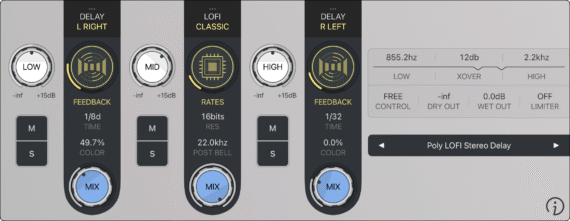
Fred Anton Corvest has released FAC Bandit 2, a multi-band AUv3 plugin for iOS and macOS that splits your audio signal into three independent frequency bands, each processed with its own effect and then recombined to create the final sound.

You can choose from a set of effects, including saturation, lo-fi degradation, ring modulation, delay, and reverb, and blend them precisely within each band.

The new version features a redesigned UI/UX, including new touch gestures, a new output limiter, enhanced linked controls, all effects included (no IAP), and full universal support (iOS/macOS/VisionPro).
Features:

  • 3-Band Multi-Effects Processor
  • Compact design with massive sonic versatility
  • Each band provides its own effect with mix blending control
  • Band effects include Saturator, LoFi, Ring Modulator, Delay, and Reverb
  • Frequency isolator equalizer (DJ style filter)
  • Two adjustable crossover points for low and high bands with a slope up to 48dB
  • Separate Dry/Wet output controls with an optional master Brickwall limiter
  • Multi-output support: each band can be routed to separate channels in your host
  • Linked Controls: Control several parameters at once
  • Advanced Responsive Design, portrait and landscape views
  • Universal Purchase: AUv3 for iOS (iPad/iPhone), macOS and Vision Pro

BANDIT 2 is available with an intro price of $9.99 USD through April 30th, 2026 (normally $12.99).
 

Rare Moog Liberation Keytar Synthesizer Donated To The Bob Moog Foundation Archives


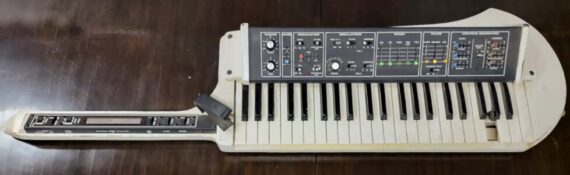
The Bob Moog Foundation – an Asheville-based non-profit, dedicated to the preservation of Bob Moog‘s legacy – has announced a new addition to their archives, a rare Moog Liberation keytar synthesizer, previously owned by composer and synthesist Gary Wright.

The keytar was donated by keyboardist and synth programmer Casey Young. This model, serial number 8041, features a rare white factory paint job. The Moog Liberation is the second in the Foundation’s archive.

“Getting to work with Gary Wright was one of the best gigs I ever had,” noted Casey Young in a personal note accompanying his donation. “He did so much to jump-start my musical journey.”

Young has worked with a wide variety of artists, including Gary Wright, Yes, Madonna, TOTO, Michael Jackson, and Tina Turner.


Here’s what the Foundation shared about the new addition:

“Keytar synthesizers were not very common until the mid-1980s, when the onset of MIDI (Musical Instrument Digital Interface) meant that keyboard controllers only needed a keybed and basic interface to remotely control a synthesizer. As it was in 1980, the Liberation needed to be an all-in-one sound-generating synthesizer, internally quite similar to a Moog Prodigy.

Naturally, this added quite a bit of weight to what was designed as a portable instrument. This, along with Moog Music experiencing market struggles, led to the Liberation’s short production run. As a result, over four decades later, the Liberation has become increasingly rare and collectible.

Gary Wright, writer and composer of the 1976 hit song Dream Weaver, famously played keytar synthesizers during live performances. The white Moog Liberation appears in his 1981 music video for Heartbeat. Ownership of this synthesizer was transferred to musical collaborator Casey Young, who maintained possession until donating it to the Bob Moog Foundation Archives.”

“We are honored by this very special donation to the Bob Moog Foundation Archives,” noted Michelle Moog-Koussa, Executive Director of the Bob Moog Foundation. “Gary Wright’s Liberation is a part of synthesizer history. We are deeply grateful to Casey Young for this important donation, and we look forward to sharing this historical gem once it has been restored.”

The Foundation’s goal is to restore the Liberation’s full functionality and cosmetic appearance for eventual display and hands-on use at the Moogseum.

The Moog Archives are part of the Foundation’s mission, along with the Moogseum and Dr. Bob’s SoundSchool – a STEAM-style educational program. You can find out more about the Foundation and its mission at the Foundation’s site.

SRM Sounds Releases ASMR Choir, A Vocal & String Library With A “Low-dynamic And Ultra-close” Vibe


SRM Sounds is a virtual instrument brand headed up by composer Max Richter and his partner visual artist Yulia Mahr. Recorded in Richter’s Oxfordshire studio space, Studio Richter Mahr, the company’s libraries are developed in partnership with Song Athletics, a creative studio founded by ex-Spitfire Audio CEO Will Evans.

Having previously released Kontakt instruments based on the sounds of his Steinway D SPIRIO | r  and a 15-piece timpani ensemble, Richter has focused SRM’s next library on the phenomenon of ASMR, or Autonomous Sensory Meridian Response, the euphoric tingling sensation some of us experience in response to soft, gentle or particularly tactile sounds.

“A palette of choral and string textures that provides a really special colour to add both a purity and ‘humanness’ to your score”

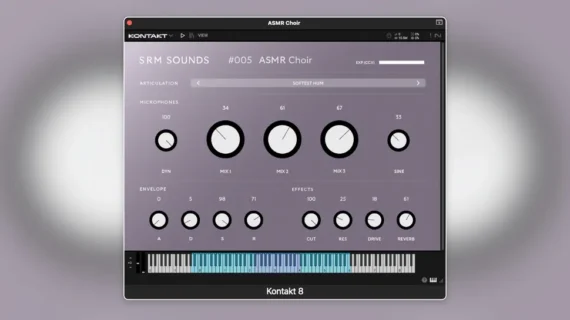
ASMR Choir is a vocal and string library made up of four separate instruments, all sharing a “low-dynamic, ultra-close” vibe, that Richter says is “the musical equivalent of someone whispering in your ear”.

“This instrument is super evocative,” Richter says. “It’s extraordinary. You start playing it and you don’t really want to stop. It leads you into this hypnagogic state which is quite beautiful.”

“This comes out of spending years in recording studios working with singers and instrumentalists and thinking about a category of sounds which is super magical, but we don’t often get to experience in isolation – all these tiny sounds that you can capture with close-mic’ing techniques.”

At the heart of the instrument is a small choir specializing in Renaissance music, recorded in the main room at Studio Richter Mahr and led by soprano Grace Davidson. Also included is a small string section of solo violin and cello, recorded on its own and also together with the choir. The vocal and string recordings were also run through Richter’s analogue vocoders to create a fourth processed instrument with a more synthetic character.

Each sound source was recorded with three mic treatments, which can be blended together before the results are shaped via the ADSR envelope and processed via onboard filter, drive and reverb.

Max Richter is a Grammy-nominated German-British composer and pianist known for his works for stage, opera, ballet and screen. Richter recently received an Academy Award nomination for his score to Chloé Zhao’s Hamnet.

“We decided to launch SRM Sounds because, even though there are a million sample libraries out there, I could find hardly any that really hit the spot for me. For composers, sound is an incredibly personal and emotional thing,” Richter says of SRM Sounds. “These instruments have the colours that I love to use to tell the stories I want to tell.”

Key Features:

  • 4 instruments total ~24.6GB
  • Choir instrument
  • String instrument (violin and cello)
  • Choir + String instrument (ensemble performance)
  • Processed instrument (via analogue vocoders)
  • 3 mic mixes
  • ADSR envelope and effects
  • Kontakt Player library (Version 7.10 or higher required)
  • NKS compatible

ASMR Choir is available currently priced at £149. You’ll need Native Instruments Kontakt version 7.10 or higher to run it, or the free Kontakt Player plugin.

Find out more on the SRM Sounds website.