Focusrite Launches Scarlett 4th Gen Line of Audio Interfaces
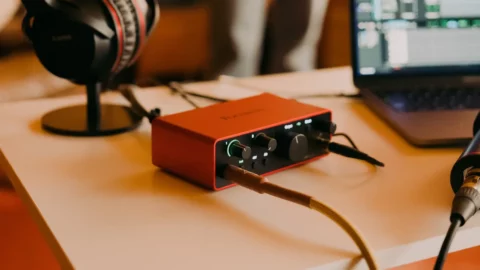

World best-selling audio interfaces reimagined as Focusrite launches Scarlett 4th Gen range. The Scarlett Solo, 2i2 and 4i4 have been updated with new preamps, converters and a number of useful features.

Focusrite has unveiled the fourth generation of its best-selling Scarlett range of audio interfaces. The 4th Gen lineup, made up of the Scarlett Solo, 2i2, and 4i4, has been bolstered with improved specs, upgraded parts and handy new features.

Audio circuitry in each of the 4th Gen interfaces has been re-engineered, with the addition of professional-grade 192kHz, 24-bit converters from Focusrite’s flagship RedNet range; these provide an extended 120dB of dynamic range. 2i2 and 4i4 have been upgraded with new, remote-controlled preamps delivering 69dB of gain, while a redesigned headphone amp offers improved sound quality.

Focusrite have added a host of new features to the 4th Gen range; the most useful of these is Auto Gain, a function that scans incoming signal to automatically set gain at the optimal levels. Once set, the Clip Safe feature constantly monitors and adjusts gain levels in order to prevent clipping. The interfaces’ Gain Halos, which display levels as a backlit halo around the gain knobs, have also been redesigned to provide output metering.

The Scarlett range’s Air mode, which adds high-frequency sheen and presence to vocals and lead instruments, has been revamped and bolstered by the addition of a DSP-based Harmonic Drive mode that’s said to imbue sounds with “console-like richness”.

Each Scarlett interface arrives bundled with Ableton Live Lite and a three-month subscription to Pro Tools Artist, alongside a Hitmaker Expansion bundle that contains an array of plugins that includes Antares Auto-Tune Access and NI MASSIVE. The bundle also includes five free masters from LANDR and a two-month subscription to LANDR Studio, offering music distribution to streaming services.

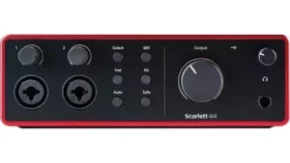
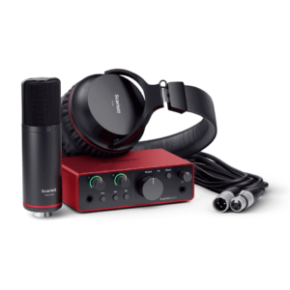
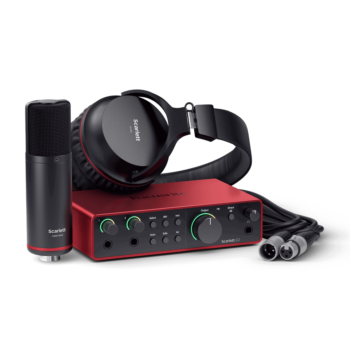
The three interfaces in the Scarlett range vary in their I/O capabilities: Solo has one mic preamp and one Hi-Z instrument/line input, 2i2 has two of each, and 4i4 offers the same plus two fixed line inputs and four balanced outputs alongside MIDI input and output. The Scarlett Solo Studio and Scarlett 2i2 Studio bundles include either a Solo or 2i2 interface with CM25 MkIII studio condenser mic and newly redesigned closed-back SH-450 headphones.
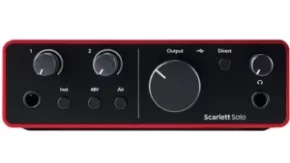
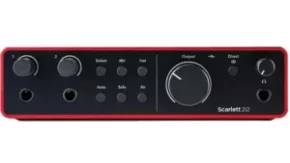
The Scarlett 4th Generation line available with the following pricing:

Find out more on Focusrite website.


Behringer Announces Kobol Expander, aka ‘The French Minimoog’ Now Available for $199


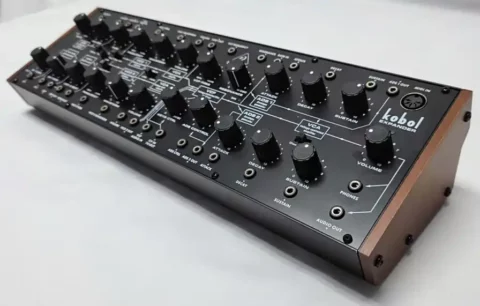
Behringer has announced that its Kobol Expander – a knockoff of the original French synth module from 1979 – is now shipping.

The Behringer Kobol Expander is an analog semi-modular synth, in Eurorack format, that features 2 VCOs and a 4-pole VCF. The original has been described as ‘the French Minimoog’.


Features:

  • Analog duophonic synthesizer with 2 VCOs and 7 morphing waveforms
  • Based on “Kobol Expander” circuitry from the ‘70s
  • Semi-modular design requires no patching for immediate performance
  • Pure analog signal path based on authentic VCO, VCF and VCA designs
  • Dual oscillators with 7 waveforms, oscillator sync and pulse width modulation
  • Unique 4-pole VCF design for natural saturation only found in ”Kobol” synthesizers
  • Analog LFO with 2 selectable waveforms and multiple destinations for advanced sound creation
  • Additional noise generator expands waveform generation
  • Oscillator sync
  • 32 patch points for modular connection and integration with external equipment
  • 31 controls give you direct access to parameters
  • External audio input for processing external sound sources
  • Complete Eurorack solution – main module can be transferred to a standard Eurorack case
  • 16-voice Poly Chain allows combining multiple synthesizers for up to 16 voice polyphony
  • MIDI support with MIDI channel and Voice Priority selection


The Behringer Kobol Expander is shipping now, priced at $199.


Future Retro Vectra Synthesizer is back in Production, Shipping in Late 2023


The Future Retro founder, Jered Flickinger, announced in 2022 that it was closing its doors after 25 years. Later in the year, though, the company announced that it was coming back, with new management and plans to reissue Flickinger’s designs.

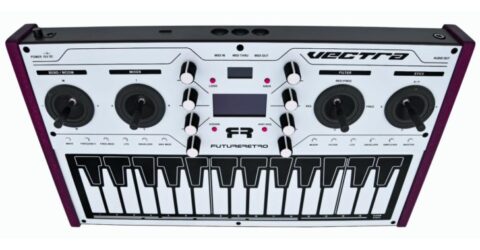
The revivified Future Retro has announced that its Vectra synthesizer is back in production and will be shipping later this year.

The Vectra is a unique digital-analog hybrid synthesizer that features four oscillators, white and pink noise sources, four ring modulators, a four-channel mixer, five LFO’s, six morphing envelopes, six primary multimode analog filter types, a main analog VCA, and numerous internal modulation routings and VCA’s controlling modulation amounts.

The Vectra’s synthesis architecture is designed to allow the greatest flexibility in recreating multiple synthesis techniques of the past, while introducing several new innovations and methods. According to the company, it’s like having a powerful self-contained semi-modular synthesizer, with approximately 500 internal signal routings and around 256 storable sound parameters.

Future Retro Vectra:

The Future Retro Vectra is expected to be available in Nov/Dec 2023. Pricing and other details are to be announced.