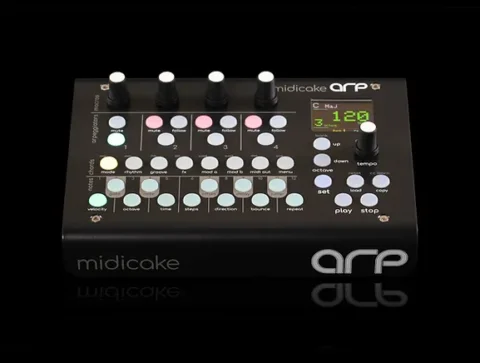
Midicake let us know that they’ve introduced a free firmware update for the Midicake ARP that introduces new Time Parameters, designed to enables you create sequence polyrhythms and polymeters.
In addition, the update brings additional new features:
Classic Arpeggiator Mode: Experience the nostalgic and beloved patterns of traditional arpeggiators.
One Finger Mode: Simplify your performance without sacrificing creativity.
Keyboard Zoning: Expand your expressive range by assigning different ARP patterns to various keyboard sections.
These features make playing the ARP not just easier, but also more fun and engaging, suitable for both studio sessions and live performances.
Midicake ARP Firmware v5 is available now as a free download.
Enjoy the sound of your own voice? iZotope’s AI-powered Vocal Enhancement Assistant plugin promises to make it sound even better.
Native Instruments today announced iZotope VEA, a new AI-powered Voice Enhancement Assistant.
More people are recording their voices than ever before – we’ll leave you to decide which of these voices are actually worth listening to – so a plugin that offers an easy way of improving the sound of the spoken word has a large potential audience. With that in mind, allow us to introduce you to iZotope’s VEA – an AI-powered Vocal Enhancement Assistant for podcasters and content creators.
VEA features AI technology that listens first, then enhances audio, designed so that creators can feel more confident with their voice and deliver better sounding content. They say that VEA increases clarity, sets more consistent levels, and reduces background noise on any voice recording.
“Many people don’t love the sound of their voice when listening back to a recording,” explains Todd Baker, VP Product at Native Instruments. “VEA quickly polishes your vocal sound so you can feel more confident as a host or narrator. VEA is also easy to use even if you haven’t worked with audio tools before, so you can spend more time focusing on what you want to say, not on how you sound.”
Promising to make any voice recording “more powerful, more polished, and more professional,” this is designed for podcasters and other content creators and features enhancement technology from RX, Ozone and Nectar, some of iZotope’s other products.
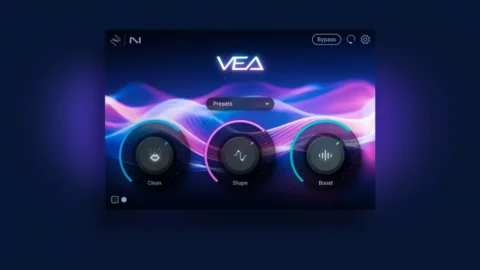
The company says that VEA is adept at increasing clarity, setting more consistent levels and reducing background noise. For people that are new to audio production, VEA offers three simple controls to help you with this: Shape, Boost and Clean.
The Shape dial is billed as an alternative to an EQ, and can tailor your recording’s tone, while the Boost knob handles compression and limiting to even out your volume. Clean is effectively a de-noiser, designed to eliminate background sound and keep your voice intact.
If you have a podcast idol, there’s also the Audiolens feature, which enables you to target a specific voice recording that you like and try and replicate its sound. VEA’s attempt to match the tone is visualised so you can see how close it’s getting.
Features:
The Shape control ensures audio sounds professional and audience-ready, without having to worry about an EQ. Shape is tailored to each voice, and matches the sound of top creators or podcasts with the free iZotope Audiolens tool.
The Boost control adds loudness and compression as it’s turned up. Easily boost the presence and power of voice recordings without spending time struggling with settings. Boost delivers a smooth and even sound to speech for a more engaging listening experience.
The Clean control takes background noise out of the spotlight so every voice can shine. VEA learns the noise in the room automatically and preserves speech for light, transparent noise reduction.
VEA works as a plugin within major digital audio workstations (DAWs) and non-linear editors (NLEs). For a list of officially supported hosts, see the System Requirements at www.izotope.com/vea.
VEA runs on PC and Mac in VST/AU/AAX formats. It is available now, with the following pricing: $29 / €29 / £29 / JPY 4200 / AUD 45 / CAD 39 / CHF 29 / CNY ¥199. You can find you more and download a 10-day demo on the iZotope website.
Korg Poetry, a ‘Chopin piano’, could be the most unexpected signature instrument ever – ‘Inspired by Chopin’.
There are plenty of signature guitars, and even the odd artist-endorsed synth, drum machine and plugin, but we weren’t expecting Korg to rock up at NAMM with a digital piano that bears homage to a composer who died more than 150 years ago. That’s what we’ve got with the Poetry, though – an instrument that “resonates with the spirit” of Romantic era icon Frédéric Chopin.
This is certainly a surprising move from Korg – not least because it missed a golden opportunity to call it the ‘Chopiano’ – but if you’re a Frédéric fan, the details of this instrument could be very exciting.
The first of Poetry’s two piano tones is based on Chopin’s 1843 Pleyel piano, which had 80 keys and was pitched at 430Hz rather than 440Hz, the modern tuning standard. This gives it a distinct tone that promises to be authentic to the one that Chopin would have experienced.
The second piano is derived from a contemporary Italian concert grand that’s used in the International Chopin Competition, no less. This one has a “breathtaking, transparent and profoundly expressive sound,” says Korg, adding that, “Were Chopin alive today, he would surely find inspiration in expressing his soulful genius through the resonant notes of this modern masterpiece”. We’ll never know if that’s true, but if it sounds good.
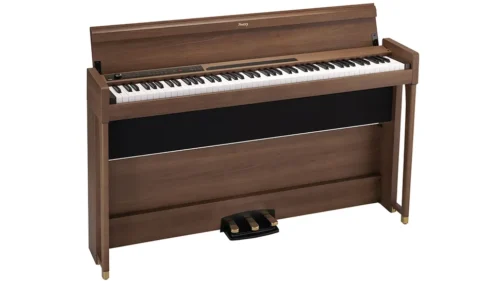
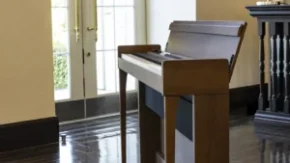
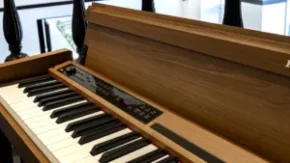
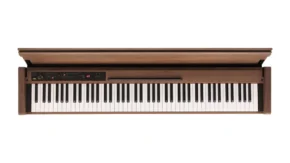
Based on what we can see in the pictures, the Poetry is certainly a tastefully designed piano, coming in a ‘Poetic Brown’ woodgrain finish and sporting gold-trimmed pedals and toes. It’s also nice and compact – with a depth of just 26cm and a flat top when the lid is down, it could be a good option for smaller rooms.
The Poetry uses Korg’s RH3 Real Weighted Hammer Action, which is designed to replicate the feel of a grand piano as closely as possible (the keys feel heavier at lower registers than they do at higher ones, for example) and you can choose from five touch sensitivity options. There’s a three-pedal setup with half-damper capability, and the piano is pre-loaded with 50 Chopin pieces that you can listen to at your leisure. Poetry also ships with 23 piano scores for you to play yourself.
A 2-track recorder enables you to capture your performances, too, and you also get such modern niceties as a built-in metronome, sound layering (so you can create a piano/strings sound, for example) and a Partner Mode that splits the keyboard in two and can be used for teaching purposes. Connectivity includes a line input, two headphone outputs, MIDI I/O and Pedal and Speaker connections, and the built-in sound system comprise two 25w speakers.
Poetry is set to ship in March priced at around £1649/€1899. Find out more on the Korg website.