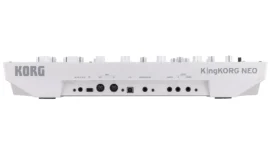
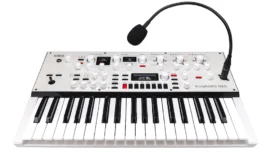
KingKorg Neo Promises A Virtual Analogue Synth Experience that’s in ‘a league of its own’


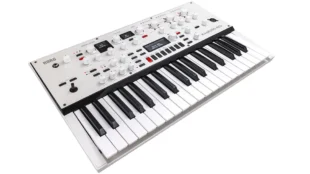
The original KingKorg synth was launched in 2013. The 61-note keyboard wasn’t dead, but never really seemed to fully capture the public’s imagination. And, Korg has now taken the XMT virtual analogue engine that powered it and added it into the more compact KingKorg Neo. Now, a new KingKorg swings into town.

XMT stands for eXpanded Modelling Technology, with the aim of it being to provide a wide variety of sounds and simple operation. This means preset algorithms that combine different oscillator types – everything from simple sawtooth and square waves to more complex offerings and PCM/DWGS.

The extensive filter section, meanwhile, models multiple types – expect the flavour of ‘70s monosynths, ‘80s polys and, of course, Korg’s own MS-20. There’s a 16-band vocoder, too, complete with formant shifting and individual control over the level and pan of each band. Either the input from the supplied mic or the synth itself can be used as the modulator.

In fact, each of the three oscillators or two timbres (A and B) can be set as the source for the mic input, opening up even more possibilities.

KingKorg Neo also offers three master effect slots, each of which can access six different effect types. The Pre FX slot includes the likes of distortion and an amp sim; Mod FX deals with phasing, chorus and tremolo; and Rev/Delay does (wait for it) reverb and delay. You can select which effect goes in each slot with a dedicated dial, then finetune it with further controls.

So far, so straightforward, but if you want to stretch the limits of the KingKorg Neo’s capabilities, you’ll want to familiarise yourself with its virtual patching system, which enables you to make six virtual patch assignments for each of the two timbres. So, you can connect control signals such as EG, LFO and joystick movements to the sound parameters of your choice.

KingKorg Neo has 200 presets spread across eight categories, so you can just dive in and start using those if sound design isn’t your thing. There’s also a handy step arpeggiator that will automatically generate arpeggiated phrases based on the chords you play; you can choose from six different arpeggio types and specify the duration, interval and on/off status of each step.

With its OLED display and block-based layout, the KingKorg Neo’s interface appears to be clean and concise, and you can also assign up to 40 programs to eight category favourite buttons for easy recall during live performances. The 37 full-size keys are velocity and release-velocity sensitive.

The Neo will be available from February priced at $949/£1,099.
Find out more on the Korg website.
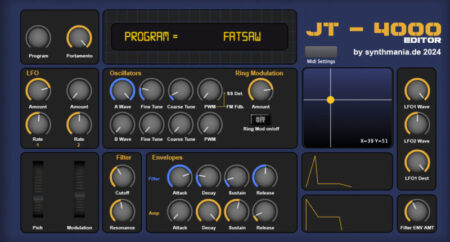
Free Patch Editor for Behringer JT-4000 Micro Synthesizer

Synthmania.de has introduced a free patch editor for the Behringer JT-4000 Micro synthesizer.


What they say about it:

“All parameters of the mini synthesizer are directly accessible. This makes the Behringer dwarf much easier and more intuitive to use.

The editor is available free of charge and can now be downloaded from my website. The app runs standalone with Apple Mac OS-X and Microsoft Windows, VST 2.4 and AU.”

Find out more on the website.


Korg microKorg 2 opens “a new chapter in synth history” the long-awaited successor to one of the world’s best-selling synthesizers


Korg unveils the sequel to one of the 21st century’s most iconic instruments and a ‘first synth’ for a whole generation of music-makers.

Ahead of the 2024 NAMM Show, being held January 25-28, 2024 in Anaheim, California, Korg has announced microKorg 2.

Here we were thinking that Yamaha’s Seqtrak might steal the show at NAMM this year, but it turns out we may have been mistaken. Korg has just unveiled a raft of new products to be shown at NAMM 2024, the most exciting of which is the long-awaited successor to the beloved microKorg.

Released in 2002, the microKorg was an affordable but deceptively powerful synth that became hugely popular with everyone from amateur knob-twiddlers to world-famous artists – Tame Impala and The Prodigy can be counted among the synth’s fans. One of the 21st century’s most iconic instruments, the microKorg was a ‘first synth’ for a whole generation of music-makers.

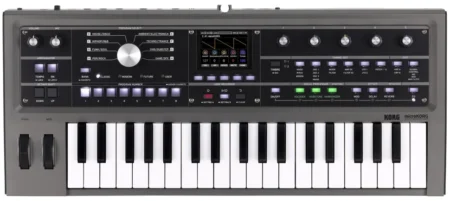
22 years on, Korg has announced the microKorg 2, which it tells us captures the essence of what made the original a global success while bringing an array of new features to the table. On first glance, the most noticeable upgrade is the synth’s 2.8-inch colour display, which offers advanced control of the synth’s parameters alongside to animated effects and an oscilloscope view that visualizes your patches.

Like its predecessor, microKorg 2 is built around a virtual analogue synth engine. The synth’s polyphonic architecture can handle up to eight voices, and sounds can be layered in Dual mode to create multi-timbral patches. The synth is equipped with 512 presets categorized into eight banks labelled by genre, and custom sounds can be saved in its 64-slot patch memory.

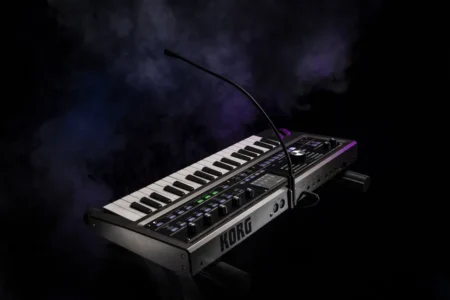
microKorg 2’s sounds can be processed through a range of effects that are grouped into three categories: modulation, delay and reverb. There’s also a two-band parametric EQ for further sound-sculpting. Like its little brother, the synth is equipped with a powerful vocoder and vocal processor and comes bundled with a goose-neck microphone.

In addition to classic vocoder effects, microKorg 2’s vocal processor offers Auto-Tune-style pitch correction and a harmonizer for creating layered and pitch-shifted vocals. Another new feature for the microKorg 2 is the loop recorder, a handy tool for recording performances to create layered compositions.

Like the original, microKorg 2 is outfitted with a 37-key velocity-sensitive keyboard, but we’re told that the new version has been redesigned to enhance playability and provide a natural feel. Measuring 54cm in width and weighing a touch above 2kg, microKorg 2 is a portable instrument that can run on mains power or six AA batteries.

As for I/O, the synth is equipped with stereo line out, headphone out, MIDI in/out, aux in and two microphone inputs. There’s also a USB-C port and a jack for a damper pedal.

microKorg 2 will be released in June of this year. We’ll be checking out the synth at NAMM next week – keep an eye on the homepage to see it in action.