2024 NAMM Show News: Korg Opsix mkII Features 64-Voice Polyphony


Korg unveils the Opsix mkII, an updated version of its six-operator ‘Altered FM’ synth.

In another major announcement made in the lead-up to 2024 NAMM Show, Korg has revealed the update to its Opsix FM synthesizer. Described by Korg as a “digital synth like no other”, Opsix mkII increases polyphony to 64 voices.

Opsix mkII operates using the same ‘Altered FM’ synth architecture as the Opsix, a six-operator FM synth engine that augments classic FM synthesis with a variety of modern sonic possibilities. Korg tells us that mkII’s Altered FM engine has been kitted out with new “sound components, waveforms, filters, shaping possibilities, effects, LFOs, envelopes, modulations and more”.

On top of the six-operator FM engine, which offers five operator modes, Opsix mkII is capable of subtractive, analogue modelling, waveshaping and additive synthesis, and signal paths can be rerouted internally to achieve semi-modular synthesis. Parameters can be modulated using a modulation matrix equipped with three envelope generators and three LFOs that can output 23 different waveforms.

Sounds can be run through a variety of analogue-style filters, including filters modelled on the Korg MS-20 and Korg PolySix, along with resonant two- or four-pole low-pass, high-pass, band-pass and band-reject filters. Opsix mkII has an impressive effects section that offers 30 effect types, including a 3-band EQ, chorus, phaser, flanger, distortion, compressor, delay, reverb, grain shifter and more.
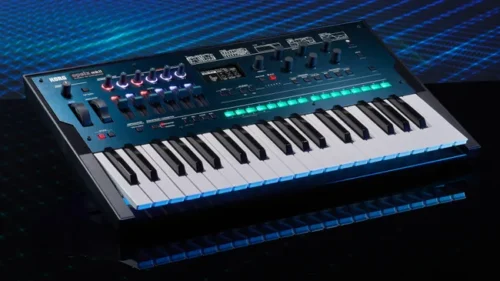
Notes can be played in via the synth’s 37-key, velocity-sensitive and release velocity-sensitive keyboard, or programmed using a step sequencer that offers up to 16 steps per pattern with up to 6 notes per step, and makes use of Korg’s Motion Sequencing technology, which lets the user record changes of up to six parameters for each step in a sequence. There’s also an arpeggiator onboard with seven preset patterns.

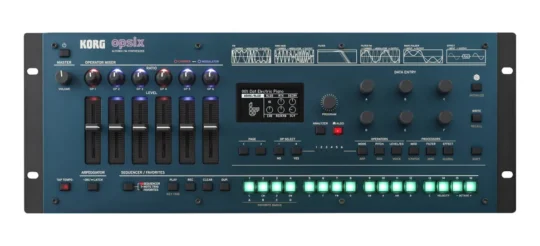
Like it’s predecessor, Opsix mkII’s interface is centred around an OLED screen and what Korg call the Operator Mixer, a set of six backlit faders and knobs used to set the level of each operator, adjust their wave shape and change the operator mode; the controls will light up red or blue to indicate whether they’re tweaking the carrier signal or modulator signal.

Opsix mkII is equipped with headphone out, stereo line out, MIDI in/out, along with a jack for a damper pedal and a USB-B port.

Korg opsix Audio Demos:

The synth is priced at £699/€799 and will ship in March this year. Find out more on Korg website.
KORG Introduces wavestate, opsix + modwave Modules


Korg releases desktop versions of three of its most popular synths: wavestate, opsix and modwave.

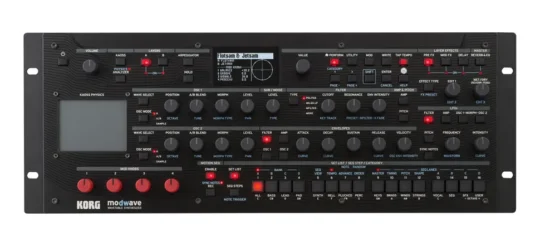
2024 NAMM Show: In yet another big gear announcement from Korg, the manufacturer has revealed three module versions of its most popular synthesizers: wavestate, opsix and modwave. If you liked the look of these instruments but you’ve no need for a keyboard or fancy integrating them into a rackmount set-up, it is your lucky day.

Each of the three synths now supports MIDI 2.0 Property Exchange, a feature that exchanges tones, programs, and other information between devices using MIDI messages, and their factory sounds have been redesigned to respond to polyphonic aftertouch. This means they’ll pair well with Korg’s Keystage, the brand’s first MIDI 2.0-compatible keyboard controller.

The desktop versions of the Wavestate, Modwave and Opsix are designed for both desktop and rackmount use, measuring 4U in height and 19″ in width, and the rear jack panel is recessed to allow easy access to cables even with gear mounted directly above. The synth’s brackets offer a choice of panel angles for desktop use: flatter for performing standing up, or more upright for working while seated in your studio.

The Korg modwave module offers of the features of the modwave mkII in a compact 19-inch desktop/rackmount package.

The Modwave is a modern take on Korg’s cult classic DW-8000 synthesizer that transforms the original into a “modern monster synth” equipped with powerful wavetable oscillators, flexible modulation capabilities and 60-voice polyphony. Korg says that its responded to user requests in updating Modwave’s LFOs with options for free-running, delayed start and retriggering, while adding a pre/post switch for reverb sends.

Find out more on the Korg website.

The module version of the Opsix offers all of the features of Korg’s Opsix mkII, also announced today. This includes an expanded 64-voice polyphony and the addition of new “sound components, waveforms, filters, shaping possibilities, effects, LFOs, envelopes, modulations and more”. Opsix is an ‘Altered FM’ synth that augments classic DX7-style 6-operator FM synthesis with subtractive, analogue modelling, waveshaping and additive synthesis, along with analogue-style filters that emulate the MS-20 and PolySix. The 19″ rack-mountable enclosure has the same controls as the keyed models, yet is easily transportable and fits neatly into any studio or desktop production system.

The Korg wavestate module offers all of the features of the wavestate mkII in a compact 19-inch desktop/rackmount package.

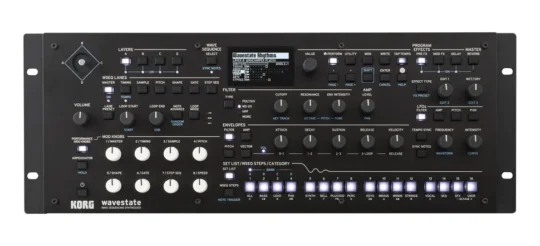
Korg’s Wavestate is a 21st-century reimagining of the Wavestation, a digital wave sequencing synth made by the company in the ’90s. Wavestate mkII was released in June last year, expanding the original’s polyphony from 64 stereo voices to 96 and adding a variety of newly designed Wave Sequences and Programs, along with expanded internal storage and redesigned companion software, Wavestate Editor/Librarian. The desktop version’s polyphony has been boosted up to 120 voices.

Here’s what they say about the wavestate:

“In 2020, the acclaimed wavestate brought KORG’s Wave Sequencing to the next level. Featuring the radically re-imagined Wave Sequencing 2.0, the wavestate delivers astonishing, ever-changing sounds with extensive hands-on control. Far from a nostalgic reissue, the wavestate was designed from the ground up for a new generation of musicians, producers, and composers, taking cues from sources as diverse as modular synths, groove boxes, and algorithmic composition.”

Find out more on the Korg website.

The Korg Grandstage X Completely Redesigned Stage Piano With 7 Inspiring Sound Engines


Could Korg Grandstage X be the best-looking stage piano yet?

We’d be happy to be seen with it at a gig.

Korg Grandstage X Stage Piano debuts ahead of 2024 NAMM Show.

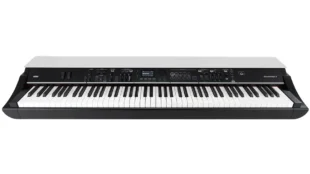
It’s been six years since Korg released the GrandStage, so a new version was definitely in order (not least because the original has now been discontinued). That has now arrived in the shape of the Grandstage X, a mighty fine looking stage piano that comes with seven dedicated sound engines.

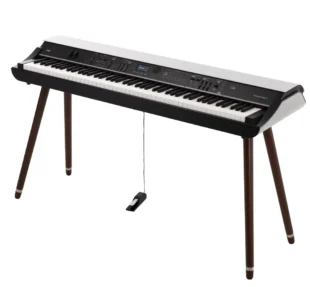
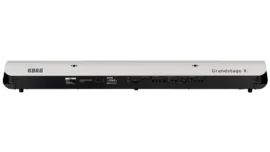
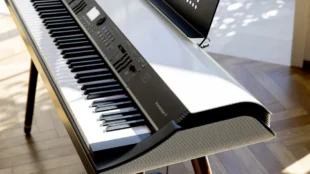
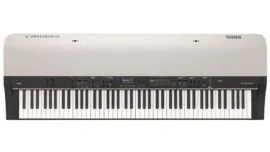
With its angled control panel, flat top, aluminium body and perforated metal cheeks, the Grandstage X certainly gets off on the right style note; the two tone ivory and black colour scheme looks great, to our eyes. It’s the sound that counts, though, and here, the story starts with the SGX-2 engine, which powers 13 acoustic pianos. These include the new GSX Piano and the existing Nautilus, Oasys and SG1D pianos from Korg’s back catalogue, and there’s a nod to the ‘80s and ‘80s house revival with the inclusion of the classic M1 Piano.

The EP-1 engine provides seven electric pianos that cover the requisite vintage bases, and there are no less than three different organ engines (CX-2, Vox and FC-1). Further engines include the AL-1 analogue modelling sound source, which deals with synths, and the HD-1 PCM module.

The interface on the Grandstage X has been designed with live players in mind, and promises to be very intuitive. You can layer and split at the touch of a button, and there are dedicated level controls for each part.

The keyboard has Korg’s RH3 weighted hammer action, and we’re intrigued by the key-touch slider, which promises “instant control over volume and timbre changes with each keystroke”. There are Nutube-powered analogue-style effects, an EQ and multiple delays and reverbs. The Grandstage X also has a slight arranger keyboard vibe with the inclusion of a rhythm and chord progression function, which creates a backing track that’s said to complement your playing.

Here’s what they say about it:

“Meet the Grandstage X, Korg’s flagship stage piano, now completely redesigned with seven inspiring sound engines, 700 preloaded sounds, a user-friendly interface, and a sleek aesthetic design. Every aspect of the Grandstage X is intuitively arranged, empowering you to select and play your favorite sounds effortlessly. With its elegant, light ivory two-toned body and perforated side panels, the Grandstage X not only delivers the highest sonic quality but also stands as a visual centerpiece whether on stage or in the studio.

Grandstage X is not just a stage piano; it’s a statement of excellence. Prepare to elevate your performance and let the Grandstage X take you and your music to new heights.”

Korg Grandstage X Sound Demo:

There’s no shortage of competition in the stage piano market, but with its distinctive look and high-quality sounds, the Grandstage X could definitely be a contender. There’s no word on a price yet, but you can expect it to arrive in June. Find out more on the Korg website.