zplane Peel Stems plugin brings Real-Time Stem Separation to your DAW


Breaking up is hard to do, sang Neil Sedaka, but stem separation services and plugins are fast becoming ubiquitous. Perhaps developers sense a gold rush before this kind of audio extraction becomes a feature that comes standard in every DAW; Apple recently added it via updates to Logic Pro for Mac and iPad, and we’d already seen it in the likes of FL Studio and Serato Studio.

To be fair to zplane, though, it has plenty of history as far as audio algorithms go – see its previous work in the areas of timestretching and pitchshifting – so the release of Peel Stems, its own take on the stem separation paradigm, feels like a logical next step.

Offering all the features of the existing Peel plugin, including its Focus Frame EQ, Peel Stems has an advantage over some of its competitors in that it works in real-time – there’s no waiting for the stem separation process to be done offline before you hear and tweak the results. It’s said to operate at low latency, giving you immediate hands-on control over the various parts of the mix.
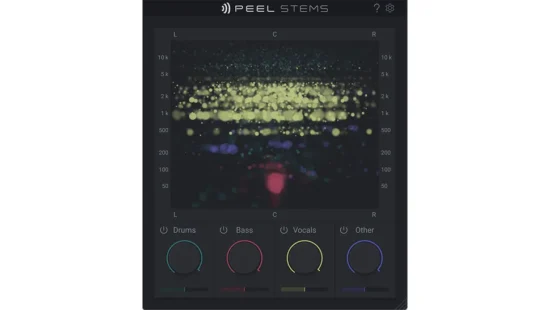
As seems to be standard with these processors, tracks are split into four parts: Drums, Bass, Vocals and ‘Other’. You can turn each stem on or off, and there are also independent level knobs so that you can rebalance a mix from within the plugin.

Each stem also has an ‘isolation’ fader so that you can finetune separation precision, and a soundfield display visualises the audio in real-time, with each stem’s signal represented by coloured glowing circles so that you can see where in the stereo field and frequency range it’s placed.

The Focus Frame EQ enables you to dive even deeper. You can isolate the snare or kick from your drums, for example, so that it can be processed individually.

“Peels Stems provides DAW users with a completely new and intuitive tool for audio manipulation,” reckons zplane’s co-founder and head researcher Tim Flohrer. “Being able to unmix tracks in real-time opens up possibilities that were unthinkable just a few years ago. We can’t wait to see how people get creative with this!”

Peel Stems runs on PC and Mac in VST/AU/AAX formats and is available now for €59 (an introductory coupon code enables you to get 25% off this price). A crossgrade from Peel, meanwhile, costs €19 – this can currently be had at a 50% discount.

Find out more on the zplane website.
 

Intellijel introduces Atlantix Eurorack Synth Voice & Atlx Expander


Intellijel has introduced Atlantix, the successor to their Atlantis all-in-one Eurorack voice module, inspired by the Roland SH-101.

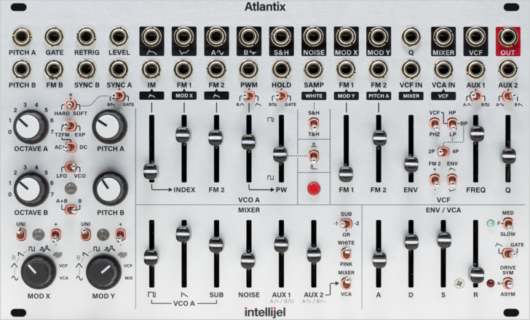
The Intellijel Atlantix is a complete analog subtractive synth voice in 42HP. It provides all the fundamental building blocks needed to make sounds in Eurorack: VCOs, VCF, VCA, S&H, Noise, and an Envelope.

Atlantix features immediate, hands-on control, with 20 sliders, 4 knobs, 27 toggles, and 2 rotary switches. 32 patch points let you integrate the Atlantix deeply into modular systems. And the optional Atlx expander adds 16 additional patch points & ring mod.

Features:

  • Cascaded 4-Pole multimode filter with LP2, BP2, LP4, BP4, HP4, and Phaser modes
  • Two Triangle Core VCOs
  • VCO A: Thru-Zero FM with INDEX and PWM, Hard/Soft Sync, Octave switch
  • VCO B: Linear FM, LFO/VCO switch, Hard Sync, Octave switch
  • Suboscillator with three modes spanning two octaves
  • White and Pink noise sources
  • Six-channel mixer comprising VCO A Waveforms, Sub, Noise, and two Aux inputs
  • Aux inputs have switched normals with sources from VCO A and B for quick paraphonic play without patching
  • Mixer Aux 2 can be routed post-VCF / pre-VCA
  • Mod X and Y buses allow for quick modulation routing of VCO B, S&H, Noise, and feedback sources without patching
  • Both Mod X and Y buses have polarity and level-shifting switches
  • Analog ADSR envelope with three time ranges, manual gate, and level (velocity) input
  • Patchable Sample and Hold modulation source
  • Asymmetric and symmetric output distortion modes
  • 20 Sliders, 4 Knobs, 27 toggles, and 2 Rotary switches for expressive hands-on control
  • 32 Jacks for creative and complex patching options
  • 16 additional jacks with the optional Atlx expander

The Intellijel Atlantix is available now for $699. The Atlx expander is $59.


40 Famous Synth Sounds on Vintage Minimoog + Minimoog Reissue


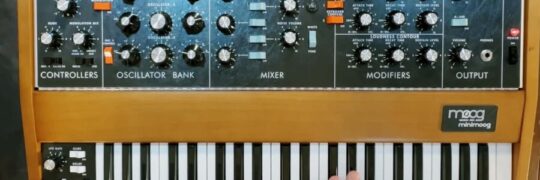
This video, via synthesist Andy Whitmore, offers a head-to-head comparison of a vintage Minimoog Model D and a ‘modern’ Minimoog Model D reissue.

Andy Whitmore compares the two synths using 40 iconic sounds:

00:00 Rush Tom Sawyer FX

00:21 ELP Lucky Man lead

00:32 Duran Duran Save A Prayer lead

00:43 Duran Duran Save A Prayer lead

01:02 ABBA Gimme! Gimme! Gimme! lead

01:19 ABBA Gimme! Gimme! Gimme! bass

01:37 Harold Faltermeyer Axel F Beverly Hills Cop Main Theme lead

01:54 Harold Faltermeyer Axel F Beverly Hills Cop Main Theme bass

02:11 D Train You’re The One For Me bass

02:27 D Train You’re The One For Me lead

02:43 Madonna Holiday lead

03:00 Madonna Holiday bass

03:16 Queen Radio Ga Ga bass

03:32 Howard Jones New Song lead

04:09 Howard Jones New Song lead

04:19 Gary Numan Are ‘Friends’ Electric? theme

05:00 Michael Jackson Rock With You bass

05:26 DEVO Smart Patrol/Mr. DNA effects

05:56 Parliament Flashlight bass

06:26 Rush Tom Sawyer lead

06:44 Stevie Wonder I Wish bass

07:02 Madonna Borderline lead

07:34 Madonna Borderline bass

07:51 Dr Dre Nuthin’ But A “G” Thang lead

08:15 Michael Jackson Don’t Stop ‘Til You Get Enough bass

08:32 Pink Floyd Shine On You Crazy Diamond lead

09:03 Rick Wakeman Catherine Of Aragon bass

09:41 Chaka Khan We Can Work It Out bass

10:02 Weather Report Birdland bass

10:26 Barclay James Harvest Victims Of Circumstance lead

10:50 The Alan Parsons Project Separate Lives bass

11:00 Europe The Final Countdown lead

11:24 Stevie Wonder Isn’t She Lovely bass

11:46 Stevie Wonder That Girl bass

12:05 Michael Jackson Workin’Day and Night bass

12:22 Gary Numan Are ‘Friends’ Electric? lead

12:46 Nena 99 Luftballons bass


Moog went to extreme lengths to recreate the build of the original Model D, to the point that the circuit boards match the originals, and they had transistors custom made to match the original components.

While Moog went to extreme lengths to recreate the original Minimoog, you can hear subtle differences between the old and new synths in Whitmore’s video. Some of this reflects the fact that no two analog synths sound exactly the same. Some may reflect slight differences in pots and how they are dialed in. And some may reflect the fact that the Minimoog Model D reissue probably sounds more like a new Minimoog would have sounded 40 years ago, than a 40 year-old synth.

Watch the video and share your thoughts on how the vintage Minimoog and Minimoog reissue compare in the comments!