In the latest episode of the Music Production Podcast 373, host Brian Funk talks with one of the rockstars of sound design, Francis Preve.
Francis Preve is a sound designer, producer, and synthesizer programmer who has made factory presets for synths from Sequential, Roland, Korg, Oberheim, Serum, and many others. So it’s likely that you’ve played Preve’s patches, even if you didn’t realize it.
In this interview, Preve discusses his new pack, Serum Models, physical modeling synthesis, sound design and more. Preve also discusses how creating great sounds is just the start of his work, and talks about the work needed to turn a set of patches into a successful product.
It’s a great interview for anyone interested in sound design. Watch the video and share your thoughts in the comments.
Synthesist and composer Anthony Marinelli – In his latest video – talks with super-producer Robert Margouleff about T.O.N.T.O., arguably the greatest synth in history.
Video Summary:
“Dive into the revolutionary world of T.O.N.T.O, the legendary synthesizer that became synonymous with Stevie Wonder’s groundbreaking music during his classic period. In this video, I explore the incredible story behind T.O.N.T.O (The Original New Timbral Orchestra), a pioneering modular synthesizer created by Malcolm Cecil and Robert Margouleff in the early 1970s.
Discover how T.O.N.T.O’s vast array of analog modules and innovative design allowed Stevie Wonder to explore new sonic frontiers, shaping timeless albums like “Innervisions,” “Fulfillingness’ First Finale,” and “Songs in the Key of Life.” From its towering size, custom wood cabinets, to its intricate patching system, T.O.N.T.O not only expanded the palette of sounds available to musicians but also set a benchmark for electronic music production.
Through my interview with Grammy Winning Super-Producer c (T.O.N.T.O co-creator), we’ll uncover its enduring impact on music production techniques and its part in shaping the evolution of synthesizers. From its role in creating iconic basslines and ethereal textures to its influence on the development of funk, soul, and electronic music genres, T.O.N.T.O remains a testament to the power of innovation in music technology.
Whether you’re a die-hard Stevie Wonder fan, a synth enthusiast, or simply curious about the instruments that changed music forever, this video provides a comprehensive look at T.O.N.T.O’s journey from obscurity to becoming an icon of musical innovation.”
Topics covered:
00:00 Intro (theme music)
00:09 Building TONTO
01:33 Meeting Malcolm Cecil
03:25 Writing Ads for the Moog
03:55 Designing the a Giant Synth on a Tablecloth
05:05 ARP, Serge, and other synths
06:45 Making “Zero Time” & 1st Record Deal
09:14 Stevie Wonder meets Robert, Malcolm & the Moog
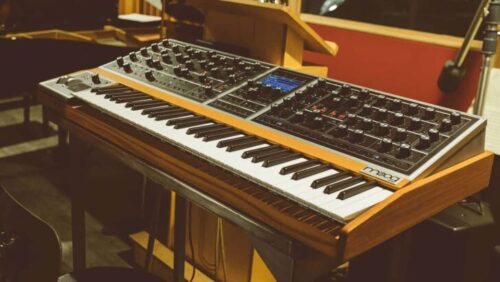
We have not seen any official announcement on this yet from Moog Music, but European synth retailer Turnlab has shared that the Moog One uber-synth is now discontinued.
“Moog One is now Discontinued (EOL),” according to Turnlab. “We were quick with sharing it. Guess the news will find its way online soon…”
The Moog One was introduced in 2018, and was Moog’s first polyphonic hardware synth in more than three decades. There are two versions: the 8-voice Moog One, originally priced at $5,999; and the 16-voice Moog One, originally priced at $7,999. Both offer synthesis capabilities not found in any previous Moog keyboard.
Essentially three independently addressable polysynths in one, the Moog One tri-timbral architecture lets you assign, split, layer, and stack voices, with up to 48 oscillators in Unison mode. Each synthesizer features its own step sequencer, arpeggiator, and effects processor.
The Moog One features a sound engine that they describe as ‘the most advanced architecture ever conceived for a Moog synthesizer.’
Per voice, the Moog One features:
Three analog voltage-controlled oscillators (VCOs);
Two independent analog filters (a Variable State filter and a Moog Ladder Filter) that can be run in series or parallel;
A dual-source variable analog noise generator;
An analog mixer with external audio input;
Four LFOs; and
Three envelope generators.
The combination of the Moog One’s tri-timbral architecture, deep analog synth voice and high-end effects engine make it an extremely capable instrument. Here’s a Moog One improvisation by synthesist Lisa Bella Donna that showcases the instrument’s performance capabilities:
*Note: We have not seen any official announcement on this yet from Moog. We will update this, as we learn more.