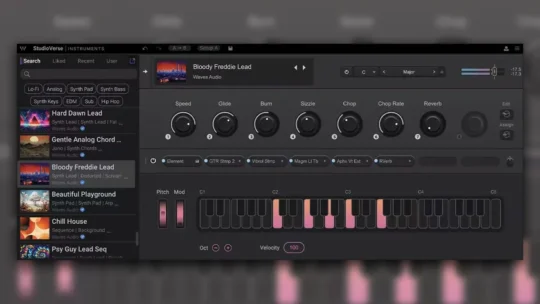
Waves StudioVerse is an online library for plugin chains that lets you save presets created in its StudioRack software to the cloud, share these with the online community and make use of chains from other Waves users and top producers.
Today, Waves has announced two more products in the StudioVerse family. StudioRack has been significantly updated under a new name; now called StudioVerse Audio Effects, it enables you to load up to eight plugins inside a single VST wrapper, assigning convenient macros to the main window to quickly and easily tweak your custom mix chains, or taking advantage of the plugin’s parallel and multiband processing options.
As was the case with StudioRack, the plugin’s AI-powered search will analyse your track’s audio within the DAW to suggest a suitable array of plugins and presets. The StudioVerse library features tons of mixing chains from Grammy-winning producers and engineers such as Manon Grandjean, Chris Lord‑Alge, Andrew Schepps and Young Guru.
StudioVerse Audio Effects benefits from a number of workflow enhancements that Waves says will let you discover presets more efficiently. Its search engine has been optimized, while tags and suggested presets can now be viewed from the main window.
StudioVerse Instruments expands this cloud-based concept to the world of software instruments, giving you access to thousands of customized instrument presets from Waves’ online library. These combine instruments, MIDI effects and audio effects to create complex presets that can be published in the StudioVerse library and shared with other music-makers.
Both of these plugins are free, but you’ll need to own any of the individual Waves plugins included in its StudioVerse presets in order to make use of them. Both StudioVerse Instruments and StudioVerse Audio Effects support third-party plugins, so you won’t be limited to using Waves instruments and effects in your chains.
German synthesist Hainbach – in his latest video – takes a look at the Quilter Labs Panoptigon, a modern optical playback instrument, that’s compatible with sample discs for the Mattel Optigan, Vako Orchestron and Chilton Talentmaker from the 70s.
The instruments play back samples that are optically encoded on to discs made of film. The sounds are imaged onto the film as concentric rings. During playback, the instrument shines a line through the film, and a sensor translates the variations in light back into sounds. It’s all very lo fi – even for the ’70s – but the technology gives everything a unique and haunting sound.
The technology was probably used most famously by Kraftwerk, who used the sound of the Vako Orchestron choir on the albums Radio-Activity and Trans-Europe Express.
Video Summary:
“The devices were not a commercial success and quickly disappeared. But one enterprising band from Germany took their lofi sound to heart. Kraftwerk employed the Orchestron in many songs, from Das Model to Uranium.
Even today its finds fans – such as Kyle Dixon of Survive, who used the iconic “choir” in their Stranger Things soundtrack. He employed the modern adaption of this arcane technology, the Quilter Labs Panoptigon. I talk with Kyle in the video, show a bit what you can do with the Panoptigon, demo classic Kraftwerk patches and introduce my own disc for this fantastic instrument.”
Watch the video and share your thoughts on the Panoptigon in the comments!
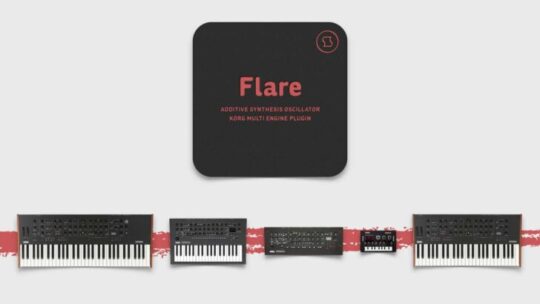
Today, Sinevibes introduced Flare, a new additive synthesis oscillator plugin for the Korg prologue, minilogue xd and NTS-1.
Flare runs 8 sine wave partials, configured as a harmonic series, that can be further shaped by one of many different pitch ratio curves, which allows the plugin to produce a wide range of timbres: from smooth and organic to atonal and metallic.
The “spectrum trim” feature makes it possible to gradually reduce the amount of additive harmonics, essentially acting like an ideal brick-wall low-pass filter – plus, it’s always working progressively towards the higher frequency range, resulting in a clean output with zero aliasing.
Flare also features a built-in multi-mode modulation generator, which can be applied to three parameters at the same time, adding dynamic sound animation.
Features:
Additive synthesis engine with 8 sine wave partials and full aliasing suppression.
Tone shaping via multiple harmonic pitch ratio curves and variable spectrum trim.
Built-in envelope generator and LFO for modulating pitch, spectral curve and spectral trim parameters.
Built-in lag filters for noise-free, ultra-smooth parameter adjustment and modulation.