Free Genesis Sound Library For Korg Wavestate Synthesizer


Synthesist and sound designer Ian Dixon has been on a tear recently, releasing a series of excellent free sound libraries Korg’s Wavestate and modWave synthesizers.

His latest free sound library is a Genesis Collection for the Korg Wavestate.

What Dixon has to say about it:

“Over the years, Tony Banks and Genesis have crafted iconic sounds featured in timeless tracks like Watcher of the Skies, Behind the Lines, Cinema Show, Invisible Touch, and Abacab. These legendary sounds came from iconic instruments such as the Mellotron, ARP Pro Soloist, ARP Quadra, Korg Wavestation, and Yamaha DX7.

Inspired by these classic Genesis sounds, this collection for the Korg Wavestate includes 36 meticulously crafted performances that span from Foxtrot to Calling All Stations. You’ll find Mellotron sounds, ARP Pro Soloist and Quadra, organs, DX7, and Wavestation patches to explore and relive that classic progressive rock vibe.”


The library is compatible with all versions of the Wavestate, including Korg Wavestate, Wavestate Native, Wavestate mkII, and Wavestate Rack.

The intro video above, demos each of the performances in the sound library:

00:00 Introduction

01:44 ABACAB Organ

02:10 Alien Afternoon

02:55 Fading Lights

03:22 Warm strings

03:48 Mini Lead

05:18 Fading Light Drums

07:00 ARP Fuzz Guitar

07:21 In the Cage

07:50 PS Telstar

08:15 ARP Trumpet

08:30 Bass Pedals

08:56 Behind the lines

09:52 Behind the Lines Brass and CP

10:16 CP80

10:34 CP80 String

11:03 Domino sounds

12:38 Fading Lights Split

12:53 Follow You Follow Me

13:05 From the undertow

13:55 Home by the sea

16:36 Invisible Touch

17:12 Mama

17:40 Mama Ghost

18:22 Mama Organ

18:55 Mellotrons

19:19 Watcher of the skies

20:21 Phased Organ

20:42 ABACAB Quadra

21:10 Alone Tonight Organ

21:49 Quadra phased organ

22:06 RMI piano

23:44 Tonight arp

24:32 Tonight drum type sequence

25:02 Tonight drums and pad

The Genesis Collection for the Korg Wavestate is available now as a free download.


Analogue Solutions Previews TC5000 Monster Synth With Wings


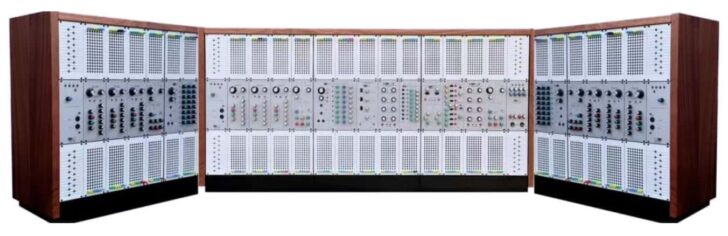
Analogue Solutions shared this preview of their design for ‘wing’ cases for their upcoming TC5000 monster synth.

The Analogue Solutions TC5000 is an analog modular synthesizer with a user interface that’s inspired by the iconic ARP 2500. The TC5000 copies the overall look of the ARP 2500, but features modules based on Analogue Solutions’ own circuits. The TC500 also uses a pin matrix patch interface, vs the matrix switch interface of the 2500.

Some of the TC5000 modules are adapted from the company’s existing synths, like Leipzig, Telemark and Fusebox, and some are new designs, specific to the TC5000.

The Analogue Solutions TC5000 is available now to pre-order, priced at £22000 (exc. tax and shipping), with shipping expected towards the end of 2024. Details on the TC5000 Wing racks has not been announced.

Syntakt Firmware Update Adds New Machines, Euclidean Sequencing and More


Elektron has released a free firmware update for the Syntakt groovebox, and it is not one that users will want to miss. Not only does the 1.30 OS add four new sound-generating ‘Machines’, but also adds some cool new sequencing tricks and welcome quality of life improvements.

Elektron Syntakt was the third arrival in the Swedish brand’s range of hardware grooveboxes that started with the Digitakt sampler and Digitone synth. Unlike those two digital machines, Syntakt combines analogue and digital sound generation, primarily focused on percussive sounds but also capable of producing basslines, chord stabs and synth melodies.

The latest Syntakt 1.30 update looks set to add even more versatility to the design. The four new Machines here are all inherited from Elektron’s top end Analog Rytm, and offer a mix of analogue and digital sounds.

First up is SY Chip, a Commodore 64-inspired engine. Elektron has history in this area – its first synth, released in 1999, was the SidStation, a compact instrument built around the MOS Technology SID chips used in the C64 home computer.

When Elektron added these SidStation-inspired sounds to the Rytm, it created plenty of excitement among the user base. Now, in the company’s own words, “SY Chip spreads those SidStation ripples even further, offering magical C64-esque goodness to dive into – but with an analogue touch.”

The remaining Machines are named SD and BD Acoustic, which aim to add additional snare and kick tonalities, and HH Lab, designed for flexible creation of metallic hi-hat tones. Syntakt’s existing BD Sharp has also been enhanced with a new square wave generator. These new additions bring Syntakt’s total Machine count up to 15.

The instrument’s sequencer also gets upgraded with the new OS, adding the Euclidean generator also found on the recent Digitakt II. This works by spreading two pulse generators evenly across a user-defined range of steps, then using a Boolean operator to dictate how these interact. OS 1.30 also adds a new Page Loop function, whereby users can focus on a single page of the sequencer when working on programming patterns.

According to Elektron, the update also adds various UI and performance improvements, along with workflow enhancements such as the ability to preview parameter locks more easily and use a random pattern name generator.

New in Syntakt 1.30 firmware:

  • Four additional synthesis machines are now available on Syntakt. SY CHIP, SD ACOUSTIC, BD ACOUSTIC, and HH LAB all come over from Analog Rytm, and are now ‘dual residents’ of both instruments.
    • SY CHIP “spreads those SidStation ripples even further”, offering C64-esque goodness with an analog touch.
    • SD and BD ACOUSTIC extend your snare and kick options.
    • HH LAB offers a new metallic monster to experiment with.
  • Existing machine BD SHARP gets a new square waveform.
  • Euclidean Mode – Euclidean rhythms are born from their namesake’s mathematical algorithms – spreading a set number of beats or pulses across a chosen span of time or sequence. This can bring balance and symmetry to your pattern, weaving rhythms that feel both organic and intriguingly structured.
  • Page Loop – Use Page Loop and pick a specific sequencer page to work in. Repeat the page and refine your sound without needing to wait for the sequencer to roll around again.
  • Other changes – On top of the above you can also save sounds from sequencer trigs, preview parameter locks easier, make use of the random pattern name generator, and enjoy GUI improvements, performance improvements, and more.

Visit the Elektron site for details.

You can read the full release notes and download the update over at the Elektron site.