Vintage Synth Review: E-Mu Emax II Sampling Synthesizer
Synthesist and sound designer Ian Dixon – in his latest video – shares his take on the classic E-Mu Emax II sampling synthesizer.
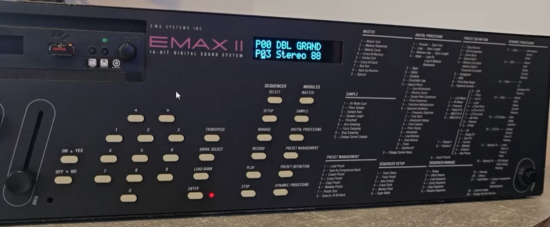
The E-MU Systems Emax II is a 16-bit digital sampling workstation, released in 1989, as a more powerful successor to the original 12-bit E-mu Emax. While the Emax II offers improved specs across the board, it dropped the analog filters of the original.
As a result, both versions have unique sonic capabilities and fans among synthesists.
Video Summary:
The E-mu Emax II Rack is a 1990 vintage sampler with 16-bit sampling, digital resonant filters, 16 voices and that classic E-mu sample-library character.
In this video I explain why I bought an Emax II Rack, how it fits into the E-mu Emulator family, and what makes this 2MB version with a Gotek drive interesting today. I look at the history from the original Emulator through to the Emax II, load sounds from the Gotek/sample library, play through factory-style patches, explore the filter and envelope controls, and talk about why vintage samplers still feel different from modern software.
This is partly a first look, partly a vintage sampler demo, and partly the start of a new Emax II journey: building a usable sound library, tagging useful sounds, sampling my own material and finding out what this classic rack sampler can add to modern tracks.
Topics covered:
00:00 Intro and music
00:15 E-mu Emax II Rack overview
00:39 Emax and Emulator history
01:03 Emax II specs and 16-bit sampling
02:06 Front panel and loading sounds
02:37 Gotek drive workflow
03:30 Sampling rates, filters, SCSI and MIDI
04:23 Exploring the sample library
05:08 Loading Grey Sounds Volume 1
06:45 Brass sounds and loading workflow
07:10 Emulator library sounds and synth-style editing
07:55 Digital resonant filter and Q
08:34 Filter envelope experiments
09:50 Synth-style modulation and envelopes
10:14 Sampling, looping and editing options
10:57 Piano, guitar, vocal and classic library sounds
14:26 Building a personal Emax library
15:08 Tagging sounds and using the library tool
15:48 Reflections on vintage digital samplers
16:26 Comments, resources and wrap-up
Watch the video and share your thoughts on the E-Mu Emax II in the comments!


