Universal Audio is renowned for its top-tier software emulations of classic bits of gear like the Teletronix LA-2A and UA 1176, but the company has also developed some fantastic plugins that recreate the sound of vintage technology without imitating a specific piece of kit.
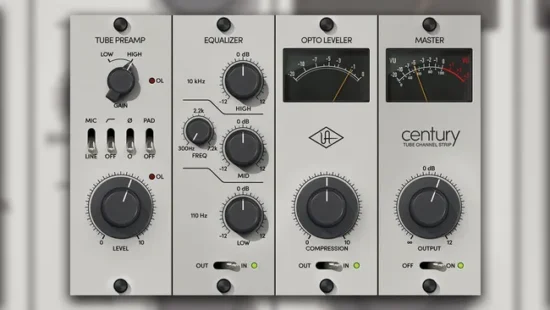
One such plugin is the Century Tube Channel Strip, a vintage-inspired recording channel that comprises a virtual tube preamp, three-band EQ, master output modules and an optical compressor.
Universal Audio have announced that they are currently offering their vintage-inspired Century Tube Channel Strip, though it’s priced at $199, the company is giving away Century Tube completely free for a limited time.
UA says Century Tube will help you get “warm, vintage sounds” from sterile-sounding digital tracks through its analogue-modelled tube mic preamp, which should gift your recordings with the characterful tone of tube saturation. The plugin’s preamp section offers low and high-gain settings for different microphone types and a 80kHz high-pass filter to remove any unwanted low-end.
Alongside this you will find a three-band EQ with two fixed bands at 10kHz and 110Hz – useful for quickly dialling highs and lows up or down by +/-12dB – and a third, sweepable band that covers the mid-range.
Modelled on an optical compressor, Century Tube’s Opto Leveller is a one-knob affair providing basic but effective control over dynamics; dial the compression amount up to 10 to imbue your signal with some analogue-style grit. Finally, a Master section gives you control over the levels of the output stage.
Watch the video below to hear the plug-in in action:
Century Tube runs on macOS and Windows and is available in VST/AU/AAX formats. It’s available free until September 15th. Find out more on Universal Audio website.
Developer Cem Olcay has introduced Note to Be, a MIDI Quantizer for iOS and Apple Silicon.
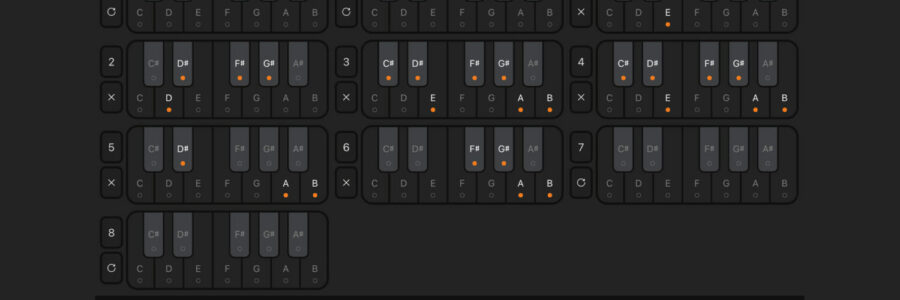
Note to Be is designed to process MIDI and automatically quantize the notes to the nearest selected note that you’ve selected.
Features:
Customizable Note Selection: Choose individual notes from any octave, or apply your selection across the full -1 to +8 octave range.
Octave Flexibility: Work within the entire octave spectrum, selecting and unselecting notes with a simple tap.
MIDI CC Integration: Use MIDI CC from hardware controllers or apps like ShiftBud to convert control changes into quantized notes. Easily create chord voicings and dynamic live performances.
Multi-Synth Support: Assign different MIDI channels to multiple synths, allowing each to respond to the quantized MIDI output independently.
Live Performance Enhancement: Engage the ‘all notes’ toggle to instantly apply note selections across all octaves or quickly select notes in a specific key and scale.
*Note: Note to Be is a MIDI app and does not produce any sound on its own. You need a MIDI input source and an audio output destination in order to work with Note to Be. The AUv3 plugin requires an AUv3 host app such as AUM, Logic Pro for iPad, Loopy Pro, Cubasis, Nanostudio, apeMatrix, Audiobus etc.
Sound designer and synthesist Benjamin Dehli shared this video demo of his Blade Runner inspired sound design for the Yamaha DX7.
What he say about it:
“The Yamaha CS-80 and Yamaha DX7 are probably polar opposites in both operation and sound. The CS-80 is an analog subtractive synthesizer, whereas the DX7 is a digital synthesizer that uses frequency modulation (FM) synthesis. The only thing they really have in common is the Yamaha brand name.
This experiment was an attempt to see if I could make the DX7 sound somewhat close to the iconic CS-80 sound famously used by Vangelis in the Blade Runner soundtrack.”
Dehli’s DX7 take isn’t an exact match for the original, but it’s surprising how good it sounds, recreated on a synth best known for its digital FM sounds.
The video is a preview of an upcoming DX7 sound library, which Dehli plans to make available via his store.