Introducing Airspace, A Hybrid Convolution Reverb & Stereo Delay Effect Plugin
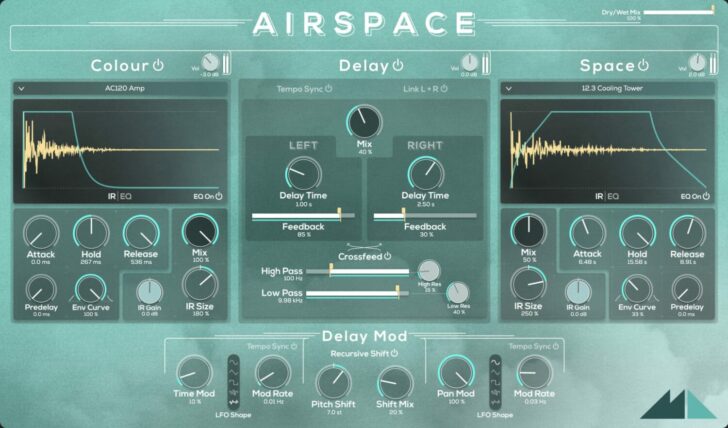

ModeAudio has introduced Airspace, a hybrid convolution reverb & stereo delay effect plugin, available in VST & AU formats for macOS & Windows.

Airspace features more than 240 presets, designed for “adding rich, natural reverbs to solo sounds to conjuring all-out drone-fests in your DAW’, according to the company.

The heart of the plugin though is its internal bank of 450+ impulse response samples, which include recordings made  in cathedral, a defunct nuclear reactor, a chocolate factory, various churches and theater spaces and even a submarine. In addition to the natural spaces, it features a wide range of vintage digital, spring and plate reverb hardware, analog drum machines, found percussion, upright piano recordings and folders of experimental loops and SFX textures.

Official video intro:

Features:

  • Combines convolution reverb & stereo delay effects for powerful spatial processing
  • Dual convolution reverb engines provide for endless combining of reverb flavours
  • Reverbs powered by 450+ meticulously recorded impulse response samples, organised into 11 folders: Amplifiers, Drums & Percussion, Found Percussion, Kitchen, Piano, Experimental Textures, Hardware Reverbs, Loops, Real Spaces (Long), Real Spaces (Medium), Real Spaces (Short) & Springs & Plates
  • Can change the perceived ‘size’ of each impulse response from 20 – 500%, plus offers full control over AHR amplitude enveloping, pre-delay & gain
  • Dual 4-band EQ effects built-in for shaping the sound of both impulse responses
  • Stereo delay features crossfeed, high & low pass filtering, resonance & dedicated modulation section, comprising a 4-octave pitch-shifter & dual LFOs for modulating delay time & panorama, complete with 5 switchable LFO shapes (sine, triangle, square, random & smooth random)
  • Extensive library of 240+ presets included, organized into 6 folders: Ambient, Blur, Cosmos, Reflect, Transform & Warp; save your own custom presets also

Airspace reverb & delay is available now for £60 (approx. $78 / €71). A 15-day free trial also available.

Nest Tamer Clips Promise To Organize Your Cable Clutter & Improve The Usability Of Your System


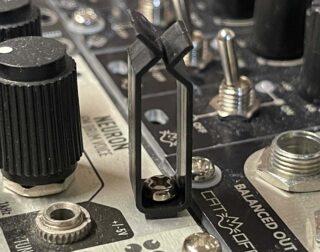
Gammalite Systems has introduced Nest Tamers, a new option for modular synth owners and anyone else that wants to better organize their patch cables.

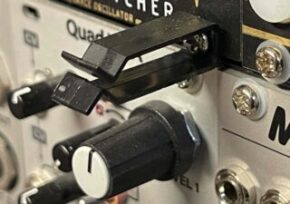
Nest Tamer clips attach to your gear, using its existing screws, and let you route and secure your cables where you want them, keeping them out of the way of your gear’s controls. By positioning Nest Tamer clips under the mounting screws of your modules, you create spots to ‘slot’ your cables on their routes between sockets.

“This neater routing vastly improves the ergonomics and usability of your modular system,” they note. “Great for performing live, as well as day-to-day sonic exploration.”

Gammalite Systems Nest Tamers are available now for $25 for a pack of 20.

Universal Audio Launches the Apollo X Gen 2 Audio Interfaces With Auto-gain & Onboard Monitor Correction Monitor Correction


Today, is a big day over at Universal Audio HQ, as the brand unveils a raft of new products in its Constellations launch event, both hardware and software.

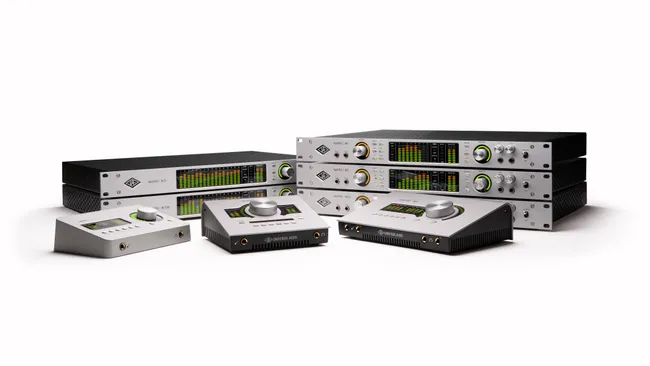
For many, the biggest announcement will be the second generation of UA’s Apollo X line of Thunderbolt audio interfaces, which have received a healthy upgrade and a host of new features such as auto-gain, bass management and onboard monitor correction.

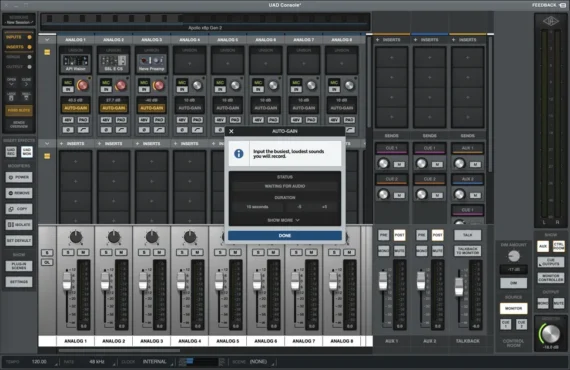
The new line of Apollo X interfaces benefits from a trio of new tools that will help you both streamline the recording process and set up a reliable system for accurate monitoring. Accessible through UA’s Console software, the newly-developed Auto-Gain system will automatically adjust input gain across multiple channels before you record, making it easy to quickly set your levels when recording a band or a podcast with multiple speakers, for example.

UA has partnered with Sonarworks to introduce monitor and headphone correction to the Apollo line, helping you achieve consistent mixes while working across multiple systems or studio spaces. UA has integrated the brand’s SoundID software – which would typically run on your machine as a standalone app or plugin – into the Apollos, meaning that calibration for both monitors and headphones can be applied in real-time at the final stage of your signal chain, using UA’s proprietary EQ algorithms. As it’s still in development, this feature won’t be available until later in the year, and requires a measurement mic that’s sold separately.

Like Apollo Monitor Correction, UA’s Bass Management tool helps you handle an aspect of studio set-up that’s essential for reliable monitoring: subwoofer integration. Bass Management can be used to integrate a subwoofer into anything from a standard stereo 2.1 set-up all the way up to an immersive 9.1.6 Atmos system, letting you adjust filter frequency and slope from within Console.

The improvements to Apollo X aren’t only on the software side, of course: the interfaces’ aesthetic has been refreshed, while their 24-bit/192 kHz converters have been upgraded across the entire range, with a particular focus on the D/A converters, which UA says – along with redesigned monitor and headphone outputs – deliver “class-leading” monitoring, with lower noise and distortion than Apollo X’s first generation.

As ever, the Apollo X interfaces ship with a bundle of plugins from UAD’s much-loved suite of analogue emulations, mixing tools and effects processors, which can be applied in real-time using the Apollos’ onboard DSP. The plugin bundles are split into three tiers, but the Essentials+ Edition, included with all core Apollo models, comprises more than 20 plugins and instruments, along with Antares Auto-Tune RealTime Access.

“We believe that the very best audio tools can ‘disappear,’ and feel like they are simply a part of the creative process,” said UA‘s founder and CEO Bill Putnam Jr. in a statement. “The new Apollo X interfaces are about pushing that concept further – bringing the best of analog and digital sounds together in a way that’s both inspiring and seamless, to let your music take center stage.”

Universal Audio Apollo X Gen 2:

  • Apollo Twin X DUO / 10-in/6-out desktop interface, 2 Unison mic preamps, DUO Core DSP / $1199 with Essentials+ Edition
  • Apollo Twin X QUAD / 10-in/6-out desktop interface, 2 Unison mic preamps, QUAD Core DSP / $1499 with Essentials+ Edition
  • Apollo x4 QUAD / 12-in/18-out desktop interface, 4 Unison mic preamps, QUAD Core DSP / $1999 with Essentials+ Edition
  • Apollo x6 HEXA / 16-in/22-out rackmount interface, 2 Unison mic preamps, HEXA Core DSP / $2499 with Essentials+ Edition
  • Apollo x8 HEXA / 18-in/24-out rackmount interface, 4 Unison mic preamps, HEXA Core DSP / $2899 with Essentials+ Edition
  • Apollo x8p HEXA / 16-in/22-out rackmount interface, 8 Unison mic preamps, HEXA Core DSP / $3499 with Essentials+ Edition
  • Apollo x16 HEXA / 18-in/20-out rackmount interface, 16×16 analogue I/O, HEXA Core DSP / $3999 with Essentials+ Edition

Find out more on Universal Audio website.