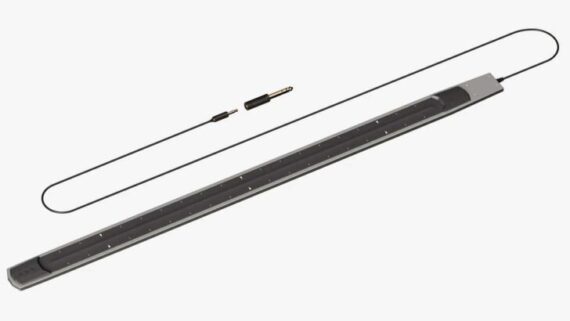
UDO Audio has introduced the RBN-1 Performance Ribbon Controller.
The RBN-1 is a detachable magnetic performance ribbon controller that works seamlessly with any device that supports an expression pedal input, giving you a tactile way to modulate your sound.
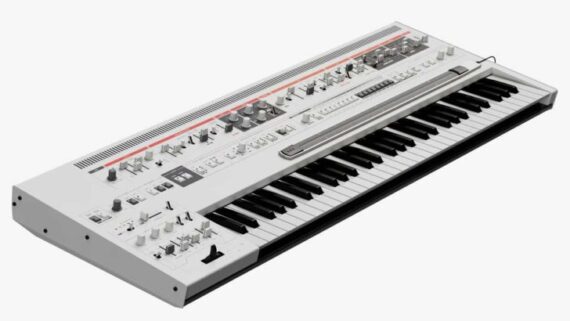
When used with the Super 6 and Super 8, the RBN-1 utilizes UDO’s musical intelligent pitch expression method, bending only the currently held note or notes, without affecting sustained sounds or reverb tails.
The RBN-1 works seamlessly with any device that has an expression pedal input, connecting via 3.5mm TRS jack or 1/4 inch TRS jack using the included adapter.
You can easily attach and detach the RBN-1 to any metal surface using its strong magnets and non-slip base, ensuring the ribbon stays securely in place during use.
They say that the RBN-1 is designed for durability and long-lasting performance, featuring a milled aluminum base and premium components.
The UDO Audio RBN-1 Detachable Magnetic Performance Ribbon Controller is available to pre-order for $285, with shipping expected for December 2024.
Arturia Synthx V plugin updates “one of the most revered synthesizer architectures of a generation” with tools that offer “advanced sound design possibilities”
The French brand’s latest plugin puts a V Collection spin on the Elka Synthex
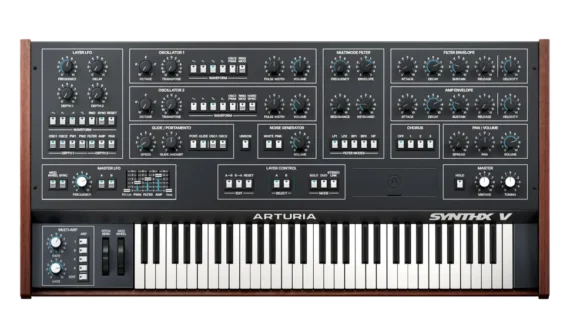
Today, Arturia has unveiled its latest synth plugin, an emulation of the cult-classic Elka Synthex polysynth. Synthx V – not to be confused with Arturia’s existing Synthi V – is a dual timbral virtual analogue instrument that recreates the core elements of the original while also expanding the feature set in some interesting ways.
Created in 1981 by Italian engineer Mario Maggi, the Synthex was designed as a response to popular polys of the age such as Sequential’s Prophet 5. The Synthex used DCOs, giving it a more stable, cleaner sound than many of the VCO-based synths that preceded it. Its multitimbral design and onboard sequencer also made it ideal for creating complex, multi-part compositions.
Once seen as a cult instrument, the Synthex has had something of a resurgence over the past decade. In 2015, a new team attempted to bring back the Synthex in hardware, but its crowdfunding campaign was unsuccessful. Maggi broached the idea of a Synthex 2 that same year, but this hasn’t yet seen the light of day. Meanwhile, both Xils Audio and Cherry Audiohave released software emulations, and the Black Corporation has a Synthex-inspired hardware synth, Xerxes.
Now it’s Arturia’s turn to put a fresh spin on the Synthex, which, according to Arturia, takes “one of the most revered synthesizer architectures of a generation and augments it with advanced sound design possibilities.”
To that end, Synthx V recreates the design of the original’s DCOs and Curtis CEM 3320 filter chip, but adds a number of new features. Firstly, the plugin doubles the original’s eight voice polyphony to 16, split into eight voices for each of the synth’s two timbral layers.
Synthx V also adds additional filter modes, with the option for a 12db low-pass mode joining the 24db low pass of the original. A three-mode analogue-emulated chorus can also be accessed from the synth’s front panel.
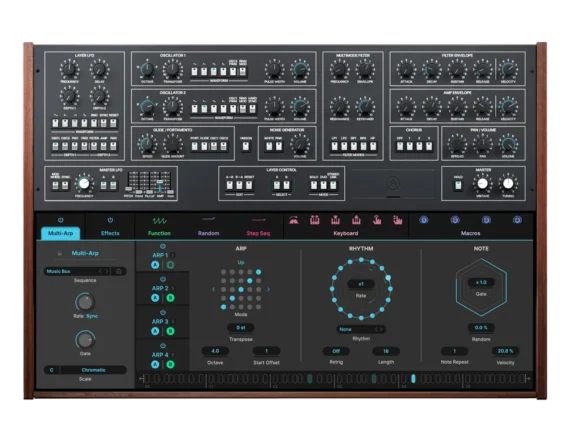
As is often the case with Arturia emulations, the most innovative additions live in the Advanced panel. Here Arturia adds a four-slot effect section, each of which can host one of 17 effects, which will be familiar to users of Pigments and Arturia’s other V Collection synths.
The Advanced panel also offers access to additional modulator controls, offering an ADSR envelope, customisable function generator and random source.
Most interesting of all is the Multi-Arp, which puts a modernised spin on the original’s 4-track sequencer. This offers four distinct arpeggiators, each with comprehensive control over the rhythm and notes of the arp line produced, with plenty of options for randomisation and variation.
As with other V Collection synths, top-level control is offered by four macros, labelled Brightness, Timbre, Time and Movement. Synthx V comes stocked with 240 presets.
Panoramic voicing – With voice layering, independent panning, stereo voice spread, dual analog chorus and a new dedicated unison.
Multimode filter – Synth V emulates the original’s filter, and adds a new low-pass mode
“Vintage Knob” – Introduce some circuit decay and detuning with the Vintage Knob, a continuous control that allows you to fine-tune the synth’s calibration from crystal-clear to worn-and-torn.
Advanced sonic treatment – Explore territory no Synthex has ever been with a one-of-a-kind Multi-Arp, 4 slot Effects rack, drag-and-drop modulation and expressive keyboard customization like MPE and Polyphonic Aftertouch.
They say that Synthx V goes above and beyond the original hardware, with enhancements and modulation options that put its sound design capabilities on par with the most powerful polysynths available today.
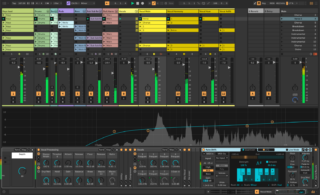
Earlier released in Public Beta, Ableton Live 12.1 is now available.
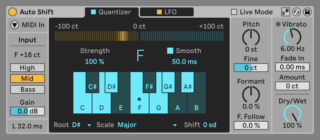
Live 12.1 introduces the new pitch correction and harmonization feature Auto Shift, compact sample player Drum Sampler, sound auto-tagging and more.
It is a free update for all editions of Live, including Live Lite, plus Push.
Live 12.1 introduces auto-tagging, making it easier to find the right sound in your user library. New tags are automatically assigned to all samples in the library less than a minute long, as well as to VST3 and AU plugins.
Auto Shift, Live’s new pitch correction and harmonization device, lets you manipulate and extract harmonies from vocals in real time. Choose a scale for Auto Shift to follow, and play and make harmonies from any monophonic signal with the dedicated sidechain.
Drum Sampler, Live’s new compact sample player, lets you tweak and enhance drum sounds on the fly. Limiter and Saturator have been redesigned, and the MIDI Editor now allows you to filter and select notes by time, pitch, or a number of other criteria. Two new MPE-specific MIDI Transformations – Glissando and LFO – let you create curves for the MPE parameters of selected notes.
Auto-tagging for all your samples. You can now search your entire user library faster with filters – and there’s no need to tag the samples yourself. Live 12.1 automatically assigns new tags to any sample in your library less than a minute long. VST3 plugins will also be assigned tags based on metadata.
Improved Limiter and Saturator. Limiter gets a complete overhaul – with a smoother release curve making for less distortion, better metering with the improved UI, and the addition of Mid/Side routing, True Peak, Soft Clip, and Maximize modes.
Along with a more focused front panel, Saturator sees the addition of a Bass Shaper curve ideal for low end processing. Drive 808 kicks and sub basses as hard as you like and let Saturator keep the frequencies in check.
MIDI improvements. You can now filter and select MIDI notes by time, pitch, velocity, chance, duration or by a number of other dimensions using a new toolbar in the MIDI Editor. 12.1 also introduces two new MPE-specific MIDI Transformations – Glissando and LFO – allowing you to create curves for the MPE parameters of selected notes.
Ableton Live 12.1 and Push. Live 12.1 comes with a host of updates to Push. With Push 2 and 3 you can now design sounds with more detail and control by mapping Macros, and experiment with a range of different sounds using Macro Variations. Push 3 now also lets you add groove instantly to all the MIDI clips in your Set with a single twist of an encoder.
The new update also brings Live 12’s filtering system to the browser on Push 2 and 3, as well as auto-tagging for samples on Push 3 standalone. Plus, you can now save Default Sets and Template Sets on Push 2 and 3, and organize your Sets by moving tracks and scenes.
Ableton Live 12.1 is available now as a free update for all owners of a Live 12 license.