Anukari 1.1 Adds Resonating Strings, Breath Excitation, More Than 1,000 Presets
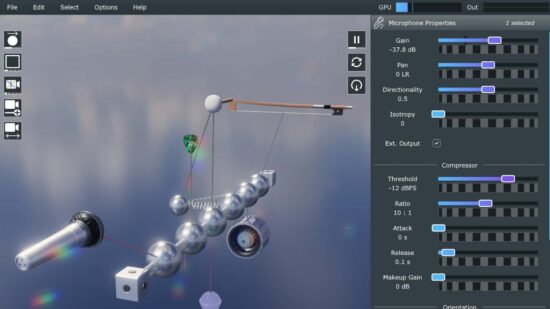
The unusual 3D physics-based synthesizer adds resonating strings, membranes, tubes and bells, along with new excitation models, expanded sound-design tools and more than 1,000 factory presets.
Anukari has released version 1.1 of its 3D Physics Synthesizer, expanding its physical-modeling engine with resonating strings, bars, plates, membranes, tubes and bells. The update also introduces a new mouthpiece exciter, additional physical models for existing exciters, expanded instrument-building tools and more than 1,000 factory presets.
New Resonators And Excitation Models:
The most significant addition in version 1.1 is a new category of objects called Resonators. These simulate the behavior of vibrating physical materials and structures, including strings, bars, plates, membranes, tubes and bells.
Resonators can be struck, bowed, rubbed or otherwise excited at different points on their surfaces. They can also be connected to the existing mass-and-spring structures, allowing users to create more elaborate physical interactions.
For example, a moving mass can strike a resonating plate, or a swinging mechanical structure can interact with a string. Strings can also buzz against a bridge, while additional tension and curvature controls introduce pitch changes and evolving resonances.
A new Mouthpiece exciter adds breath-driven excitation. Its available models include Jet, Reed, Lip and Free Reed, corresponding to different types of wind and brass instrument excitation. These can be used to drive tubes and other resonating objects.
The existing Bow, Mallet and Plectrum exciters have also received additional physical models. The Bow now includes a Stick-Slip mode with simulated rosin, the Mallet adds a Contact mode with a felt head and physical bouncing behavior, and the Plectrum adds a Pick mode that incorporates release clicks and string scraping.
Expanded Instrument-Building Tools:
Version 1.1 also introduces new tools intended to make constructing complex physical systems easier.
Generate Shape can automatically create connected structures in layouts including grids, rings, spirals and helices. Duplicate in Pattern allows users to replicate selected objects across similar geometric arrangements, with the option to connect the resulting structures.
Another addition is the Modulosphere, a new modulation object that moves through the 3D environment and applies modulation to objects within its radius. It can also attract physical bodies toward its center, introducing another way to combine physical movement and modulation.
The update additionally introduces new spring types, including Stable Springs, Collision objects and Rigid Rods. These expand the range of physical interactions that can be constructed, from stable mechanical structures to bouncing objects and rigid connections.
AI-Assisted Instrument Design:
Anukari also supports integration with external AI assistants through MCP. This allows compatible assistants running on the user’s computer to interact with the software, including creating and editing instrument presets.
This is an integration with external AI tools rather than a built-in AI assistant. Users must provide and configure their own compatible local assistant.
Anukari version 1.1 is available for macOS, Windows and Linux for $74 USD (normally$149).


