Arturia MiniFreak V Now Available to Everyone


Good News! Arturia is now letting anyone buy its MiniFreak V as a standalone product.

Arturia has announced that MiniFreak V – the software version of its MiniFreak hardware synthesizer – is now available as an independent product for everyone.

When Arturia initially announced that its new MiniFreak  hardware synth would come with an accompanying like-for-like software version, there was some disappointment. It was only available as a freebie for owners of the MiniFreak hardware. It’s now available to everyone.

MicroFreak V is described as a “like-for-like software emulation of its hardware polysynth counterpart”. It is a six-voice, twin-engine synth. Each engine can operate in multiple different modes, and you can use the engines individually, stacked, or to process each other’s output for “unique compound sonic behaviour”. While the hardware MiniFreak has analogue filters and VCAs, these are emulated in V version.

Further sound design takes place in the modulation matrix, which offers the likes of polyphonic ADSR envelopes, customisable multi-segment LFO shapes, FM & ring modulation, and ‘Spice & Dice’ randomisation
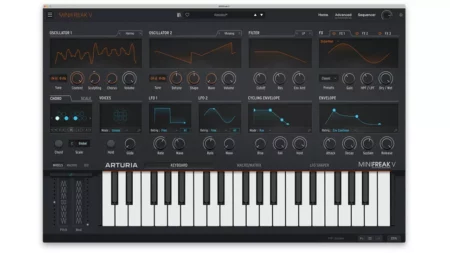
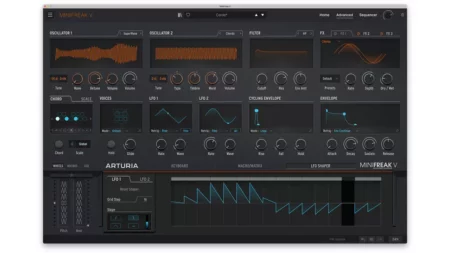
The MiniFreak V’s controls are spread across multiple pages: the front panel keeps things relatively simple with a stripped-back set of parameters (you can tweak the two oscillators, filter and FX), while the Advanced panel adds access to the mod matrix, shaper and more. Finally, there is a dedicated page for the sequencer and arpeggiator.

MiniFreak V comes with the same preset selection as the hardware, and sounds can be exchanged between the two versions. It runs on PC and Mac in VST/AU/AAX formats. All users can enjoy limited-time discounts on MiniFreak V itself and is available now for the introductory price of $99 until 2 February 2023 (the regular price, as of 3 February, will be $199). It’s also currently being given away for free to anyone who buys V Collection 9. Find out more and download a demo on the Arturia website.
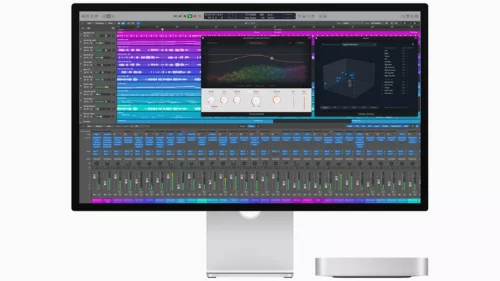
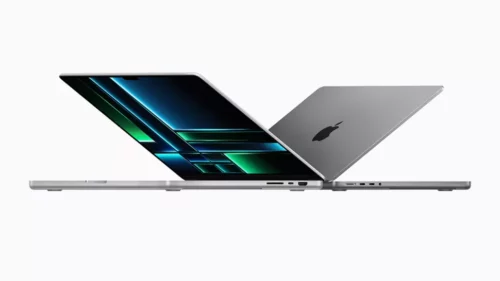
 

Apple updated Mac mini and MacBook Pro models with new M2 Pro and M2 Max chips


Apple has unveiled M2 Pro and M2 Max, its latest ‘systems on a chip’, and brought them to the Mac mini and both the 14-inch and 16-inch MacBook Pro.

An evolution of the standard M2 chip, the M2 Pro features up to 12 CPU cores and up to 19 GPU cores, and can accommodate up to 32GB of RAM. CPU performance is said to be up to 20 percent faster than the 10-core CPU in the M1 Pro chip, and graphics speeds up to 30 percent faster.

M2 Max also has a 12-core GPU, but ups the ante by offering a GPU with up to 38 cores, along with a larger L2 cache. What’s more, you can equip it with up to 96GB of memory.

One of the first products to host the M2 Pro is the updated Mac mini, which is also available with a standard M2 chip for the first time. Prices start at $599/£649, though you can’t get an M2 Pro-powered machine for less than $1,299/£1,399, and there’s no M2 Max option.

The M2 Mac mini supports up to two displays, while the M2 Pro model can run up to three.

The same can’t be said of the revised 14- and 16-inch MacBook Pros, which can now be spec’d with either M2 Pro or M2 Max chips. Prices start at $1,999/£2,149 and $2,499/£2,699 for the 14- and 16-inch models respectively, while the cheapest M2 Max machines will set you back $3,099/£3,349 or $3,499/£3,749, depending on which size you go for.

The new MacBook Pros are also notable for offering up 22 hours of battery life – the longest ever in an Apple laptop, we’re told – and support displays of up to 8k via “advanced” HDMI. There’s WFi 6E support, too.

All the new Macs can be ordered from today and will be available from 24 January. Find out more on the Apple website.

Roland GP-3 “ultra-compact” Grand Piano


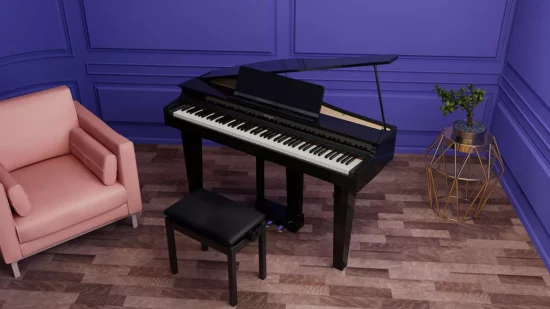
If you have always wanted a grand piano but have never had the require space to house one, Roland has come up with the solution in the shape of the GP-3, an “ultra-compact” model that you can actually fit in your living room.

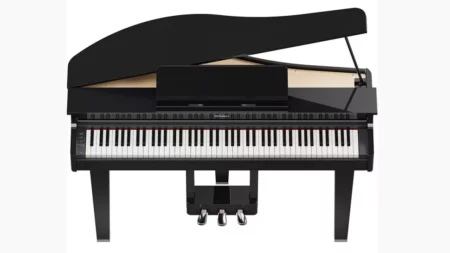
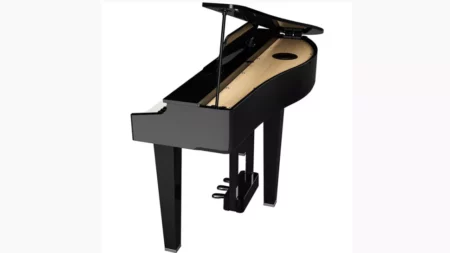
However, we want to make clear that this is very much a digital instrument, so you are not going to get all the sonic benefits of owning an acoustic grand, but it does have a lid that you can lift up.

In addition, the GP-3 is the tiny grand that Roland says it is. From front to back, it measures less than 70cm. It is also a nice looking piano, coming with a slick gloss black finish.


Under the hood, Roland has used what it calls an “advanced sound engine”, and the 88-note hammer-action keyboard promises an authentic grand piano touch, complete with ivory-like feel. Additionally, there are sustain, soft and sostenuto pedals with support for half-pedal techniques, while the stereo speaker system delivers an immersive sound.

There are some clear benefits to the GP-3 being digital, example – Bluetooth audio/MIDI connectivity and compatibility with the Roland Piano App. Other features include a metronome, recorder and dual headphone jacks, and unlike with an acoustic grand, you will never have to pay for the GP-3 to be maintained.

Roland has not mentioned on the price and release date for the Roland GP-3. In the meantime, check it out on the Roland website.