Warsaw Wave Releases Revolt Patchable Synth for Windows, Mac, and Linux
Warsaw Wave’s Revolt Patchable Synth combines configurable oscillators, flexible modulation routing, and extensive randomization in a software instrument designed for hands-on sound design.
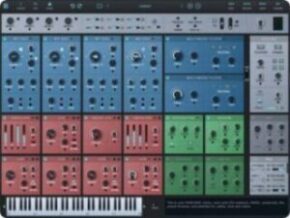
Warsaw Wave has released Revolt Patchable Synth, a software synthesizer developed around a configurable panel system that allows users to build sounds by connecting oscillators, modulators, filters, and effects.
Rather than presenting a fixed synthesis architecture, Revolt lets users choose and arrange its components within a single-page interface.
The instrument provides four oscillator slots, eight modulation slots, two multimode filters, and four reorderable effects slots. A modulation matrix follows the user’s connections, while controlled randomization can generate new patches using selected parameters and adjustable variation settings.
Features:
- Revolt provides four oscillator slots that can be configured with analog-style oscillators, wavetables, and noise sources. Additional oscillator functions include frequency modulation, feedback, and hard sync, giving users several approaches to creating harmonically complex tones, sharp leads, bass sounds, and evolving textures.
- Two multimode filters can be routed in series or parallel. This arrangement allows users to build different signal paths and experiment with how filtering affects the oscillator sources. Filter routing can be changed as part of the instrument’s configurable panel layout.
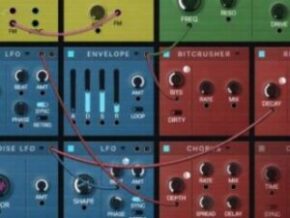
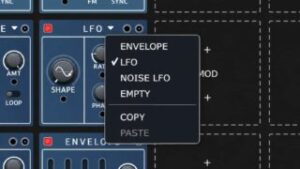
- Eight modulation slots can be assigned to envelopes, LFOs, or Noise LFOs. Users can connect these sources to synthesis parameters through the modulation matrix, adjusting modulation depth, polarity, and response curves. The interface visually follows changes to connections, helping users keep track of how a patch is constructed.
- Four assignable macro controls provide a way to map multiple parameters to performance-oriented controls. MIDI learn and modulation-depth automation support integration with external controllers and digital audio workstation workflows.
- The instrument supports both monophonic and polyphonic playing, along with unison, glide, and an arpeggiator. Velocity, aftertouch, modulation-wheel data, and MPE expression can also be used to influence patches, providing options for expressive keyboard performance.
- Four effects slots can be configured and reordered to suit a particular sound. Available processing includes reverb, delay, chorus, flanger, distortion, and bitcrushing. Users can change the order of effects to explore different processing chains rather than working with a single fixed arrangement.
- Revolt includes a patch-randomization system with controls for selecting which parameters can change, excluding specific settings, adjusting randomization strength, and working with parameter groups. This lets users generate variations while retaining important parts of an existing sound, offering an alternative to building every patch through manual parameter adjustments.
- The interface can be customized independently for each plugin instance. Users can select and save color schemes and panel styles, allowing different instances to have distinct appearances within a project. Presets can be saved and recalled in both the paid and free versions.
Revolt Patchable Synth is available for Windows 10 or later, macOS 12 or later, and Linux. Supported formats are VST3 and standalone on Windows; Audio Units, VST3, and standalone on macOS; and VST3, LV2, and standalone on Linux. The Linux version is experimental and has limited support.
The introductory price is $59, reduced from the regular $89, with the promotion scheduled to end November 11, 2026. A free version is also available permanently, with two oscillator slots, four modulators, one filter, two effects, and reduced macro and arpeggiator functionality. A full-featured seven-day trial is available for users who want to evaluate the complete instrument.


