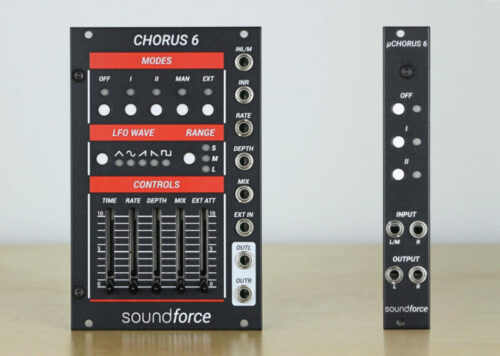
At Superbooth 2023, SoundForce has introduced 2 new Eurorack modules to complement their Juno-inspired range: Chorus 6 and uChorus 6.
Both modules are Juno-inspired analog BDD chorus effects, using the Xvive MN3009 BBDs and the same audio path as the original circuit. They can do the classic I, II and I+II modes. I+II modes are available from both the Juno 6 and Juno 60, each in mono (as the original) or stereo, giving you 4 I+II options.
The 4HP uChorus 6 offers only the basic functionality, but can give you the classic chorus sound in minimal amount of space. Both modules are skiff friendly at a depth of 38mm.
The 14HP version offers the basic modes, but additional manual and external modes can take the module away from sweet and pretty sound territories right into weird and noisy soundscapes.
The manual mode gives you the opportunity to control every parameter of the chorus and gives you access to the LFO that modulates the BBD delay times.
Here is what you can tweak:
time slide pot: sets the start delay time
rate slide pot and CV input : sets the frequency of the delay time modulation
depth slide pot and CV input: sets the depth of modulation around the start time
mix slide pot and CV input: sets the mix between the dry input signal and the BBD delays outputs
LFO wave: selection of different waveforms to modulate the delay time
range: selection of 3 different frequency ranges for the LFO (S: 30Hz to 500Hz | M: 1Hz to 100Hz | L: 0.016Hz/1min to 10Hz)
In external mode, the delay times can be modulated using an external signal through the EXT IN cv input. Plug in a CV/LFO source from your Eurorack case into the EXT IN, set manually the starting delay time using the time slider and use the EXT ATT slide pot to attenuated the incoming CV signal (equivalent to setting the depth). In external mode, the depth/rate sliders and CV inputs are not active.
Both modules can take Eurorack or Line input signals and either stereo or mono inputs.
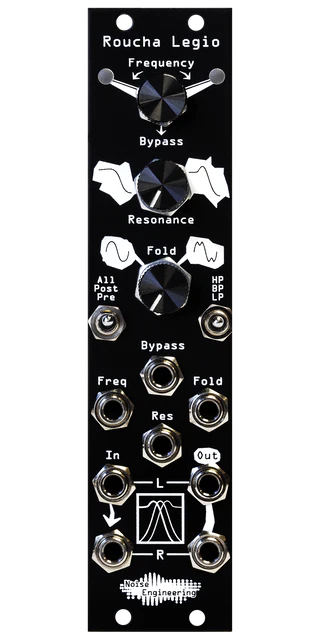
At Superbooth 2023, Noise Engineering has introduced the Roucha Legio, the fourth module on their Legio platform.
Their concept for Legio is that it’s a Eurorack hardware platform that can load a wide variety of firmware, making it the foundation of a variety of module types. Anyone with any Legio module will be able to try any firmware for it, for free.
The Noise Engineering Roucha Legio module is a stereo resonant multimode filter with wavefolding, 1V/octave tracking, and gateable bypass.
Roucha Legio features lowpass, bandpass, and highpass filter settings. The filter frequency is adjustable via the dedicated encoder or the one-volt-per-octave CV input. Roucha Legio is designed not to self-oscillate without an input signal, but once a signal is added, the Resonance control can offer anything from clean to the squelch of an acid house bassline. Resonance is also CV-able, which means filter sweeps are easy to achieve.
Features:
6 HP
CV-able inputs
Bypassable filter
1v/8va tracking
Self-calibrating frequency CV
Part of Legio ecosystem: buy one module, get them all
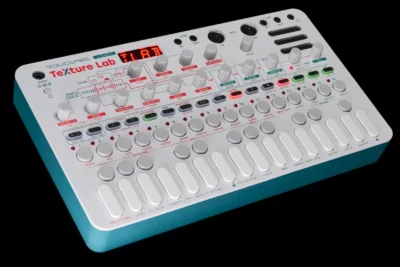
Sonicware – makers of the Liven Bass & Beats Groovebox, the Liven 8bit Synth and the SmplTrek Portable Production Sampler – has introduced the LIVEN Texture Lab, a granular synthesizer and effects processor.
The LIVEN Texture Lab offers a wide variety of sound textures, ranging from lush ambient pads to aggressive experimental noise.
The Texture Lab uses a granular processor that slices sounds into grains, ranging from 2 ms to 1 second in length, then transforms and reconstructs them in a variety of ways, including manipulating grain shape, density, time warp, spatial position, and playback method to create entirely new sounds.
Features:
Sample, slice, transform and reconstruct audio to synthesize completely new sounds
Granular synthesizer with granular effects processor mode
Shimmer reverb for fantastical and majestic sounding spaces
128-step sequencer with parameter locking
A full tutorial on using the Texture Lab:
Texture Lab Audio Demos:
Texture Lab is available now to pre-order for $239.00, with shipping expected in June.