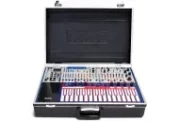
Tempera, New Granular Synth features Unique Interface (Sneak Preview)


Tempera is a beguiling granular instrument that can create dreamy sample-based soundscapes

Superbooth 2023: A sneak preview of the Tempera synth, a new granular instrument by the makers of the Vector Synth.

The company website indicates that this won’t be properly unveiled for 13 days, but the developer will be going to Superbooth.

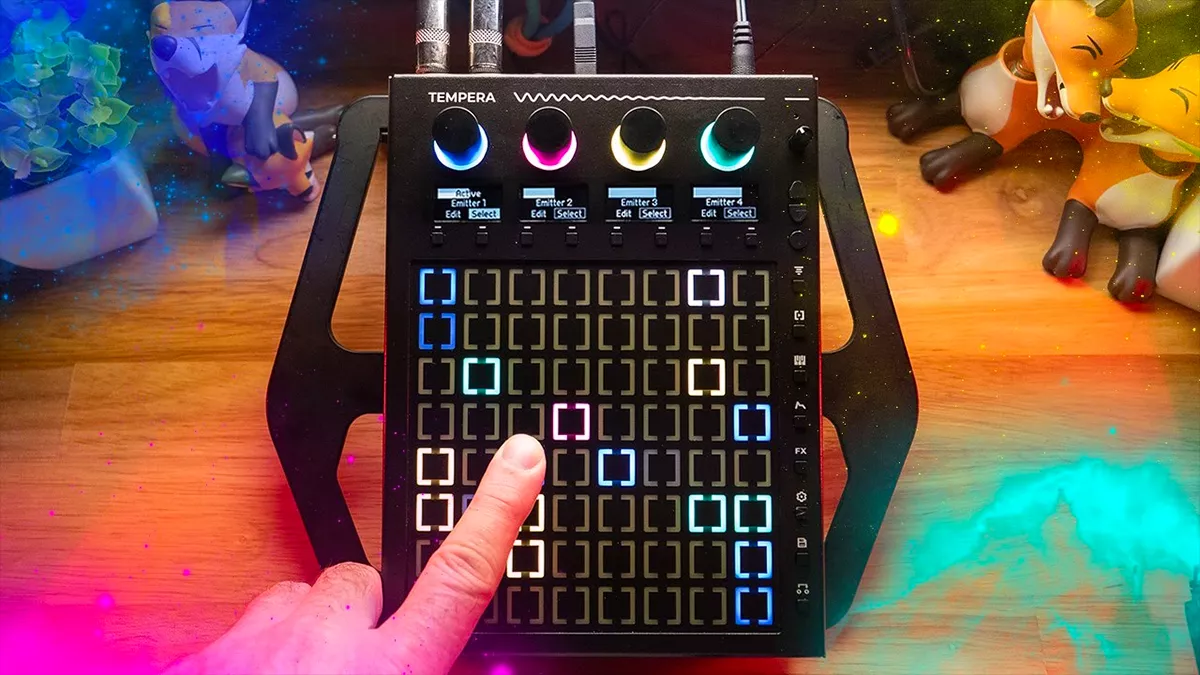
The good news is that Tempera looks great. It features eight sample slots, each of which is represented by a vertical column of buttons. You can move up and down to scrub back and forth through the sample, and the samples can be played back polyphonically.

Other features include four granular emitters, envelopes, LFOs, a filter and a reverb.

As the video demonstrates, Tempera does a great job of creating evolving ambient soundscapes.

Features:

  • 8 sample slots, each represented by a vertical column, that can be played back polyphonically;
  • 4 granular emitters;
  • Envelopes;
  • LFOs;
  • A filter; and
  • Reverb

Official details on pricing and availability are still to come at the Tempera website.

Buchla USA announces Music Easel + 50th Anniversary Music Easel

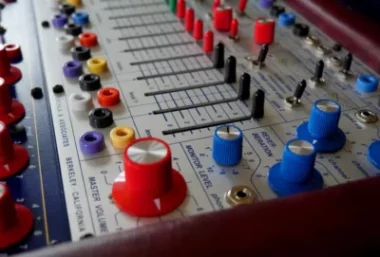
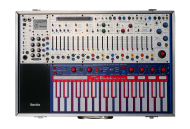
Buchla USA has announced the Music Easel and the 50th Anniversary Music Easel.

Both are new releases of the classic 1973 Buchla Music Easel design, but with slightly different styling and features.

What they say about it:

Fifty years ago, in 1973, only a few dozen were made. Unlike many iconic technologies, the influence was not grown through force of scale, but rather the force of the ideas. The Music Easel made available virtually every musical dimension: timbre, melody, rhythm, and time; how these dimensions intersected was no longer the court of acoustics and material, but signals and voltage. The 208 Stored Program Sound Source engendered “a new functional organization [with a] particularly rapid system of patching and program storage via plug-in cards.”

Taking cues from the then-recent discipline of cybernetics, the 218 touch plate was for “real-time communication” to help realize the “potential vocabulary” of the Easel, rather than exploiting existing modes of musical virtuosity. The Stored Program Cards ensured rapid repeatability and repertoire on its own terms. The battery terminals made sure the music was as portable as any acoustic instrument. And the name let you know it was designed for art rather than science.

Buchla is ecstatic to revive the Music Easel for its third run in 50 years. We first released the updated 208 Stored Program Sound Source, dubbed the Easel Command, with expanded MIDI and USB capability. Next came the update of the Easel Program Manager – a complete kit for storing and recalling sounds sources, even more rapidly than imagined in 1973. Our new 218 Touch Activated Voltage Source provides the optimal input facility, as originally envisioned. We can now bring it all together in a rugged case and the advanced EMBIO module that unifies all the audio and control inputs and outputs for integration with the rest of your musical world.

More than a retro novelty, the Music Easel still speaks to a future we strive for. A technology that invites conversation, not chats, and controls that engage expression, not work. There are many new worlds to explore in this instrument created at the crossroads of the jazz and computer ages. Designed as “an integrated assemblage of functions“, rather than a collection of modules, the Music Easel’s color coding, comfortable access to controls, and solid patch connections allow for satisfying sessions of sonic discovery.

The Music Easel will available for pre-order starting in June at Buchla.com and your Buchla Dealer, priced at $4,999. Delivery of the Music Easel is expected early October 2023.
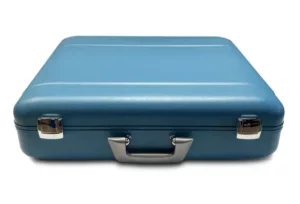
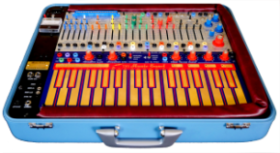
The 50th Anniversary Easel is built into a powder blue aluminium case, with gold keys on the 218 touch surface and Rogan knobs.

Buchla will be taking orders from June 1 to June 30, and build to order. Pricing is to be announced.
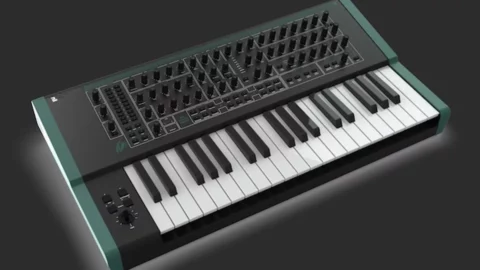
PWM Mantis Duophonic Synthesizer a Spiritual Successor to EDW Wasp


PWM Mantis is a Wasp-style synth with an OSCar-inspired filter

The Mantis is a collaboration between the late Chris Hugget (Gnat, Wasp, Oscar) and Paul Whittington of PWM, and turned out to be the legendary designer’s final synth.

Here, Whittington tells the story of the synth’s origin:

PWM’s Paul Whittington calls Mantis a “unique-sounding synth” and a “beautiful collaboration”, confirming that it’s being released with the blessing of Huggett’s family. “We are thrilled to bring you our new synth that we are sure will be loved as much as he was!” he says.

Mantis is duophonic and features mathematically generated oscillators and an analogue signal path, both of which are based on Huggett’s designs. In fact, Mantis is said to offer a contemporary architecture based on Hugget’s classic Wasp synth, plus a filter that takes its lead from his OSCar instrument. There are two oscillators plus a sub-oscillator per voice, with the oscillator drift feature creating random pitch variations between the oscillators.

Each signal path has its own multimode analogue filter, and there are also two LFOs and two independent envelopes. You have a choice of six ‘control’ modulation parameters, and six ‘source’ effectors.

Other features include a digital effects section with reverb and chorus, an arpeggiator and a full-size 37-note keyboard with velocity-sensitive keys.

Features:

  • 200 Patches
    • All patches in RAM so can be overwritten
    • Bank A: 100 Factory presets
    • Bank B: 100 User presets (all set to initial patch)
    • Compare function
    • Initialize patch function
  • Duophonic with 2 analog signal paths
    • Mathematically generated oscillators designed by Chris Huggett
    • Analogue signal path designed by Chris Huggett
  • 2 Oscillators plus sub-oscillator per voice
    • Sine / Triangle / Saw / Pulse plus additional wave types
    • Shape control and shape modulation input
    • Will create pulse width modulation on the pulse waveform with perfect square
    • at the center
    • Pitch modulation control
    • Octave selects per oscillator
    • OSC 1 SUB follows oscillator 1 parameters
  • Oscillator Drift
    • Creates random pitch variations between oscillators
  • ?Multi-mode state variable VCA filters with overdrive
    • 2 Analogue filters – 1 per signal path
    • Low Pass / Band Pass / High Pass in 12dB and 24dB configurations
    • Additional WBAND (series) and WSTOP (parallel) types
    • Filter Cutoff
    • Filter Cutoff Modulation
    • Filter Resonance
    • Filter Width
    • Filter Width Modulation
    • Filter Keytrack
  • LFO (Low Frequency Oscillator)
    • 2 LFOs
    • 4 waveshapes per oscillator
    • Fade In / Fade Out parameter
    • SYNCable
  • Rate control
  • Envelopes
  • 2 Independent envelopes
  • ENV 1 normalised to amplitude
    • ADSR

* + Sustain Fall parameter for shaping during key-down

* + Repeat which can be used to create looping envelopes

* Velocity positive and negative control

  • Ring modulation
  • Mixer
    • First mix: OSC1 and OSC2
    • Second mix: OSCillators and noise
    • Third mix: OSCillators + noise and Ring modulator
  • VCA (Voltage Controlled Amplifier)
    • All amplification is done in the analogue domain in multi-stage VCAs
  • Modulation Routes
    • Control – 6 choices of modulation parameters
    • Source – 6 choices of effectors from envelopes and LFOs
    • Scale – choices of controls used to scale the effect of the modulation
  • Glide
    • Glide amount
    • Auto-glide mode
  • Indicator LEDs
    • Two LEDs for Voice
    • LED for Keyboard activity
  • Master tune
  • Master volume
  • Triggering
    • ENV 1 Legato
    • ENV 2 Legato
    • LFO Keytrig
    • LFO Keytrig
  • CONNECTIONS
    • Master power switch
    • DC 9V input
    • USBC
    • MIDI IN / OUT / THRU
    • Sustain pedal input (switch)
    • Pedal input (continuous)
    • Stereo 1/4” line Outs: L/Mono and R
    • Stereo 1/4” headphone out
  • ?Multi-function Joystick control
    • Left / right for pitch bend
    • Performable vibrato
    • Latching hold mode
  • Arpeggiator
    • 6 arpeggiator types – Up, Down, Up/Down 1, Up/Down 2, Played & Random
    • Sync rates control from 2nds to 32nds
    • Tap tempo button
    • Swing including positive and negative swing
    • Auto clock sync – Detects MIDI or USB-MIDI clock and synchronises the arpeggiator
    • automatically
    • Latch via joystick HOLD
    • 6 Octave range
  • Dedicated tempo control
  • Duophonic mode control
    • Duo mode
    • Duo mode with simple filter
    • Pan control for duophonic voicing
  • Digital Effects
    • Reverb time
    • Reverb level
    • Reverb High Pass Filter
    • Reverb Low Pass Filter
    • Chorus level
    • Chorus type
  • Keyboard Control
    • 37 Full-size semi-weighted velocity-sensitive keys
    • Channel aftertouch
    • Octave shift

Mantis is scheduled to ship in the summer priced at $1,499/£1,349/€1,599. Find out more on the PWM website.