Archive for April, 2026

AUXY Debuts Svensson 49 Keyboard Instrument
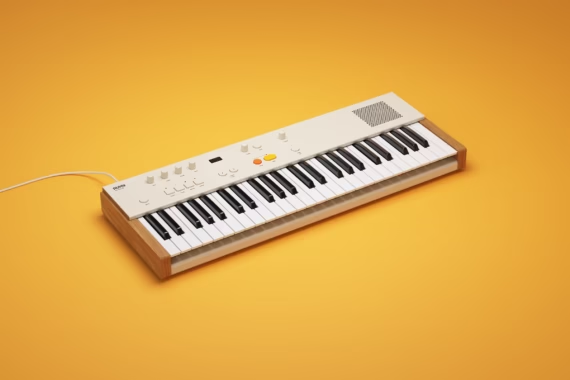

Auxy unveils Svensson, a minimalist keyboard built for instant music-making.

Auxy partnered with Cuckoo on the development of Svensson, a well-known YouTuber in the world of music technology. Cuckoo was the lead sound designer responsible for creating Svensson’s bank of around 100 presets, which are divided into four categories: Drums, Bass, Bread and Butter.

The first two are self-explanatory, and the other two cover everything else that falls outside of those categories: keys, leads, pads, plucks, organs and more, spanning both acoustic and electronic sources. Svensson’s sounds have a distinctly organic and expressive quality, with a touch more personality and character than the presets you’ll find in the average home keyboard; it’s clear that a lot of love went into designing these.

Developed in-house by Auxy, Svensson’s polyphonic sound engine uses a combination of samples and wavetables. Each sound has three macro controls – Tone, Mood and Shape – and each macro has been customized to offer a tailored variation on each sound, dialling in effects on an independent per-preset effects chain covering reverb, delay, chorus, phaser, compression, EQ, and various styles of distortion and saturation.
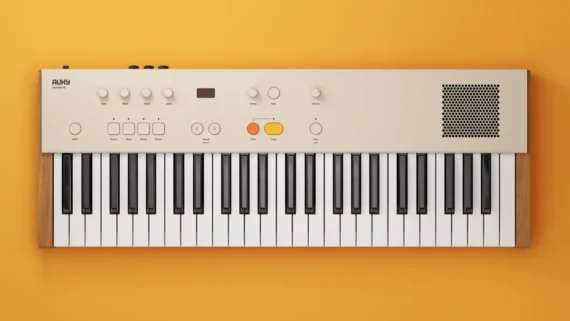
Svensson is equipped with a multi-track MIDI looper that can play four different sounds at the same time, and each of those sounds can be looped in multiple layers, with no limit on length. There’s a metronome onboard, a tempo control, and the looper has smart quantization that can be turned off.

Loops can be stored on Svensson to revisit later, and you can trigger loops from its memory via the keyboard.

Cuckoo Demonstrates Svenson 49 Walkthrough Video Below:

Svensson’s looper is triggered when you start playing, and can be used to go back and retrieve ideas you just played without hitting record.

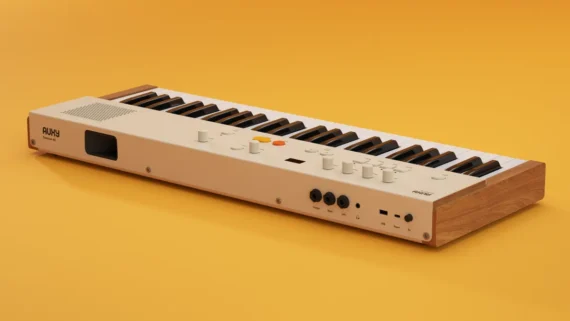
On the hardware side, Svensson 49 is a sturdy instrument, with a metal chassis and solid oak sides, and the interface is clean, stylish and uncluttered, in keeping with the theme of accessibility. Auxy says that particular attention was paid to the design of the speaker, crafted by Swedish speaker guru Ingvar Öhman, which is “surprisingly loud” and benefits from a bass port on the instrument’s rear.

Connectivity includes two ¼” line outputs, a 3.5mm headphone output, and a sustain pedal jack, along with USB-A and USB-C for power.
Svensson is currently in pre-production, and preorders for a first limited batch will start soon, with shipping set for early fall 2026. While a final price hasn’t yet been determined, it’s expected to be around €899/$999.

“We struggled to find products that combine ease of use, inspiring features, and a quality build,” said Auxy’s Henrik Lenberg. “There are some great digital pianos out there, but we wanted something with more playful features, a broader range of sounds, a smaller form factor, and a design that feels at home in your living room.

“We wanted to make a great instrument for playing at home. Something that invites you to play and create in the moment. No need to read the manual or connect other gear. No menus to dive through. No modes to get stuck in. Just play, loop, and explore your musical ideas.

“A lot of music technology has been shaped around the idea that everyone can be a producer and make tracks for an audience. That’s great, but I think we’re moving in a direction where more people want to take part in music again, not only as listeners. People want to play to have fun, to be present, to learn, or to connect with others. Svensson was made for that.”

Find out more on Auxy website.
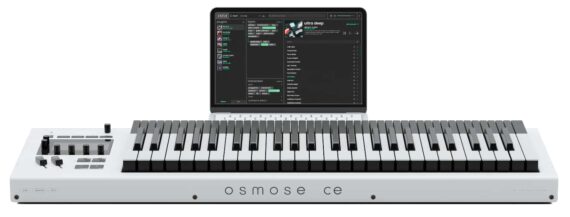


Expressive E Introduces Next Generation Osmose CE MIDI Controllers


Ahead of Superbooth 2026, Expressive E today introduces the Osmose CE, a MIDI controllers based on the same expressive, MPE-enabled keybed as the French manufacturer’s Osmose synth. Available in 49- and 61-key versions, Osmose CE is priced at $999 and $1,199 respectively.

Released in 2023, the original Osmose put MPE-level expression into a traditional piano-style form factor, its full-size black and white keys offering three-dimensional control over its internal EaganMatrix synth engine, with per-note pitch bend, polyphonic aftertouch and specialized keybed gestures opening up new performative possibilities.

Osmose CE is based on exactly the same expressive keybed as Osmose, but ditches its EaganMatrix synth engine. In its place, Expressive E has developed Ctrl-e, a free companion plugin that gives users access to a library of expressive sounds that have been mapped and optimized specifically for the Osmose keybed.

This circumvents the issues with MPE configuration and routing that many users faced when using the original Osmose as a MIDI controller, providing players with a collection of more than 900 presets designed to respond intuitively to Osmose’s MPE control straight out of the box, with no setup headaches involved.

Custom-built to respond to Osmose CE’s seven expressive gestures (Tap, Press, Pitch Bend, Vibrato, Shake, Strum, and Note-Off), Ctrl-e’s presets can be browsed directly from the hardware when used with supported DAWs, and eight pre-mapped macros are available per preset. The sounds also take advantage of Osmose’s performance tools, like the MPE Arpeggiator and Press Glide, which allows for a dynamic portamento that reacts to the pressure placed on two notes on the keyboard.

As well as drawing on Expressive E’s own software instruments, Ctrl-e integrates multiple sound engines from a number of third-party developers, including Synapse Audio, AAS, Kilohearts, GForce, Dawesome and Vital. Collectively, these cover a variety of synthesis types, including wavetable, physical modelling and analogue modelling.

Outside of Ctrl-e, Osmose CE can function as a traditional MIDI controller, a fully-fledged MPE controller, or anything in between, and it’s equipped with dedicated DAW controls for transport, track and device navigation, and mixer control, which are currently compatible with Ableton Live, Cubase, Bitwig and Logic Pro.

On the hardware front, Osmose CE is decked out in a slick white aluminum, and weighs a tad more than the synth version at 10kg. You get 5-pin DIN MIDI In, Out and Thru, along with a USB-C port and two assignable pedal inputs.

Features:

  • Keybed – 49- or 61-key expressive keybed with per-note control
  • Gestural Control – Tap, Press, Pitch Bend, Vibrato, Shake, Strum, Expressive Note-Off
  • Software Ecosystem – Ctrl-e included
  • Preset Ecosystem – 900+ expressive presets
  • Performance Tools – MPE Arpeggiator, Press Glide
  • Configurations – MPE Controller • Traditional MIDI Controller • DAW Controller
  • Macro Control – 8 pre-mapped macros per preset via Ctrl-e
  • DAW Integration – Live 12+ • Cubase 15+ • Bitwig 5+ • Logic Pro 12+
  • Interface – 7 knobs/encoders • 9 buttons • 4.3″ color LCD • pitch and modulation sliders
  • MIDI / Connectivity – DIN MIDI In • DIN MIDI Out/Thru • USB-C • 2 assignable pedal inputs
  • Power – USB-C Power Delivery • 5V / 3.0A
  • Build – White aluminum top • Black base

Here’s a deep dive into how the Osmose CE works:

The Osmose CE is available now, with the following pricing:

  • Osmose CE 49: €999 / $999
  • Osmose CE 61: €1,199 / $1,199


iZotope Upgrades RX With A Film-focused Stem Separation Module & Improved Machine Learning


iZotope has announced RX 12, the latest version of its audio editing and restoration suite RX.

RX 12 promises an improved workflow and a smoother interface.

A favourite of professionals working in film, mastering or post-production, RX specialises in tools that can fix and adjust old or poorly-recorded audio sources. Fully flexible, RX 12 advances further into this niche with the introduction of several new tools aimed at reworking audio, as well as by rebuilding some existing elements of the software with improved machine learning.

According to iZotope: “Whether you’re releasing albums, mixing dialogue, or editing podcasts, RX makes pristine audio achievable, fast. From blockbuster films and chart-topping tracks to home recordings and anything in between, RX offers a vast collection of plugins and editing tools that you can rely on to rescue any audio.”

The most interesting addition is the Scene Rebalance module, specifically designed for use in audio-visual production. Scene Rebalance uses AI-assisted separation in order to divide film or TV scenes into individual dialogue, music and effects tracks, which can then be edited and rebalanced individually.

This makes use of RX’s new Stem View, which also comes to RX’s other separation plugins. This view allows audio files to be divided into their component parts – via Scene Rebalance or the existing Music Rebalance and Dialogue Isolate modules – and then allows each stem to be processed using the full suite of RX tools.

The Music Rebalance and Dialogue Isolate tools have also been enhanced. Both are now available as standalone plugins, and can be used both in realtime and offline mode. According to iZotope, all of these separation tools now benefit from improved neural nets, resulting in cleaner quality stems.

RX 12 also introduces a new Trim Silence feature, for automatically identifying and deleting periods of silence, with the aim of speeding up editing for those working with things like dialogue, podcasts or audiobook recordings.

Beyond these additions, iZotope says that RX 12 incorporates a variety of workflow and UI improvements, including a smoother, updated interface with a larger spectrogram, a new module search function and a resizable history panel.

Here’s What’s New in RX 12:

  • Brand-new modules – Independently adjust dialogue, music, and effects in post production with the new Scene Rebalance module, and manage long audio files in a flash with Trim Silence.
  • Deeper control – Visually split your audio into stems with Stems View (via Scene Rebalance, Music Rebalance, or Dialogue Isolate), then apply any RX tool exactly where you need it.
  • Better results, faster – Updated neural nets, new realtime plugins, rebuilt fan-favorites with cutting-edge machine learning – the new RX 12 toolkit makes crystal-clear audio easier than ever.
  • Overhauled experience – Make finer edits with a larger default spectrogram, skip menu diving with a new module search, easily trace your steps with a resizable History panel, and much more.

As before, RX 12 will be available in three tiers, containing a varied collection of tools. The top-end RX Advanced has the full suite of 50+ modules, and costs $1399. RX Standard, which is focused more at music producers than post-production, costs $399.

The most affordable entry point, RX Elements, includes six ‘essential’ plugins focused around RX’s intelligent Repair Assistant feature, and costs $99.

iZotope also states that, “with RX 12, iZotope has redesigned its loyalty pricing to offer even deeper discounts for those with more recent versions of RX.”

Visit the official site for more information.