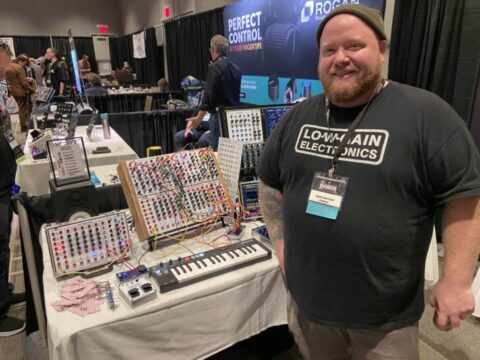
We caught up with Logan Erickson of Low-Gain Electronics, who introduced a variety of new gear at Knobcon 2023. The event held September 8-10, 2023 in the Chicago area.
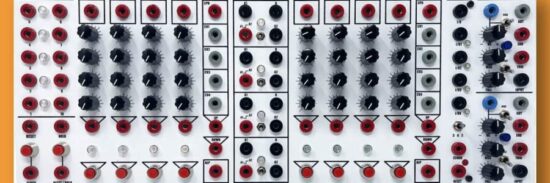
Low-Gain highlights were a pair of 4U synth panels, Elements of Melody and Sequence of Events. The format is Serge-inspired, but the designs are Erickson’s.
The Elements of Melody brings together a collection of modular functions “focused on voicing”. This includes:
Tri-Core VCO
Tri-Core VCO
Triple Waveshaper
Dual Processor
’73 Filter
R7 Envelope Generator
Smooth Stepped Generator
Dual AM / RM
Pots & Pans
The Sequence of Events focuses on sequencing, routing and CV processing, and includes the following modular functions:
Gate Sequencer
Discrete Programmable Sequencer (4 stage)
Bi-Directional Router
Discrete Programmable Sequencer (4 stage)
Sequential Switch
Dual Slopes Compact
The two panels will be available built-to-order, with a 3-6 week lead time, and also as DIY projects.
Low-Gain was also showing several varieties of matrix mixers, including their Passive Matrix Mixer, which you could build at one of Knobcon’s DIY workshops, and several larger mixers.
In the last few years, Erickson has built up a complete line of Low-Gain 4U modules, in addition to Euro-format and standalone mixers and utility modules. Details are available at the Low-Gain website.
NPR’s latest Tiny Desk Concert features Japanese composer/keyboardist Hiromi Uehara and her band, Hiromi’s Sonicwonder, getting their fusion jazz on and melting faces, up close and in person.
Hiromi performs on acoustic piano and Nord keyboards, and – whether she’s playing an acid bassline or more traditional fusion keyboard parts – she brings ecstatic energy and massive chops.
In other words, Hiromi will melt your face off, and do it with a smile. Check out the video and share your thoughts in the comments!
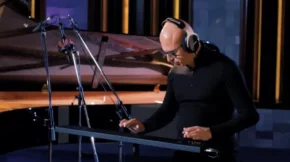
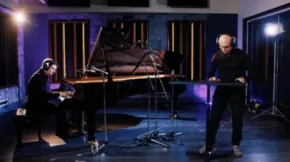
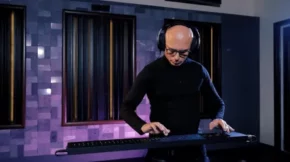
SOMA Laboratory has introduced FLUX, a new synthesizer instrument that reimagines the theremin using modern technology, to offer precise expressive control over timbre.
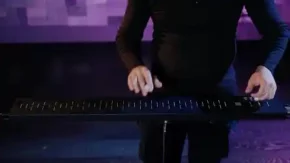
The FLUX is played gesturally, like the theremin, using your hands to control pitch and volume. The FLUX uses magnetic ‘bows’ and a sensor strip, though, which allows for much more precise and repeatable control over pitch, while still supporting continuous expressive control, like the theremin.
FLUX also allows for additional dimensions of expression, going beyond the theremin’s capabilities. This means that it gives you continuous express control over not just pitch and volume, but also over timbre.
FLUX works in monophonic, duophonic and polyphonic modes. Staccato-enabling and quantization modes are available. The quantization function has an adjustment parameter for vibrato.
What SOMA say about the FLUX:
“Unlike the Theremin which works by virtue of the capacitive coupling of hands and antennae, FLUX is based on magnetic principles. Two magnetic bows are pressed between your fingers, and the interface is a multipolar magnetic sensor, registering the bows’ positions and movements.
The X coordinate of the artist’s right-hand bow controls the note’s pitch, while the Z coordinate controls volume. The left-hand bow’s X, Y and Z coordinates control the various synthesis parameters.
Since a magnet has two poles, FLUX not only detects the bows’ spatial coordinates, but also the bows’ angle. This means that flipping the right-hand bow on the Y-axis changes the octave, which allows a range of six continuous octaves without transposing the keyboard. With transposition you can get a range from sub-bass all the way to ultrasonic. The left-right tilting of the right-hand bow on the X-axis controls two independent modulation parameters.
The left-hand bow controls the timbres. The timbral sensor, placed in the left part, has six poles, and independently registers positive and negative magnetic fields. This lets you change which parameters you control by flipping the bow, allowing you to control up to twelve independent sound parameters. Together with the pitch, volume and two additional tilt parameters on the right-hand bow, you have access to a total of sixteen sonic controls that you can use during performance, without ever touching the surface of the instrument.
Summing up the concept of FLUX: the most direct and immediate way to play with a large number of synthesis parameters in a musical way, creating a dynamic timbre composition. Different synthesis algorithms (engines) will be created as complete musical instruments for direct timbral control. All engines will be available in a single firmware and any engine can be launched in a fraction of a second. Presets will allow the user to save and recall the entire state of the synth including engine and all tunings.
We developed FLUX with the aim to create a modern instrument for academic music, offering powerful sonic tools such as distortion, complex FM and physical modelling of non-existent, surrealistic musical instruments. We invite modern performers and composers to use FLUX in their work.”
SOMA Laboratory was founded by designer Vlad Kreimer in 2016. Since then, the company has established a reputation for creating uniquely original electronic music instrument designs, including the LYRA-8 “organismic synthesizer”, the PULSAR-23 drum machine and The Pipe voice/breath-controlled instrument.
With the FLUX, Kreimer and SOMA are aiming high, with an instrument that offers the expressive gestural control of the theremin, but with better control over pitch and with entirely new capabilities for controlling synthesis.
FLUX is under development. Details are to come at the SOMA website.