25 Apr, 2023

GPU Audio and Vienna Symphonic Library have announced the MIR Pro 3D Multi Impulse Response Convolution platform, powered for the first time by GPU Audio technology.
The announcement is a milestone for GPU Audio, because one of the most established plug-in manufacturers is now partnering with them to take advantage of the potential of GPU-powered audio effects. They say that, by leveraging the power of your GPU, it opens up system resources ten-fold, so you have fewer resource headaches and more creative options.
Many modern computers now have extremely powerful graphics processing units (GPU), designed to support graphics-intensive applications like gaming. GPU Audio’s platform is designed to take that massive processor and make it just as useful for audio as it is for graphics, freeing up your computer’s CPU to handle other tasks.
Vienna MIR Pro 3D is designed to let you approach space as a musical instrument, giving you virtual representations of some of the world’s most interesting acoustic spaces, with up to four listener/mic positions and virtually unlimited source positions.
MIR’s core engine relies heavily on convolution; a mathematical process that ordinarily pushes the CPU to the limit, with a huge number of sound sources (such as orchestras), multiple output channels (for the likes of 3D audio) and long reverb tails resulting in hundreds, or even thousands of convolutions. For example, an orchestra made up of 80 stereo sources, mixed in 7.0.4 for Dolby Atmos, will create a maximum of 1,760 positional impulse responses and consequently the same number of convolutions (80 x 2 x 11).
Vienna MIR Pro 3D Features and Benefits:
- Direct access to virtual representations of some of the world’s most exciting acoustic spaces, from up to four listener/mic positions and virtually unlimited source positions.
- Based on pure, true-to-the-source audio recordings upscaled to 3rd Order Ambisonics – no algorithmic reverb or physical modelling.
- Full 3D audio support, six degrees of freedom – instruments or any other sound source, virtual microphones and microphone capsules can be moved in a fluid three-dimensional space and rotated and tilted in any direction
- Total flexibility of audio output formats, from stereo to surround to immersive and raw Ambisonics.
- The unique MIR Control Icon allows for easy placing of any audio signal in a three-dimensional room and control of almost any sonic aspect quickly and intuitively.
- Tabbed instances provide multiple venues simultaneously, with instruments taking up “Roles” to move between venues.
- Individual RoomEQ settings for different signal sources allow for specific fine-tuning of the “wet” signal
- Character Presets (such as ‘Air’, ‘Silk’, ‘Bite’, ‘Distant’, ‘Warm’) for quick timbral changes
- Advanced Preset Management of Venue Presets and Roles
- Optional distance-depending air absorption filter and volume scaling
- Adjustable Room Tone (natural noise floor) recorded from each microphone position in full Ambisonics
- Directional frequency profiles with reflectional information from every single Vienna Instrument, plus a selection of “General Purpose” profiles for 3rd party sources, for the most accurate rendering
- Works with any commonly used sampling frequency, up to 192 kHz
- AU/VST/VST3/AAX Native plug-in for direct integration with most modern DAWs
Find out more at the VSL website.
19 Apr, 2023

At The 2023 NAMM Show, GPU Audio and Mach1 introduced the Mach1 Spatial System, a free tool that is designed to take advantage of your GPU to power flexible spatial and multichannel audio mixing.
The Mach1 Spatial framework unifies all multichannel and spatial audio formats, making it format, codec, and platform agnostic. Mach1 Spatial is 100% transparent, with no additional filtering or signal-altering processing required to simulate spatial audio, enabling Mach1 to bring much-needed interoperability and standards to spatial audio production and development.
Features:
- Transparent spatial audio mixing: The spatial audio mixing framework from Mach1 Spatial means there are no additional room models, delays, or filters to simulate spatial audio (unless the user adds them themselves), and the mixing sound-field environment is 1:1 synonymous with stereo mixing expectations but scaled for 3D spaces.
- Flexible multichannel and spatial audio outputs: By utilizing Mach1 Spatial as the intermediary format, the user will have access to the publicly maintained Mach1Transcode API and be able to effortlessly output any multichannel or spatial audio format, whether it is any of the sub-specs of the following: Mach1 Spatial, Dolby Atmos, Sony 360 Reality Audio, ambisonics, surround, etc,.
- Continuous multichannel master file rendering: As the user plays the spatial audio mix downstream to this product, the app will intelligently join the played segments and continuously update a rendered master file to the user’s hard drive; this removes the requirement to figure out how to externally “arm and record” this app, and the user is no longer expected to figure out how to manually render or export a distributable file as they need. The user can also finely enter the start and stop points as needed for precision.
- No additional save file required: All the mixing settings for multichannel and spatial audio mixing are saved with the user’s DAW project settings. This is true even if the DAW does not support multichannel audio.
- Aggregated head-tracking input: This product will have an aggregated head-tracking tool included, allowing users to add their own head-tracking hardware/software for better spatial audio monitoring. The head-tracking tool is open-source, so IMU or head-tracking-enabled device manufacturers, developers, or users can add new units as they appear on the market, providing more user access and flexibility to this tool.
- Better spatial/3D visual aid: Additional tools to monitor and visually view the spatial sound-field mix and even spatial metering.
- Opensource playback tool for sharing mixes: Another component that lets users brand their own player to share their spatial audio content as they prepared in their preferred spatial audio format while we are waiting for more distribution market adoption.
An accompanying series of Mach1 Spatial System Pro-Tier paid plugins are also being designed to take advantage of GPU processing for audio, which will further enhance the Mach1 Spatial System workflow for spatial audio.
“Spatial audio is not just a processing effect or feature; it is a new medium,” states CEO Jacqueline Bosnjak. “We are ensuring what has existed for stereo as a medium can also exist for multichannel and spatial audio. Since we all understand stereo and no one owns it, we can collectively develop tools that interface with it properly, which allowed it to thrive as a creative digital medium. Mach1 and GPU Audio are building tools to enable spatial audio to reach its full potential as a new medium where artists and engineers have full creative control”
The free cross-platform Mach1 Spatial System, in collaboration with GPU Audio, will be released later this year.
10 Apr, 2023
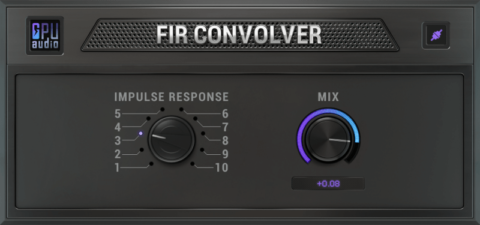
GPU Audio has released a free collection of impulse responses, along with a free, GPU-powered convolution reverb for Mac and Windows, Fireverb.
Impulse Responses essentially ‘sample’ the acoustic qualities of an environment, so they can be used to realistically reproduce the way a particular space effects sounds.
The pack contains 50 IRs from a huge range of sources. The IR pack is available to use royalty-free. The free pack includes the sounds of large spaces such as Churches, Halls, and Rooms, as well as more off-the-wall sounds, like the sounds of someone’s pharynx, a rotary telephone speaker, underwater bubbles, ribbon microphones, digital modular effects and more.
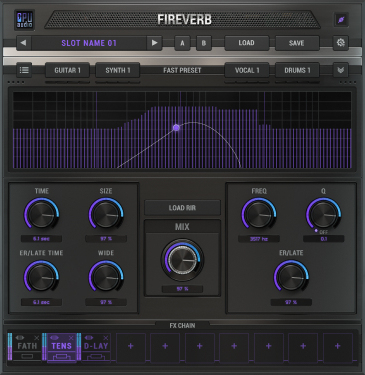
The free IR pack is available now, and can be used in a multitude of DAWs which have convolution plugins – but GPU Audio encourages you to try their GPU-powered FiReverb, which is available as a free download.
FiReverb and the 50 Impulse Response pack are available as free downloads at the GPU Audio website.

