Anukari 3D Physics Synthesizer Now Available
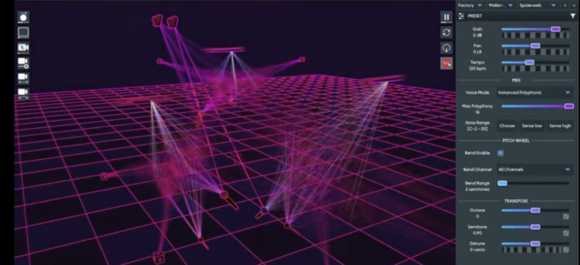
Anukari Music has released Anukari, a physical modeling synthesizer and effects processor for macOS and Windows that’s based on visually modeling a network of small masses, connected by springs.
The masses can be vibrated by striking them via MIDI input, or they can be vibrated directly via audio input, so it can act as an effect processor or reverb plugin.
Here’s what they have to say about it:
“Anukari is built entirely on real-time physics simulation. You can build structures that ring, vibrate, interact, and feed back into one another. Excite them with mallets, bows, your own audio, and more. And explore sonic palettes that are wildly out of this world.
What does it sound like? Whatever you want. Sometimes it’s subtle, and sometimes not so subtle. Does it create time paradoxes? Will you tear the fabric of space-time? Hard to tell… but Anukari invites you to find out.”
Features:
- Create a 3D instrument made from masses and springs, and then use your MIDI keyboard to trigger mallets, plectrums, bows, and traditional oscillators.
- Hook up virtual microphones to pick up the sound the 3D instrument makes. You can keep it simple, or build sprawling systems of hundreds of masses.
- Powerful Effects Processor – Anukari can accept audio input signals, either as a sidechain input alongside MIDI or as the primary input. Create 3D audio signal inputs and connect them to the parts of the physics system you want to vibrate, and then pick up the resulting sounds with virtual microphones.
- Full MPE Support – Works with both “legacy” MIDI and Midi Polyphonic Expression (MPE), so you can use a regular MIDI keyboard or your Linnstrument, Roli Seaboard, Haken Continuum, or other favorite MPE controller with Anukari.
- In addition to the basic physics objects, there are lots of options for modulation. Powerful sample-accurate LFOs which can operate all the way up to audio frequency for FM. MIDI-triggered envelopes. Envelope followers. The modulation matrix is simple to understand: it’s displayed via physical connections in the 3D world. Nearly every parameter can be modulated.
- Plugin and Standalone Mode – You can run Anukari in your favorite DAW on Windows or MacOS as a VST3, AU, or AAX plugin, or run it in standalone mode to play it as a MIDI instrument without the complexity of a DAW.
- Tactile Real-Time 3D Interface – You create the instrument’s physics layout in an intuitive 3D editor, and then see how it vibrates, flexes, spins, and moves in real-time as you play it.
Anukari is available now for $99 USD (normally $149).


