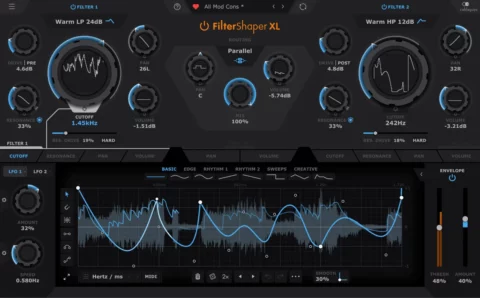
Cableguys has announced the release of FilterShaper XL Modulatable Dual Filter. It’s an update to its FilterShaper 3 plugin, originally released in 2014. Described as a ‘modern reboot’ of the original, FilterShaper XL has been updated with new features, modulation capabilities, support for additional formats and more.
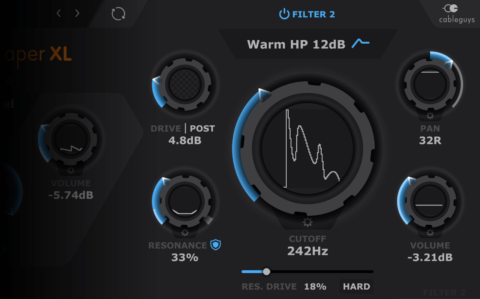
FilterShaper XL is built around two multi-mode filters, both of which feature a redesigned filter algorithm that offers 20 filter types, including variations on low-pass, high-pass, band-pass, notch and peak. ‘Warm’ filter types recreate the sound of the “Sallen-Key filters of a legendary semi-modular synthesizer” while the ‘Clean’ options offer a more precise, modern and digital sound.
The original FilterShaper was praised for its deep and complex modulation options, and FilterShaper XL is taking the modulation possibilities of its younger brother to new heights with 60 LFOs and 50 envelope followers onboard. Every parameter in FilterShaper XL is equipped with its own LFO (including the LFO parameters themselves) and customized waves can be drawn in using the LFO-editing tools found in CableGuys ShaperBox 3.
Also new in FilterShaper XL is a drive algorithm that’s said to be capable of everything from subtle saturation to gnarly distortion. Drive can be applied at both filter stages, pre- or post-filter. FilterShaper XL’s revamped interface is now resizable, and its preset library browser has been redesigned and equipped with a variety of new filter presets.
FilterShaper XL is available now in AU/VST2/VST3/AAX formats for Mac and PC. It is currently priced at an introductory €49/$49/£49 before it goes back up to €79/$79/£79, but if you own FilterShaper 3, you can have it for free.
sonicLAB has introduced Oceanic, a software bundle for Mac and Windows that they say “captures the essence of the ocean’s waves and transforms them into a symphony of additive sound synthesis.”
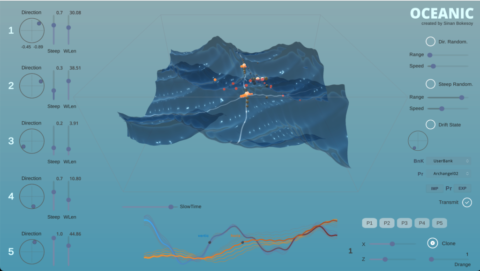
Oceanic controls sound using Gerstner’s wave solutions, a mathematical representation of sea waves. The Gerstner’s trochoidal wave solution captures the nuanced movements of wave surfaces, both vertically and horizontally. By utilizing five periodic trochoidal waves and their superposition, Oceanic crafts a fluid sea surface motion, rich in variations and fully controllable.
Oceanic uses this to control wavetable oscillators and calculate complex modulations of synthesis parameters.
The Oceanic bundle comes with three applications:
Oceanic – A sea-wave simulation that generates intricate wave shapes, providing the foundation for the entire bundle. The scanned sea-waves surface at selected probe points are being used to calculate the wavetables ( micro scale ), the modulation waveforms for synthesis parameters ( meso scale ) and macro scale variations of these waves.
WaveBot – A wavetable synthesizer in plugin format that sources its wave data and modulation from the evolving sea-wave simulations. It’s the heart and soul of the oceanic sound, producing the authentic resonance of sea waves without relying on artificial wavetables or sources. Everything comes from the sea-waves simulation.
WaveCC – A MIDI CC generator that derives its modulation data from Oceanic, ensuring seamless integration and real-time communication
Oceanic is available now, with an intro price of €89,00 (regularly €109,00).
Acon Digital is the latest company to offer an AI-powered real-time stem separation solution, via a plugin, Remix.
The ability to ‘break apart’ mixed audio files is something that producers have long requested, and there are now multiple tools that enable you to do it. Serato recently added similar feature to its Sample 2.0 plugin.
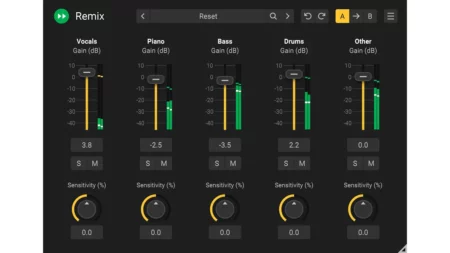
Remix enables you to extract five stems: vocals, piano, bass, drums and ‘other’ audio. You can adjust the volume of each of these within the plugin, and a sensitivity control enables you to tweak the balance between “elimination and spill”. All parameters can be automated, and there are separate outputs for each stem so that you can process them individually.
All of which sounds neat and tidy enough but, the real test will be how effective the stem separation is on the kind of material you like to work with. As of Remix, the technology was licensed by Acon Digital from Hance, a company that specialises in machine learning and digital signal processing.
Remix is available now for PC and Mac in VST/AU/AAX formats, and there’s also a demo version. It costs $49.90 and you can find out more on the Acon Digital website.
Besides, based on current trends, it might not be too long before stem separation is included into your DAW, as it is already included in Serato Studio, and part of Tracktion Waveform Pro updated version 12.5 .
Apparently, that stem separation is on its way to FL Studio 21.2, which is currently in beta. A video is circulating in social media X that appears to show this in action .