Waldorf Iridium Core is a Compact version for performers and musicians on the move


Today, Waldorf has introduced the Iridium Core, a compact synthesizer that they say puts the full Iridium synth engine into a compact desktop synth with 12-voice polyphony.

Waldorf’s Iridium synth began life as a desktop module, then turned into a keyboard, and has now risen in a desktop format once again. Known as Iridium Core, this new 12-voice version contains the full Iridium sound engine, and enables you to access it via a supposedly easy-to-use interface.

The Iridium Core is compact enough to fit into laptop bags and in carry-on luggage, but still features 5 synthesis engines: Wavetable, Multi- & Granular-Sampling, Waveform, Kernel FM and Resonator. Combined with a broad selection of digital filter and processing options, Iridium Core lets you explore a huge range of electronic sound.

Why the need for it, though? “Many performing musicians have asked us for a more compact and portable form factor for the incredible Iridium sound engine to pack into their travel bags or allow already densely-packed studio environments to more easily accommodate another hardware instrument,” explains Waldorf Music CTO Rolf Wöhrmann.

“Inspired by their feedback, we came up with the Iridium Core concept, and are very proud of the finished result,” he adds. “Indeed, it’s a thing of beauty, ready to be taken anywhere, and we can’t wait to hear all the music made with Iridium Core!”

Iridium Core shares the same software platform as Quantum, Iridium Desktop & Iridium Keyboard. All instruments are powered by the Waldorf synthesizer OS and will receive joint updates.
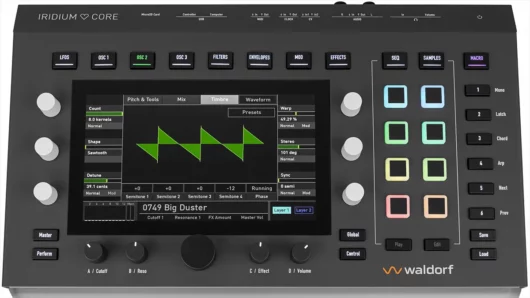
Iridium engine features three oscillators, five synthesis models (wavetable, multisample/granular, waveform, resonator and kernel), filters, a 40-slot mod matrix with LFOs and envelopes, effects, an audio recorder and more. As on previous iterations of the synth, these features can be accessed from a combination of a touchscreen, buttons and knobs.

These controls include six assignable macro buttons for performance control, and four user-definable knobs that work on either a patch or global basis. There are 1,700 factory presets, and patch compatibility with not only the other members of the Iridium family, but also Waldorf’s Quantum and Quantum MK2.

Connectivity includes mini-jack MIDI I/O, CV, Clock, audio I/O and a MicroSD slot.
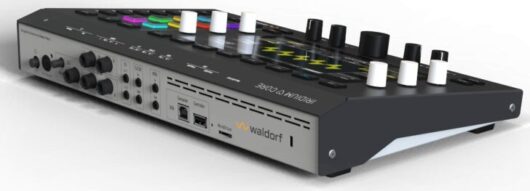
Specifications:

  • Compatible with the Waldorf Quantum synth engine
  • Software: Waldorf Synthesis Platform OS
  • Oscillators
    • 3 Oscillators each capable of 5 synthesis modes:
      • Wavetable
      • Waveform (VA)
    • Particle (Sampling and Granular Sampling)
    • Resonator
    • Kernels (up to 6 sub-oscillators which can be interlinked through FM, AM or Wavetable-position at audio rate)
  • Dual Stereo Filters per voice
    • True stereo pathDual Digital Filter with independent modes:
      • 12/24dB LP/HP/BP in all combinations
      • Nave, Largo, PPG, Quantum and State Variable models
      • Analyzer displayed in Filter view
    • Filter curve animation when modulated (optional)
    • Sophisticated filter routing options with modulatable panning and levels
  • Digital Former
    • Filter models like State Variable, Waldorf Nave, Largo and PPG in HP/LP/BP/Notch
    • Comb filters, Bit-Crusher, various Drives, Ring-Modulation
  • Modulators
    • 6 Envelopes
    • 6 LFOs
    • Komplex Modulator (LFO/Envelope combination with user-definable shape and morphing)
  • Mod Matrix
    • 40 slots
    • Fast assign mode
    • One additional control amount per slot
    • Identical Sources and Destinations can be used multiple times until the matrix is full
  • Effects
    • 5 slots per layer
    • Various parallel and sequential routing options
    • Reverb, Delay, Chorus, Phaser, Flanger, Drive, EQ, Compressor, Tremolo
  • Performance features
    • Advanced Arpeggiator
    • Step-sequencer with up to 64 steps for notes and parameters
    • 2×4 button pads assignable to notes or chords
    • 4 user-assignable potentiometers
    • 6 user-configurable macro buttons
    • Favourites screen for quick patch recall
    • XY control on touchscreen
    • Wheels touchscreen for MIDI controls like mod wheel, pitch bend, aftertouch and velocity
    • MPE capable
  • Screen
    • Industrial-grade highly responsive touch screen with Brightness control
    • 1024×600 pixels
  • Voices
    • 12 voice polyphony
    • Duo-timbral
    • Mono, Legato and Unisono modes
  • Patches
    • Over 1700 factory patches
    • Capacity of 7000 patch memory slots (numbers 0000-9999 can be used)
    • Patches from Quantum and other Iridium variants can be loaded and vice-versa
    • Category filter for patch list
    • 6 GB sample flash memory preloaded with 2 GB factory samples
  • Connections
    • Stereo Audio Out: 2x TS jacks
    • Stereo Audio In: 2x TS jacks
    • Headphones TRS output with level control
    • DIN MIDI IN & Out, mini-TRS Type A (two adapters to DIN MIDI sockets included)
    • USB Type B (device) for MIDI connection to computer
    • USB Type A (host) for storage media and MIDI devices
    • MicroSD slot
    • 2 high-resolution CV Inputs which can be used as modulation sources in the Mod-Matrix
    • Analog clock In & Out with clock divider settings
  • Sturdy metal case

Iridium Core Audio Demo:

Waldorf Iridium Core Synthesizer is available now for €1,849, rising to €1,941 after four weeks. Find out more on the Waldorf website.


Cherry Audio introduces ‘The Best Instrument For Fat Sounds’, PS-3300 Virtual Instrument


Cherry Audio has certainly had what you might call ‘a busy spell’, recreating many synth legends like the Yamaha CS-80 (in its GX-80) and Jupiter-6 (with its Mercury-6) over the last year alone.

Cherry Audio today introduced PS-330, a new virtual instrument, based on the Korg PS-3300 semi-modular analog polyphonic synthesizer from 1977, of which only 50 hardware units were ever made.

This 1977 synth was apparently once described as “the best synthesizer for fat sounds” by Bob Moog. Not the greatest PR exercise in that his own Minimoog was supposed to be that very synth, but either way, that is some endorsement.

Cherry Audio managed this recreation thanks to the Electronic Music Education and Preservation Project (EMEAPP) which allowed it full access to its own vintage PS-3300.

The organisation role is to “share the history, artists, sounds, equipment, and technology of electronic and rock music, keeping it relevant and accessible for future generations,” and as such it owns a number of iconic machines.

Cherry Audio’s PS-3300 has 360 presets (by sound designers James Terris, INHALT, and Drew Schlesinger) plus a legacy set of sounds from the original PS-3300 owner’s manual.

We should finally add that Cherry Audio’s PS-3300 is not the first Korg PS-3300 emulation of the year. Full Bucket Audio announced a similar 3300 clone, the FB-3300, a few years ago.

Here’s what Cherry Audio say about it:

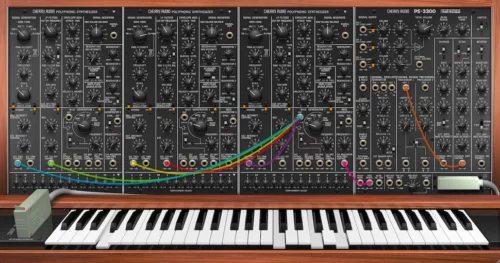
PS-3300’s unique architecture set it apart from the handful of polysynths available at the time. It had three independent “signal generator” panels, each essentially a complete polyphonic synthesizer. Each of these synth panels included 12 independently tunable divide-down oscillator banks as well as independent discrete VCFs, envelope generators, and VCAs for every note. This enabled all 48 keys of the external keyboard to be simultaneously played with independent articulation.

Dual LFOs and triple voltage-controllable resonators for each generator further shaped its signature tone. A dedicated master panel featured a mixer with VCAs for each of the three voice panels, sample & hold, an additional envelope generator, and two control voltage processors. It also delivered extensive modulation possibilities through an astounding 67 front-panel input/output jacks.

Taken as a whole, the PS-3300 was so powerful and revolutionary that even Bob Moog was impressed, stating that it was, “the best synthesizer for fat sounds.”

The PS-3300 virtual instrument replicates the functionality, layout, and sonic characteristics of each of the three PSU-3301 signal generator panels, including the six-waveform oscillators; two modulation generators (LFOs); dynamic lowpass filters, envelopes, and amps; its distinguishing triple-peak resonators; independent per-note “temperament” tuning knobs; and patchable jacks (with virtual cables) for signal routing.

The voice panels have been expanded, though, with additional faculties, including PS- or MS-style filter selection, tempo sync, copy/paste between panels, and temperament tuning presets.

The master signal mixer replicates the PSU-3302 sample & hold, a general envelope generator, and jacks for advanced sound-shaping and control. Cherry Audio has expanded the panel with continuously variable CV control of level, per-channel panning, bend range, and studio-quality integrated effects for chorus, delay, and reverb.

Features:

  • Virtual analog emulation of the semi-modular analog polyphonic synthesizer released by Korg in 1977
  • Three independent “signal generator” panels, each with an oscillator, lowpass filter, three-peak resonators, envelope with velocity, amp, two mod generator LFOs, and per-note tuning:
  • 3X VCOs with six waveforms: triangle, saw, rectangle (square), two preset pulse waves (with different widths), and PWM (variable-width pulse)
  • 3X resonant VCF 12 dB/oct lowpass filters with the option to select between the standard “clean” PS filter or the “crunchier” MS-style filter
  • 3X modulatable “triple resonators”: 12 dB/oct bandpass filters to produce vowel and phasing tones
  • 3X discreet ADSR-type envelope modulators with velocity control, and amplitude modulation
  • 3X two syncable “mod generators” (LFOs) with output jacks: one with triangle, saw, ramp, rectangle, pink noise, and white noise, and the other with triangle waveform
  • 3X temperament section with individual tuning knobs for the 12 chromatic notes, and temperament presets for Equal Tempered, Mean Tone System, Hepatonal System, and Just Intonation
  • Copy/paste settings from one signal generator panel to another
  • Polyphonic mode with up to 24 voices of polyphony and three monophonic modes: last, low, and high note priority
  • Semi-modular synthesizer with virtual jack and cable system, featuring unlimited mults per jack and customizable (color, transparency, animation) cables
  • Master signal mixer panel with sample & hold, general envelope generator, and two control voltage (CV) processors
  • Individual channel panning
  • User-selectable bend range and master tune
  • Studio-quality integrated effects: chorus, echo with sync, and three types of reverb (spring, plate, and Galactic)
  • Over 360 professionally designed presets in a dozen categories. These include a bonus Legacy collection of basic presets based on the patch sheets in the original PS-3300 Owner’s Manual, a 3100-based Glissando patch, and a 432 Hz Equal Temperament patch, all to get your started in your own sound design adventures.
  • Standalone virtual instrument and plug-in versions
  • Complete MIDI control and DAW automation for all controls, with easy-to-use MIDI Learn and mapping
  • Focus zoom-in feature, as well as standard UI zoom and resize via drag
  • Complete documentation available directly online from the instrument or in downloadable PDF format
  • User-adjustable oversampling control

Cherry Audio PS-3300 is available now for $49 (normally $69)


Akai APC64 Ableton Live Controller Review


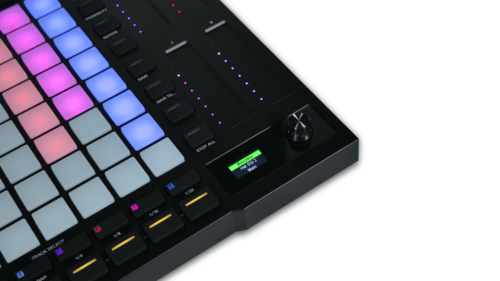
Host Ziv Eliraz – In his latest Loopop video, takes an in-depth look at the new AKAI Professional APC64 controller for Ableton Live.

As always, Eliraz offers a comprehensive feature overview, demos and examples, and his take on the pros and cons.

Watch the video, and share your thoughts on the new APC64 in the comments!

Topics covered:

0:00 Intro

1:40 Overview

2:05 Grid modes

4:30 Fader modes

6:30 Seq mode

8:40 Buttons

9:35 Screen

10:35 Build

11:00 I/O

11:50 Note mode

12:45 Chord mode

13:20 Drum modes

14:00 Ableton Live

14:30 Live rec

15:15 Quantization

16:05 Automation

17:00 Step seq

17:45 Seq settings

18:40 Modifiers

20:10 Seq live rec

21:45 Performance

22:15 Important tips

22:25 Poly AT v MPE

23:00 Device params

23:50 More buttons!

25:20 Device lock?

25:55 Seq + Live

26:40 Note repeats?

26:55 Latency

27:30 Pros and cons

32:15 Outro