Supercritical Redshift 6 Variable Character Synthesizer Now Available To Preorder
Supercritical Synthesizers has introduced their first desktop instrument, Redshift 6, a six-voice analog “Variable Character Synthesizer”.
“To distorted misbehaviour and beyond” – Redshift 6 could well be the unexpected synth star of NAMM season.
Supercritical Synthesizers Redshift 6 is a synth that certainly looks as cool as it sounds, and seems to have the specs to match. It features both six-part polyphony and multitimbrality – hence the name – and has some super-flexible oscillators at its core, all of which look like making it one of the synths to look out for this year.
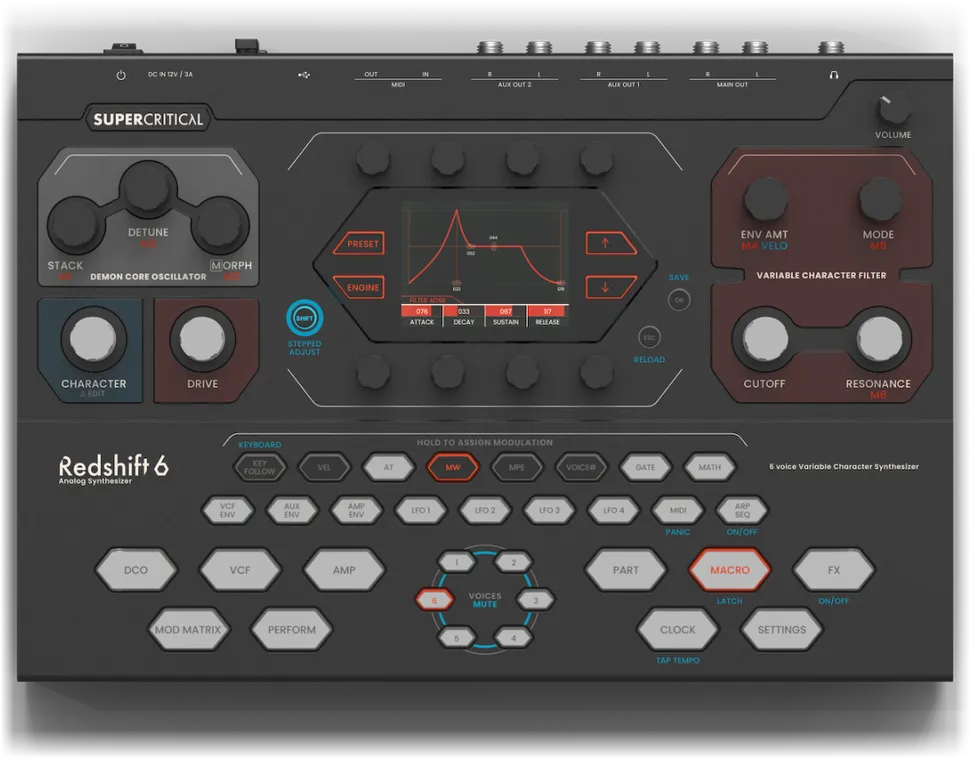
The Supercritical Redshift 6 combines technology from the company’s previous products, the Demon Core Oscillator and the Neutron Flux Filter. Each of the six voices features a DCO, with analog waveforms generated under digital control. The filter core is an analog 4-pole state variable filter, also digitally controlled, to “act like almost any classic vintage synthesizer filter and more”.
There’s a Demon Core Oscillator behind each of Redshift’s 6 voices, with this providing digitally-controlled analogue waveforms. This oscillator is unusual, though, in that the user can choose between various engines, including traditional twin oscillators, supersaw, flanging phase sync, or a transistor organ.
The Neutron Flux filter is an analogue 4-pole, state-variable type, also under digital control, and can “act like almost any classic vintage synthesizer filter and more,” according to Supercritical. Whether it can power a Starship is debatable, however.
What is certain is that this digitally-controlled analogue marriage seems to be central to Redshift 6’s ‘Variable Character Synthesizer’ philosophy. It essentially means it has a pure analogue signal path but can go in multiple digital directions, all controlled by way of a software-updatable engine and a lovely-looking screen.
“It can cover the full [sonic] range from almost digitally sterile and clean to distorted misbehaviour and beyond,” says Supercritical. “No modelling here – it’s all analogue until the bypassable stereo DSP effects processor.”
The multitimbral angle in Redshift 6 is also interesting because you can use the synth in a single sound mode, with all six notes of polyphony accessible, or in a six-part mode with six different sounds, all monophonic. Or use any combination of sounds versus polyphony in between, including a classic vintage poly dual-layer mode with two voices, each with three parts of polyphony.
As if that’s not enough – and to slightly muddy the polyphony water – each of the six voices can also operate as a paraphonic voice with up to 16-note paraphony. Paraphony verses polyphony – there’s a feature right there.
In addition, Redshift 6 has plenty of modulation action built in, MPE support, and DSP effects. There are two main plus four auxiliary outputs, so you can presumably assign one sound to each output, which could be very cool indeed.
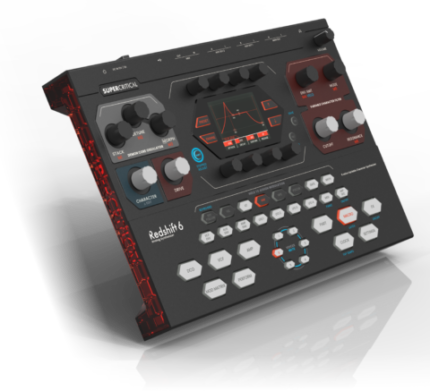
Features:
- Six voices
- Full analog signal chain
- Digitally controlled analog Supercritical Demon Core Oscillator
- Analog four pole Variable Character Filter
- Flexible gain staging with an analog boost circuit
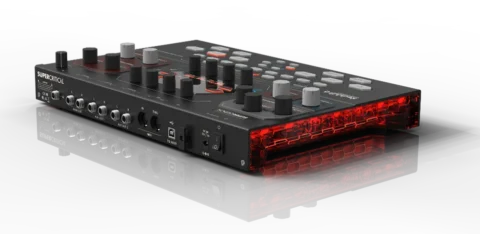
- Physical audio output per voice (2 main outputs and 4 aux outputs)
- Optional voice chaining
- Bypassable digital effects in main outputs 1-2
- 7 inch TFT IPS color screen with a bank of 8 endless clickable potentiometers and quick navigation via button grid
- Quick powerful controls for oscillators and filters.
- Six user-assignable macro controls
- Six parts multitimbral
- Modern MIDI implementation with USB-B connection and DIN IN/OUT
- MPE
It’s not due until summer 2024, but Redshift 6 is certainly making a synth statement ahead of this year’s NAMM Show. It has a distinctive desktop design, complete with lit-up access to its innards (or so it seems) and even – get this – hexagonal buttons and screen.
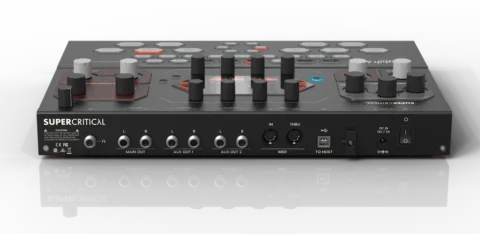
The Supercritical Redshift 6 will be available in summer 2024 with an MSRP of £1,099/$€1,259. Preorders are open now. There’s more info at the Supercritical Synthesizers website.