2024 NAMM Show: Casio Announces New Celviano AP Digital Piano Series


“A truly authentic playing experience” – Casio brings an immersive spatial sound system to its new Celviano digital piano range, and an automatic recorder means you’ll never lose your best performance.

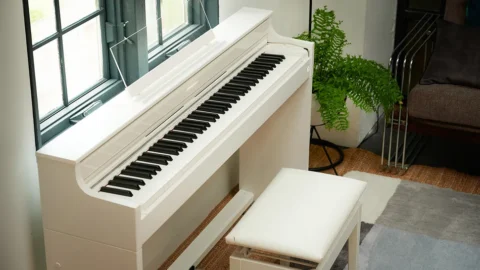
2024 NAMM Show: If you want to buy a digital piano that looks like it belongs as much in your living room as it does your studio, one of Casio’s new Celviano models might well fit the bill. These three ‘furniture pianos’ – the AP-750, AP-550 and AP-S450 – prioritise both style and sound, and come with redesigned speaker systems and a visual information bar that promises to aid your learning.

The sonic highlight here could be the new Hamburg Piano Tone, which Casio has created to “faithfully capture the natural bloom of one of the world’s most coveted and majestic pianos”. This has been matched to the new Celviano speaker system, which is designed to emulate the sound of a grand piano by creating a 3D effect that feels like it’s coming from both above and below the soundboard.

Both the AP-750 and AP-550 have a top lid that can be physically opened in order to project sound forward.

The new Visual Information Bar, can either display a pulsing metronome that will help to keep you in time, or provide feedback on your playing strength and pedal depth, giving teachers additional insight into students’ finger and pedal technique.
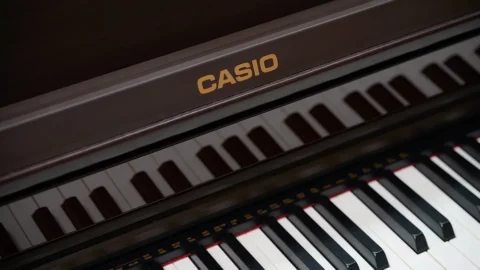
The Instant RePlayer feature also sounds handy – use it to return in time to a recent performance or a moment of inspiration that you might otherwise have lost. This might also help you to avoid the stress that comes with pressing the red button and knowing that you’re recording, which can hinder performance.

The AP-750 is the flagship model here, offering a Grandphonic 8 spatial sound system and 39 built-in tones. Nine of these are grand pianos; as well as the Hamburg tone, you also get a Berlin Grand that was developed in collaboration with Bechstein, and the Vienna Grand, another tone that’s based on “one of the world’s finest pianos”.

In the middle of the range, the AP-550 has a 2-channel/4-speaker system and 26 tones, six of which are grand pianos. Here, the Hamburg tone is joined by the New York Grand.

The AP-S450 is similar but more compact, and like the AP-550 is available in black, white and brown colour options. You can have the AP-750 in any colour as long as it’s black.
All three models include the Celviano edition of Casio’s Smart Hybrid Hammer Action Keyboard, a refinement of the action found in the most recent Privia models, and come with the WU-BT10 Bluetooth adapter, which supports wireless MIDI and audio. One of the many apps you can connect to is Casio’s own Music Space; available for iOS and Android, this enables you to adjust the piano’s settings, view and annotate sheet music, engage with interactive game-like lessons, work with audio files and more.

The AP-750, AP-550 and AP-S450 priced at $3,399.99/£1,999, $2,999.99/£1,749 and $1,999.99/£1,549 respectively. Find out more on the Casio website.
 

2024 NAMM Show: AlphaTheta Corporation Announces the OMNIS-DUO Portable DJ setup


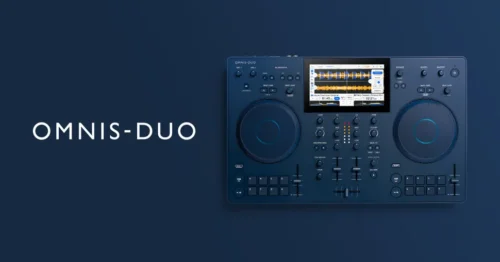
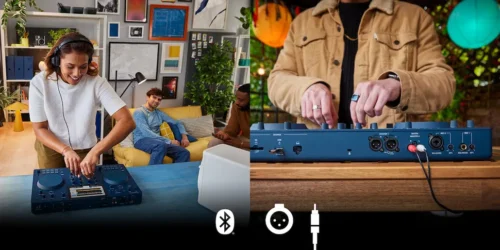
2024 NAMM: The Pioneer DJ parent company celebrates its new brand by throwing a party, and OMNIS-DUO is playing the tunes. AlphaTheta Corporation has been quick off the mark after announcing a new eponymous brand that will sit alongside its roster of Pioneer DJ products. One of the first new products off the mark is OMNIS-DUO, the “perfect” portable DJ setup to take to your next party. And its colour is inspired by denim jeans.

It is a big hello to AlphaTheta, a new brand that is spinning out of, but apparently not actually replacing the Pioneer DJ brand.

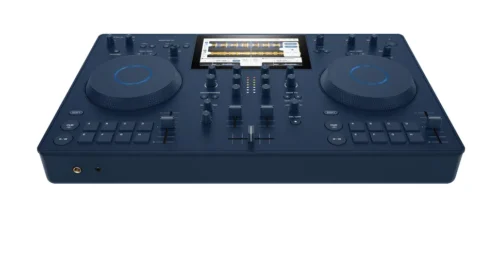
As well as being a flexible and portable DJ setup that can fit in a backpack, OMNIS-DUO sports a distinctive indigo colour which is, yes really, inspired by denim jeans. That’s because, says AlphaTheta, “it looks at home in professional venues and casual environments”.

OMNIS-DUO is lightweight and portable enough to be taken anywhere – it can be powered by batteries if you wish – and can even be used outside, according to AlphaTheta. It has Bluetooth connectivity, so anyone with a phone can chip in with their favourite tunes, and there’s plenty of connectivity around the back. As well as offering two mic inputs, you can also plug into decent sized PA systems using XLR connections, or simple speakers with its RCA terminals.

You can play music from a variety of sources, as well. OMNIS-DUO supports USB Type-A drives, and SD cards can be plugged straight into it. Alternatively, link up to a Mac or PC via USB-C and use the rekordbox Performance mode. There’s also a Wi-Fi option, for doing all of the above wirelessly.

OMNIS-DUO has a touchscreen in the centre that operates in either Light or Dark mode, depending on whether you are indoors or out, and the batteries should give you five hours of operation before needing a recharge by mains or USB.

Onboard controls include an EQ, effects (eight Beat and six Colour), tempo change, eight hot cues, and scratching, so there should be enough options to sound ‘pro’ while you are playing on the beach.

The OMNIS-DUO is price $1,499.00 There’s more info at the AlphaTheta website.


Waves Space Rider ‘Dynamic Rider’ Features Chorus, Delay, Reverb & Envelope Follower


Waves goes intergalactic with Space Rider, a new multi-effects plugin for applying spatial effects to your project.

Space Rider features chorus, delay and reverb alongside an envelope follower that can be used to modulate any of its parameters via an external source.

Hardware tends to dominate the spotlight at NAMM, and while we can’t deny that the new synths unveiled by brands like Korg and Yamaha have got us pretty excited, there’s also a ton of new plugins and music software being announced that deserve your attention.

One such plugin is Waves’ Space Rider, a new multi-effect that packs reverb, delay and chorus together in a single processor. Waves tells us Space Rider is designed to allow producers and mix engineers to quickly and easily create “deep, lush and high-quality spaces” in their projects.

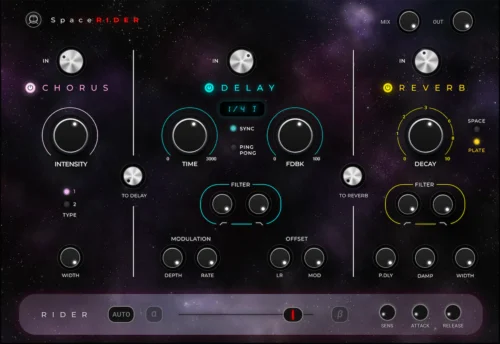
Space Rider’s interface is divided into three, with each effect on its own separate panel with its own gain knob; effects can be fed into one another using the dials positioned between them. This will be a time-saver for anyone looking to get experimental with their effects without having to mess about with auxiliary channels.

The delay panel features controls for delay time and feedback, and delay time can be synced to project tempo or dialled in milliseconds. There’s high and low-pass filters onboard, along with controls for modulation depth and rate, and an offset control for introducing subtle variation between delay times in the left and right channels. Those hoping to get their stereo fix will be pleased to know that Space Rider is also capable of ping pong delay.

Space Rider can do two types of reverb; Space is a more realistic, conventional algorithmic reverb while Plate emulates the lush sound of a plate reverb unit. Decay time can be tweaked along with high and low-pass filters, pre-delay, dampening and stereo width. Finally, the plugin offers two distinct types of chorus, with controls for intensity and width.

The plugin also features an envelope follower, controlled by the slider at the bottom of the interface, which can be used to modulate any of Space Rider’s parameters via an external signal from elsewhere in your DAW.

We like the look of Space Rider, and while it lacks some of the more advanced controls you might find in dedicated (and more expensive) reverb, delay or chorus plugins, this looks like a fun and intuitive tool for quickly and easily applying spatial effects to your project.

Waves Space Rider is available now for Windows and macOS in VST/AU/AAX formats. The plugin is priced at $49.99 and is free for Waves Ultimate subscribers.  Find out more on Waves website.