Behringer teases UB-Xa Mini, A $99 Taste of the ‘Authentic Sound Of The OB-Xa’
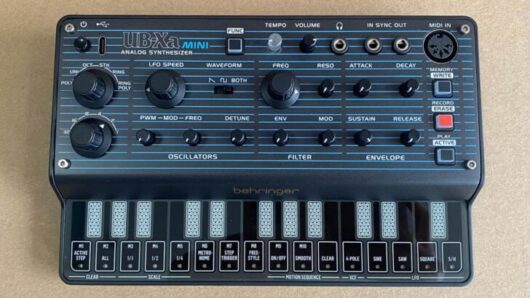

The last product that Behringer has (so far) announced this NAMM is the UB-Xa Mini.

Today, Behringer shared this sneak preview of their upcoming UB-Xa mini analog synthesizer,  a minisynth that they say offers “the authentic sound” of the Oberheim OB-Xa.

Details are still to be announced, but Behringer says that the UB-Xa mini offers three voices. It’s not clear if that is three paraphonic voices or if three polyphonic OB-Xa style voices.

Like the CZ-1, this is another $99 budget synth.

That said, of course it is probably a cut-down version, although Behringer doesn’t give any info on just how cut down it is, saying, “we now have a more affordable option, the UB-Xa Mini, available for only 99 USD for those who want the authentic sound of the OB-Xa. The synth is currently in beta testing and we are looking forward to shipping it soon.”

Finally, the company gave a more general update on how its various projects have been affected by chip shortages, and it looks like that situation is improving.

“As we near the resolution of the chip crisis, we are intensifying our efforts to deliver all our pending products,” it said, concluding with the rather up beat,”synths for all!”

And get more info (possibly) from Behringer website.
Oeksound Bloom Adaptive Tone Shaper Makes Your Music Sound Better


Oeksound is one of those companies that makes plugins that make your music sound better. The company’s new Bloom processor looks to continue the trend.

Oeksound doesn’t release that many plugins, but they have all made a big impression. 2018’s Spiff was originally designed as a corrective vocal processor, but turned out to be an equally useful tool on almost any sound source. And as for Soothe2, well that is one of the great plugins of our time, one that we described as “a dynamic EQ plugin that no producer should be without”.

Big pressure for Oeksound on this latest release, Bloom. According to the company, an “adaptive tone shaper” – basically it sounds like it makes your music sound better, or, depending on how it sounds in the first place.

“It analyses the character of a signal and applies corrections to the perceived tonal balance for a more even and refined sound,” says Oeksound, brilliantly saying everything and nothing in one sentence.

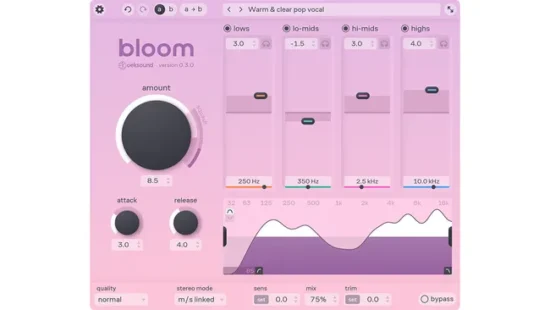
Bloom does seem to do ‘stuff’ in various frequency bands, though, so we could call it, broadly, an EQ.

“Four frequency balance sliders can be used to further shape the tone to taste, enabling both fine adjustments and radical transformations. These sliders change the overall tonal balance that Bloom is working towards, rather than making absolute cuts or boosts as found in an EQ.”

Which leaves us bemused, especially after Oeksound itself concludes: “Bloom steps away from explicit problem-solving and towards colour and tone-shaping. It can be used to fix audio, but also to sculpt it creatively.”

Which ultimately means you probably need to check it out to understand it.

You can watch a NAMM Show floor demo video below via Sonic State:

Oeksound hasn’t revealed how much Bloom will be or when it will be available, just saying “soon”. Find out more info at Oeksound website.


Behringer intros 72 HP Eurorack Spring Reverb Effect


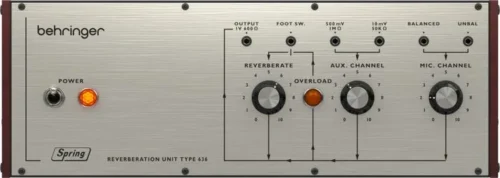
Today, Behringer introduced the Spring Reverberation 636, an unofficial copy of the Grampian 636 spring reverb, in Eurorack format.

The original was used in genres from rock to spaghetti western soundtracks to dub. Here’s what Behringer has to say about it:

“Emulating our heroes is one of the many things we can have fun with as musicians which is why we wanted the SPRING REVERBERATION 636 to be as faithful as possible to the original Grampian Type 636 used by Pete Townshend and legendary reggae dub master Lee “Scratch” Perry.

Now you can have their legendary secret ingredient added to your setup so you can create your very own masterpiece, or to just have fun with.”

Behringer appears to have translated the original design into Eurorack form factor fairly literally, resulting in a large hardware effect that takes up a lot of rack space – 72HP – while only offering three controls. The design also doesn’t add any modular CV control over the effect.

The 72 HP width may also strike some synthesists as awkward, since it’s wider than Behringer’s 70HP Euro synths, like the D, and narrower than the 80 HP width of the Neutron and Pro-1.

Unusually for the company’s products, the Behringer Spring Reverberation 636 is more expensive and takes up more rack space than some readily available options. Other solutions generally mount the spring reverb in the case, so the panel is only as big as needed for the controls. For example, the Doepfer A-199 Spring Reverb Module offers more control in 8 HP, for about $50 less.

Because of these design decisions, the Spring Reverberation 636 may appeal more to people interested in an inexpensive copy of the Grampian 636 than to synthesists interested in a hardware reverb unit.

The Behringer Spring Reverberation 636 is expected to be available within 1-2 months, priced at $199.

What do you think? Watch the video, and then share your thoughts on the Behringer Spring Reverberation 636 in the comments!