Musique Concrete + Sampling The World Around You


Reader Sam Spiers (Kindred Sol) shared this video, demonstrating his approach to sampling the world around us, with the goal of using field recordings to capture unique sounds that you can use in your music.

The video is part 1 of a planned four parts. So this is accessible to anyone, Spiers tried to limit his demonstration to the devices that are available in Live Intro + some nice free 3rd-party plugins.

What he has to say about the video:

“I’ve taken an everyday sound (carrot in the kitchen) and turned it into kicks, hi hats and some interesting percussion parts – plus a lead and bass.

And in the name of keeping it more accessible (ie affordable), I’ve tried to do all of this limiting myself to the devices found in Live Intro (and some lovely free third-party plug-ins).

It’s aimed at beginners and intermediate Live users, though the concepts could probably translate to other DAWs.”

Everything you hear in Part 1, aside from Spiers’ voices, comes from the same field recordings.

Topics covered:

00:00 – Intro

01:43 – Getting Started (Live Intro + free plugins)

05:10 – Mangling Recordings/Sound Design (Clip Automation)

07:40 – Mangled Audio (example) + Wrappig Devices

09:55 – Talking About Stereo/Mono mic

10:24 – Nice Crunchy Beat:) (Pt 2 will go into more detail)

10:38 – Digital Housekeeping (boring, but important)

11:25 – Creating Kick Drums + Hi Hat

15:11 – Creating Lead & Bass (+Another Crunchy Beat)

17:51 – Putting It All Together (making a beat)

19:40 – Parallel Processing (Return Channels) + A Note on Mono

22:09 – Wrapping it Up

22:35 – Nice Outro Beat + Visuals

You can find more from Spiers at his website and Bandcamp page.


Solid State Logic Announces SSL Module8 Plug-in


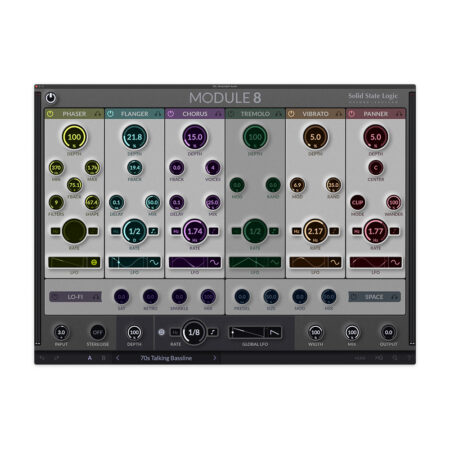
Solid State Logic announces its latest plug-in, Module8.

The new plug-in, which is available now as part of SSL Complete, combines classic modulation effects with modern functionality.

Jonathan Sandman, SSL Studio Plug-ins Product Manager comments, “We’re very excited to launch Module8 as it brings SSL’s renowned sound quality and advanced workflow to a modulation FX-based plug-in for the first time. We have taken great care to include features like Global LFO and drag-n-drop reordering, which not only speeds up the production process but encourages experimentation with sound design – grab yourself a demo and find out.”

6+2 FX rack
Module8 includes six modulation-based effects driven by LFOs, along with two additional effects on FX returns, resulting in a total of eight processors within Module8. Individual Phaser, Flanger, Chorus, Tremolo, Vibrato, and Pan effects are available, each with dedicated controls over LFO rate, depth, and shape. To encourage experimentation, users can easily customise the order of effects processing via drag-and-drop reordering.

To complement Module8’s modulation effects, ‘Lo-Fi’ and ‘Space’ processing modules are available on two dedicated FX returns expanding Module8’s creative potential even further. Additionally, parameters like ‘Stereoise’ and ‘Width’ offer users further control of the stereo field.

LFOs
Each of Module8’s six effects features a dedicated LFO, which offers a range of different shapes, including Sine, Triangle, Saw, Ramp and Square. Phase offset and inversion parameters allow further manipulation of the LFO. ‘Global’ syncs the individual effect processors to the Global LFO, whilst ‘Manual’ allows Module8’s LFOs to be synced to external LFOs in compatible DAWs. Global LFO parameters like overall depth and mix offer quick adjustments across all modules, streamlining the workflow and keeping users in the creative zone.

Features:

  • All-in-one modulation FX rack plug-in designed to encourage creativity and the exploration of sound design.
  • Six LFO-driven modulation effects (Phaser, Flanger, Chorus, Tremolo, Vibrato, Pan) with comprehensive control over rate, depth, and shape for intricate sound manipulation.
  • Two additional Lo-Fi and Space processors on independent FX returns for adding vintage character and spatial depth.
  • Each module can sync to the DAW’s tempo, be set manually for precise control, or be synced to external LFOs in compatible DAWs.
  • Drag-and-drop reordering of processing modules to encourage experimentation.
  • Global parameters to quickly adjust overall depth and mix to streamline workflow and stay in the creative zone.
  • Module8 comes packed with a wide range of presets to kickstart your creativity and help you achieve desired sounds faster.

SSL Module8 is available now for $99.


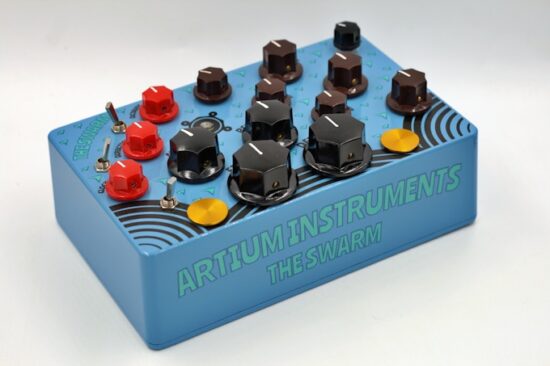
The Swarm, New Compact Synthesizer Features Supersaw Oscillator, Onboard Effects + More


New synth company Artium Instruments has launched a Kickstarter campaign to fund production of The Swarm, a polyphonic desktop synthesizer with built-in effects.

The compact synth features 8-note polyphony, onboard effects, per-knob control, plug-and-play connectivity and more.


Features:

  • Polyphonic Desktop Synth w/ Onboard Effects – The Swarm features a SuperSaw oscillator with 8-note polyphony, curated onboard effects, and a full-featured arpeggiator
  • Knob-For-Knob Functionality – Every feature of The Swarm is directly mapped to a knob, button, switch, or jack, ensuring effortless control. There’s no need for menu-diving or complex button presses to access features; everything is immediately accessible.
  • Onboard Effects – These are designed to complement the synth core, including freeze, delay, reverb & chorus. You can also use the onboard effects with other equipment, allowing you to route external audio through the inputs on the back.
  • Plug and Play Functionality – The Swarm utilizes a USB-C MIDI host for simplicity and ease of use. Most modern class-compliant MIDI controllers with USB functionality should plug in and work immediately with zero setup. Additionally, The Swarm provides power to your controller, streamlining your setup process. For older controllers that only have DIN connections, a USB to DIN converter can be used to ensure compatibility. (These converters typically cost $10-20)
  • Open Source Platform – Artium desktop synths use an open source platform known as Axoloti or Ksoloti for development and implementation of its products.

*Note: Crowdfunded projects involve risk. See the project site for details.

Production of The Swarm is being funded via a Kickstarter project. It’s available to project backers for $379.