iZotope Intros Plasma ‘world’s first’ Intelligent Tube Saturation Plugin


iZotope has announced the releases of a new plugin that it says is the “world’s first” intelligent tube saturation plugin, utilizing machine learning to help you quickly and easily imbue your mixes with “depth, warmth and character”.

Plasma is a dynamic saturator that applies adaptive tube-modelled saturation to your mixes and masters. By analyzing the makeup of your mix and identifying precisely where in the frequency spectrum to add saturation – and when to add it – Plasma aims to make the process of applying saturation simpler and more intuitive.

Plasma’s ‘Flux Saturation’, iZotope’s name for the plugin’s intelligent saturation algorithm, can be guided by selecting one of 24 target profiles which help the plugin tailor its processing to a specific mixing task or type of audio. The effect can be fine-tuned even further with Attack and Release dials, along with an Overdrive control.

Frequency Handles on the plugin’s central visualizer can be used to manually determine which frequencies the saturation will affect, while Channel Modes can be used to apply saturation to Mid or Side portions of the audio or to focus exclusively on transients or sustained elements. Plasma ships with 49 presets that cover a variety of mixing and mastering applications.
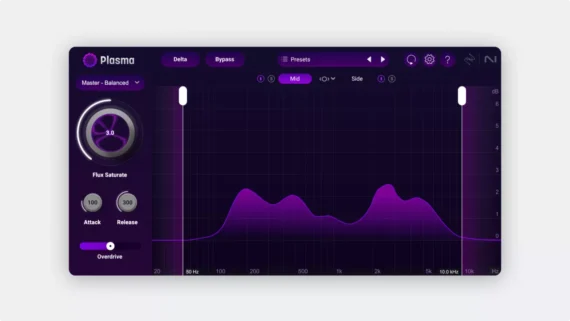
Plasma is the first instalment in iZotope’s Catalyst Series, a series of “purpose-built” and easy-to-use plugins aimed at helping you quickly solve common mixing issues and ensuring you remain in the creative flow.

iZotope Plasma is available now for macOS and Windows in AAX/AU/VST3 formats, Priced at $49/£49. Find out more on iZotope website.


HOW TO Use The Moog Labyrinth As Your Main Sequencer


In the video, synthesist Matthew Piecora (aka EZBOT) digs into how he uses the new Moog Labyrinth synthesizer as the sequencer ‘brain’ for a compact modular techno rig.

As always with Piecora’s videos, he shares tips and tricks based on a deep understanding of his gear, and shows how to create a rig that works well for live performance.

“The Labyrinth is fine on it’s own, but what if we use it’s generative sequencer to sequence our other modules?” asks Piecora. “I am finding this workflow is fantastic for techno production, and sampling in general. The riffs that you can pull out of a quick session are awesome!”

Topics:

0:00 Start!

01:15 What we are working with

03:46 My techno rig for generative everything

10:02 Do this on your Digitakt kick drums

29:08 Nice minimal techno jam

30:17 Talking to the chat and goin off on tangents

48:44 Sampling the siren for a bassline

53:25 TECHNO

1:01:59 Labyrinth is a sequencing monster, too easy

1:19:23 TECHNO AGAIN

1:21:09 Digging this groove big time

1:22:17 CLOUDS for the win

1:27:44 ambient improv breakdown

1:39:40 HYPER FX TEMPLATE DEMO

1:42:56 SWEET SPOT just as we are leaving

View the video and share your thoughts on using the Labyrinth as a modular sequencer brain in the comments!


Melbourne Instruments Delia Synthesizer Hands-On Demo

Synthesist and composer Matt Johnson (Jamiroquai) – In his latest video – shares his take on the new Melbourne Instruments Delia synthesizer.

Delia builds on the motorized control panel and voice architecture of Melbourne Instruments’ Nina. Delia introduces a 49-key velocity and aftertouch sensitive keyboard, new multi-mode analog filters, high pass and low pass resonance control, 3-stage overdrive, and more modulation possibilities.


Matt Johnson offers an overview of the Delia, along with lots of sound and performance demos. He also offers his take on the Delia, saying that the motorized controls are ‘absolutely wonderful’, that the synth is built like a tank, and that, “from a sound design point of view, it’s just a dream”.

View the video and share your thoughts on the Delia in the comments!