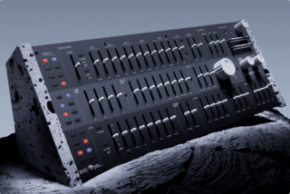
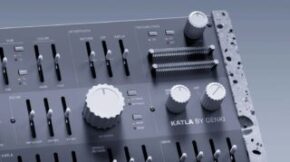
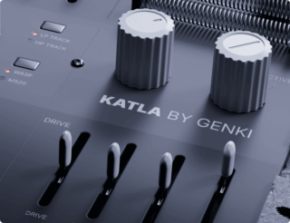
Genki – Icelandic electronic music gear maker – has introduced the Katla, a unique new instrument that they say “draws inspiration from Iceland’s powerful subglacial volcano”.
The name ‘Katla’ means “kettle” in Icelandic, fitting for a volcano often on the verge of eruption. Katla is one of Iceland’s most active volcanoes, located on the South Coast near the town of Vík. It has erupted at least 20 times since 1100, making it the fourth most active volcanic system in Iceland. It last erupted on the 12th of October, 1918, but has been showing signs of unrest in the past decades.
Features:
Handmade in Iceland
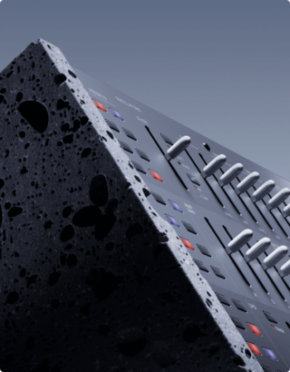
Basalt side panels, each unit is unique
Genki’s “digilog sound engine”
Built in spring-reverb, analog filters and warmth circuits
Specifications are still to come at the Genki site, but it looks like the Katla offers four oscillators that can be used in monophonic, duophonic and four-voice paraphonic modes. Other features include a suboscillator, dedicated controls for aftertouch modulation, dual spring reverbs, dual filters, dual envelopes, LFO, chorus, and preset memory.
German electronic music manufacturer Synth-Werk has announced that it’s working with Noisebug to make their synthesizers and effects available in the USA.
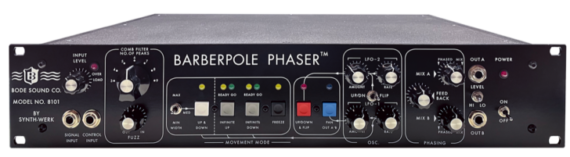
Effective immediately, they are making their BODE Sound Company products available. These include official reissues of these rare hardware effects units:
SW 8101 BODE Barberpole Phaser
SW 735 BODE Frequency Shifter
Starting in 2025 Q1, they will expand this to their line of full-size R.A. Moog 5U clones, including individual modules and complete systems.
Synth-Werk modules are full-size clones of the original Moog modular designs.
What Synth-Werk has to say about them:
“SYNTH-WERK modules are based on original and unchanged designs out of the 60s, utilizing the same hand assembly methods used in the Moog Music factory in Trumansburg, NY in the 60s. The modules are built just as the originals were, by hand-stuffing and hand-soldering components to circuit boards, and using traditional wiring methods. We are using only high precision and selected components combined with vintage NOS components.
All modules follow the Moog format (5U industry standard) and come with the standard „.com“ connector for easy integration in existing systems. The modules work with supply voltages of +15/-15 Volt. All modules can be modified to work on the moog standard of +12V and -6V, e.g. to be used in a Moog system and on the internal power supply.”
Are you a sampling genius? Win $10,000 and have your track released on Ninja Tune with Tracklib’s Sample Breakdown competition – it’s free to enter.
To celebrate the launch of the competition, Tracklib have broken down the most iconic electronic music sample of each year since 1990 in a new video.
Tracklib’s Sample Breakdown series is one of our favourite things on YouTube. Breaking down legendary tracks like Daft Punk’s One More Time and Burial’s Archangel, the series visualizes the sampling techniques used by gifted artists and producers to provide a fascinating insight into their creative process.
Tracklib has released a new bumper edition of Sample Breakdown this week that breaks down what they believe to be the most iconic sample flip of every year since 1990 in a single video.
Focusing specifically on electronic artists, the video charts the history of sampling from Deee-Lite’s Groove Is in the Heart all the way through tracks from The Prodigy, Fatboy Slim, and Moby to the modern day, breaking down samples from Four Tet, Jamie xx, Bicep and Major Lazer before ending on Fred Again’s leavemealone.
Tracklib hasn’t only put together the video to “celebrate the past”, it says, but also “to find the talent of tomorrow”, inviting music-makers across the globe to create the next iconic sample flip and win a cash prize of $10,000.
The winner will also get their track released on Ninja Tune, a record label that’s home to Bicep and Bonobo, among many others, and they’ll have a Sample Breakdown video produced based on their submission.
Tracklib is a platform that enables producers to discover, sample and license original recordings without the hassle and cost of the traditional sample clearance process. To enter the competition, you’ll need to write and produce a track that samples a song from Tracklib’s library of over 100,000 songs. If you’re not a Tracklib subscriber, you can access a free 3-day trial.
“Tracklib is all about the art of sampling,” reads a statement on Tracklib’s website. “We aim to give sampling the recognition it deserves, and provide a platform for producers to be able—for the first time ever—to sample freely, without obstacles.
“Electronic music has, together with hip-hop, been the cultural foundation from which sampling flourished. That’s why this video and competition exists: to pay homage to that evolution and its contributors, while also paving the way for future talents to shine.”
Find out more and enter the competition on Tracklib website.