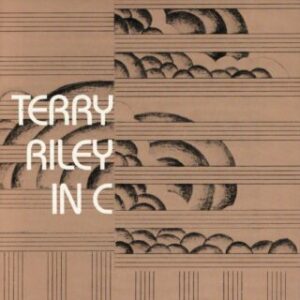
NPR shared a retrospective of Terry Riley’s In C, arguably THE seminal work in the rise of minimalism in classical music, and a hugely influential work on electronic musicians.
In C was a unique work when it was introduced – an avant garde classical music work that immediately embraced by listeners. It debuted Nov. 4, 1964 at the San Francisco Tape Music Center, with composers Steve Reich, Morton Subotnick and Pauline Oliveros participating.
The composition is built around 53 short musical phrases that each musician plays, repeating the phrases an undetermined number of times before moving on to the next. Instrumentation is up to the performers. Because of the way the phrases can be repeated a different number of times by each performer, and the open instrumentation, the piece can vary in texture, shape and length.
In C was a direct influence on minimalists Steve Reich and Philip Glass, who were soon creating their own styles of minimal music. And you can hear the influence of In C and Terry Riley’s music in popular works, ranging from The Who‘s Baba O’Riley from 1971, Mike Oldfield’s Tubular Bells from 1973, and the work of Tangerine Dream and other electronic music groups.
Terry Riley’s In C: The eternal evolution of Terry Riley’s minimalist masterpiece
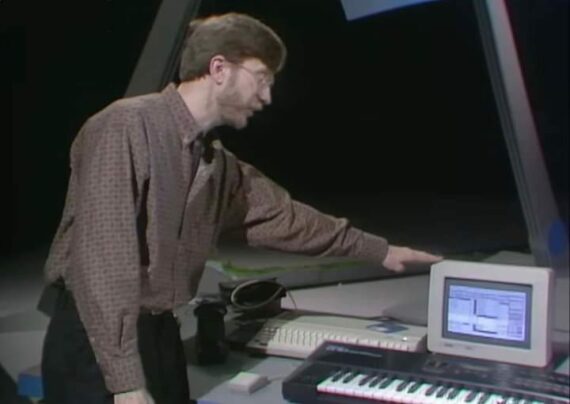
The BBC shared this video, from 1990, that offers a vintage look at MIDI and what it meant for the future of music-making.
MIDI was introduced in 1983, and was initially used as a standard for connecting hardware devices. But, as the video highlights, musicians were quickly connecting computers to hardware, via MIDI, which would lead to decades of innovation in how music is recorded, arranged and performed.
Video Summary:
“Kate Bellingham explores the exciting possibilities afforded to electronic music fans by MIDI – Musical Instrument Digital Interface – which can connect together a whole host of electronic instruments and audio devices through a computer.
MIDI enables a single person to play, record and edit entire musical compositions. Composer Clive Williamson is an avid user of the technology, and demonstrates his setup – a synthesiser hooked up to an Atari ST computer running the Notator sequencing software. With a bit of arm-twisting, Chris is able to convince Kate and Techno co-presenter Mat Irvine to pick up an oboe and guitar and accompany him for a live performance.
Clip taken from Techno, originally broadcast on BBC Two, 5 March, 1990.”