Telepathic Instruments Orchid Will Be Available On December 18th


Back in late November, Telepathic Instruments shared sneak preview for Orchid, an advanced chord generating hardware synthesizer, that the company says is “a tool for anyone who wants to step outside their musical comfort zone.”

Today, Telepathic Instruments has shared details on how exactly music-makers can purchase an Orchid. An initial run of 1000 instruments will go on sale next week, Wednesday December 18th, as part of a limited beta release in advance of a wider release in 2025. Orchid is priced at $549.

The company says that the response to Orchid has “far exceeded” their expectations, and for this reason they’ve put a special system in place to “manage the demand, security risks and ensure fairness of this sale.”

If you’re hoping to get your hands on an Orchid, you’ll need to sign up to The Garden, Telepathic Instruments’ Patreon community, where they’ve been sharing product demos and behind-the-scenes insights into the development of the instrument, including an AMA with Orchid developer Tom Cosm.

Once you’ve signed up, you’ll need to head over to the Patreon on Wednesday at 5PM PST/8PM EST to find a password that can be used to unlock the company’s website, which will be temporarily password-protected. With that password, you’ll be able to access Telepathic Instruments’ online store to snag an Orchid, some merch, or both. There’s a limit of one Orchid per customer.

Telepathic Instruments will be updating its website on Monday to give you a chance to browse the site and view detailed product information in advance of Orchid going on sale.

Rhizomatic Software Synthesis Releases Synestia, A Unique Multi-Effect Plugin


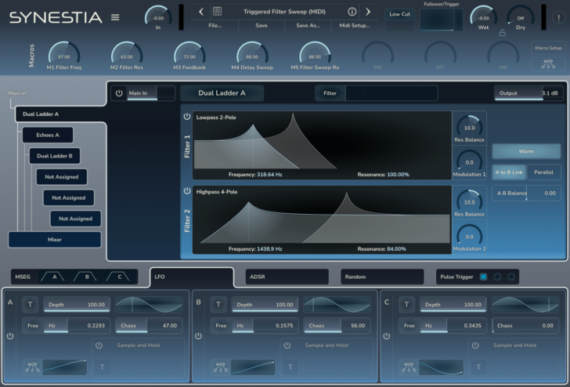
French company Rhizomatic Software Synthesis has announced the release of Synestia, a multi-effect plugin for the creative sound processing.

Synestia combines eight effects: physical modeled resonators, filters, modulated delays, distortion and more. All parameters can be controlled by any combination of a wide selection of dynamic modulators. They say that its flexible and unique approach to patching opens unexpected possibilities, and brings signal routing under the control of modulation.

Synestia Effects Include:

  • Sympathetic: An array of 6 physical-modeled resonators. Sympathetic responds to the audio it’s fed with shimmering harmonic textures.
  • Diffuse Delay: A network of modulated delays, covering a huge range of sounds, from shifting metallic resonances to vast spaces.
  • Echoes: A pair of delays with lots of character, from 0.1ms to 10 seconds in length.
  • Dual Ladder: A pair of self-oscillating multi-mode filters. Combine them to create dynamic new filter shapes.
  • Distortion: Saturation and Wavefolding mayhem, with a selection of dynamic waveshapes.
  • Sidebands: Frequency Shifting with its own feedback delay for unique effects.
  • Flanger: Deep modulated delay effects. Flanger covers a very wide palette of tonalities.
  • Formants: Rich and complex filter resonances.

MIDI Control: Synestia’s Sympathetic resonators can be played by MIDI note input, with MPE and microtuning support. And all modulators can be triggered by MIDI notes, opening all kinds of possibilities for rhythmic effect control.

Modulation: Modulators can be triggered rhythmically, freely looped, or triggered by MIDI and audio input. Modulation depth, polarity, inversion and more are all adjustable per-parameter, making modulation control very precise.

Synestia Modulators Include:

  • 8 Macros provide control over groups of parameters, making it easy to expressively modify any preset. All factory presets have extensive macro assignments.
  • 3 Multi-Segment Envelopes with up to 128 segments and precise editing of breakpoint parameters.
  • Envelope Follower-Trigger: Make Synestia’s effects respond expressively to musical input.
  • 3 LFOs with Sample and Hold, plus a unique chaos control to break up cyclic monotony.
  • 3 ADSR which are fast and precise.
  • 3 Random Generators for obscuring predictability.


Synestia was developed by Brian Clevinger, creator of Rhizomatic’s Plasmonic and Native Instruments‘ Absynth.

Synestia is available on the Rhizomatic website at an introductory price of $79/€79, increasing to $119/€119 after the promotional period. A free demo of Synestia is available at this link.

Roland Jupiter-Inspired Behringer JT Mini Synthesizer Now Shipping


Today, Behringer announces that the JT Mini, a new analog synth in their Mini format, with a voice inspired by the Roland Jupiter-8.

This is the company second announcement this week. Tuesday saw the announcement of Wave, its long-awaited PPG Wave clone, and today Behringer has unveiled a $99 analog synth inspired by the legendary Roland Jupiter-8.

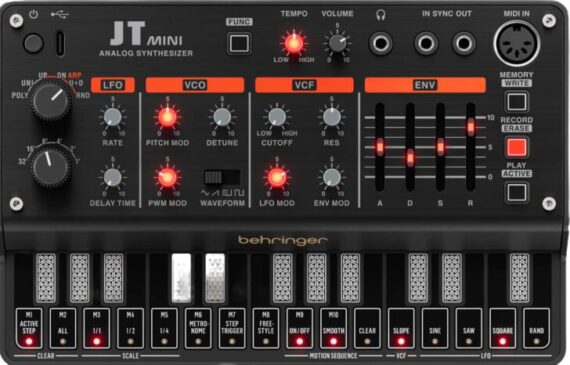
JT Mini promises to pack the sound of the Jupiter-8 into a portable, lightweight and affordable package, adopting the same diminutive form factor as Behringer’s JT-4000 Micro and Pro-VS Mini.

JT Mini’s three analogue oscillators are equipped with saw, triangle, square and pulse waveforms, along with pitch modulation and PWM, and it’s a paraphonic instrument, meaning that JT Mini can play multiple notes simultaneously, but its voices share a filter and envelope.

The synth’s oscillators run through a multimode analogue filter with both 12 and 24 dB/oct slopes, and there’s a single LFO onboard with multiple waveshapes. Both this and its ADSR envelope can be used to modulate a number of different parameters across the oscillator and filter sections.

JT Mini features a compact 27-key touch-sensitive keyboard that can also be used to program its 16-step sequencer. As well as recording melodic patterns, the sequencer can be used to record parameter changes and can store up to 10 sequences. There’s also a multimode arpeggiator onboard. As for I/O, you’ve got USB-C, MIDI in, sync in/out and a 3.5mm headphone jack.

Behringer JT Mini Intro Video:

Features:

  • Portable analog polyphonic and programmable synthesizer
  • Inspired by the Jupiter synthesizer from the ‘80s
  • 27 touch-sensitive keys
  • Analog signal path based on authentic VCO, VCF and VCA designs
  • VCOs with 4 selectable saw, triangle, square and pulse waveforms
  • Pulse width modulation
  • Vintage multi-mode filter with resonance
  • Filter switchable between 2- and 4-poles for additional sound creation
  • Extensive play modes featuring poly, unison and arpeggiator
  • 16-step motion sequencer with 8 memory slots and recording of knob movements
  • LFO with saw, triangle, square and random waves for vibrato, tremolo and wah-wah effects
  • Voltage Controller Amplifier with a dedicated ADSR envelope
  • USB Type C allows powering via smartphone, power bank or computer
  • Sync Input and Output to synchronize with other synthesizers or drum machines
  • Comprehensive MIDI implementation (including NRPN/CC control of all parameters and bulk load/save)

Earlier this year, the company shared a glimpse of JT-16, a 16-voice clone of the Jupiter-8 that has been years in development; with the JT Mini now shipping, perhaps JT-16 is still in development and is a step closer to becoming a reality.

The Behringer JT Mini is now shipping from the factory, with a street price of $99. Note that it has typically been taking a month or so for their shipping gear to be available at retailers. Find out more on Behringer website.