The Korg Multi/Poly Returns In Module Design Debuting At 2025 NAMM Show
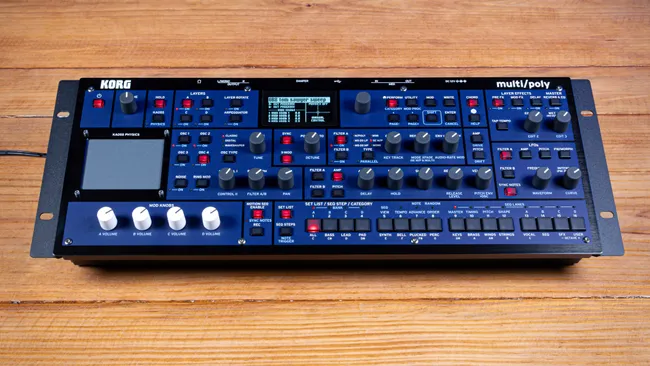

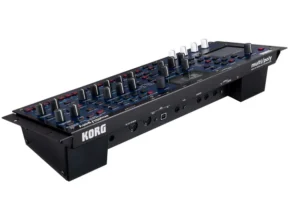
Ahead of the 2025 NAMM Show, Korg has introduced the multi/poly module, a new version of the multi/poly that can be used as a desktop or rackmount synth.

Korg Multi/Poly was one of our favourite new synth of last year. Loosely inspired by the company’s classic Mono/Poly analogue synth, the Multi/Poly is a multi-timbral digital polysynth that Korg describes as an analogue modelling synth.

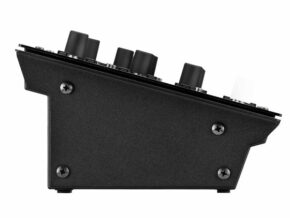
The original Multi/Poly landed in a 37-key unit matching the design of Korg’s Modwave, Opsix and Wavestate. Like those synths before it, it’s now available in a rack-mountable module version too, and perfect for modern studio setups.
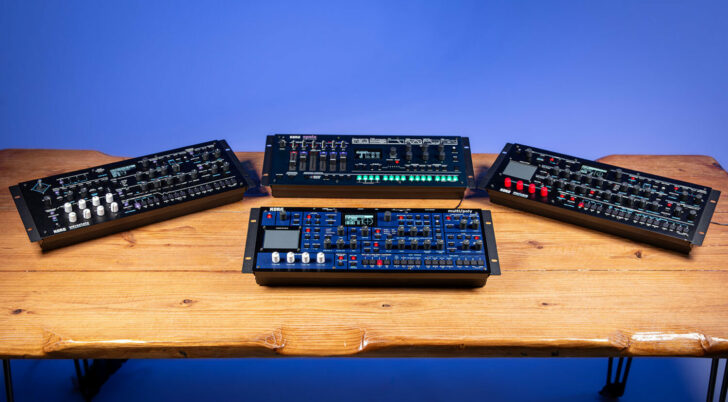
The Multi/Poly features four timbral layers, each with four oscillators. These oscillators can make use of virtual analogue waves – complimented by dual analogue modelling filters and envelopes – as well as a flexible wavetable and waveshaping modes. While it’s certainly possible to create some convincing faux-analogue sounds, these various modes can do far more besides this, including rich atmospheric textures, oddball FX and multi-timbral sequences.

The official multi/poly module intro video:

Its best feature is its Layer Rotate function, which allows the four synth timbres to be triggered in a round-robin manner inspired by the original Mono/Poly. Other feature highlights include an X/Y pad with a fun virtual physics engine, which can be used for creative modulation, a multitude of modelled filter types, flexible effects and a deep multi-lane sequencer.
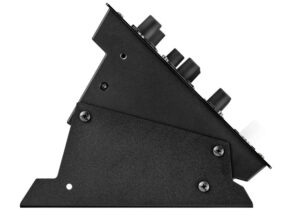
The Multi/Poly module is 60 voice polyphonic and equipped with MIDI 2.0 capabilities. In terms of I/O, it has balanced stereo outputs, MIDI connectivity and USB, which allows the synth to make use of Korg’s desktop editor/librarian application.

The Korg Multi/Poly Module will arrive with RRP of £709/$850 at Amazon site. Visit Korg website for more.

 

New Mackie ProFX10 GO Battery-Powered Mixer With USB & Enhanced Effects


With mobile music-making only ever in the ascendancy and all the big money to be made in live performance, products that enable you to take your skills and your sounds out into the open are similarly on the rise.

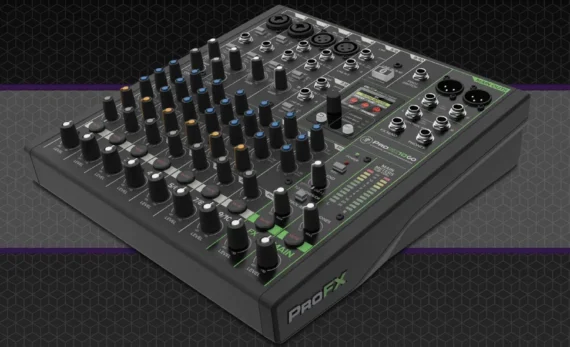
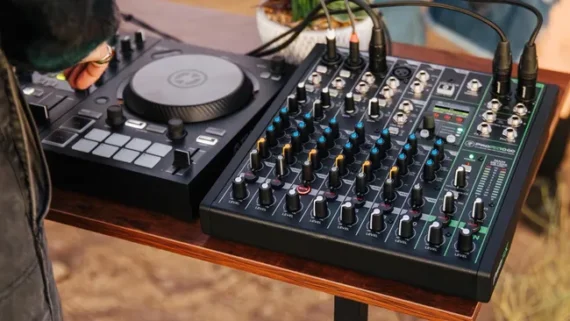
Mackie has announced a new addition to their ProFX line, the battery-powered ProFX10 GO. The new ProFX10 GO mixer is the latest offering from the company that’s been making high-quality, great sounding mixers and associated audio gear for decades. But this mini miracle goes one step further, working its familiar Mackie magic without the need for a power cable.

In fact, it’s not only a 10-channel audio mixer but also a 24-bit/192 kHz, 2×4 USB-C audio interface. Plus, there are additional luxuries such as Mackie’s own GigFX+ effects engine – offering reverbs, delays, choruses and more – and a full-colour LCD display for editing and saving presets.

And – as is increasingly becoming a must – there’s full Bluetooth on board, so you can send and receive audio to and from your audience’s devices without the need for a pesky cable.

And all this without the need for a power connection, as the unit’s built-in but swappable battery keeps the whole gig going for up to eight hours. And when you’re running low, just drop in another GB-10 battery (available separately) to keep the party going.

When you do come across a power outlet, simply plug in the ProFX10 GO and continue your jam while the GO’s battery dutifully recharges in the background.

Via Bluetooth you can stream in songs from phones, tablets and laptops and even use them as backing for your band or DJ who can play on the top. Alternatively, turn your phone into your own remote broadcast studio and stream your performance on the ProFX10 GO to your phone and onwards to Twitch, YouTube, Instagram and more.

Spec hunters will be pleased to note that, despite all the new wireless bells and whistles, Mackie hasn’t skimped on the ProFX10 GO’s capacity to sound great.

The new mixer carries four of Mackie’s famous Onyx mic preamps with up to 60 dB of gain on channels 1 through 4. Channels 1 and 2 carry Hi-Z switches for DI injection of guitars and more, and all channels feature Mackie’s famous musically-optimised three-band EQ.

There’s even a built-in ‘one-knob’ compressor built into channels 1 and 2.

A spokesperson told us, “Now you really can mix anything from anywhere and never miss a beat. Dial in legendary Mackie professional sound wherever you are, no matter how remote.”

In essence, the new GO formulation is everything you loved from Mackie’s existing ProFX10V3 and (plus the effects) ProFX10V+ mixers, plus that all important ability to play in a desert, car park or warehouse and everywhere in between.

Features:

  • Battery-powered 10-channel mixer allows you to mix anything, anywhere
  • 4 Onyx mic preamps with +60dB of gain and ultra-low noise performance
  • 3-band EQ on all channels; 1-knob compression on channels 1–2
  • hi-Z switches supply easy instrument DI-ing
  • 100Hz low-cut filter and +48V phantom power on each mic channel
  • Stereo 1/8-in. input on channel 9/10
  • High-resolution GigFX+ effects engine delivers 24 studio-quality effects
  • Full-color LCD screen permits editing and saving presets on the fly
  • Built-in 2-in/4-out USB-C audio interface yields dead-simple computer recording
  • 3 recording modes: Standard, Loopback, and Interface
  • Effortless latency-free monitoring
  • Bidirectional Bluetooth functionality makes integrating calls and streaming audio a breeze
  • Swappable rechargeable battery provides up to 8 hours of use

The GO comes as part of Mackie’s new line-up and will be fully revealed at 2025 NAMM Show. The Mackie ProFX10 GO will be available soon, priced at RRP $399.99. Find out more on Mackie website.

Musik Hack To Showcase Fuel Its Sound-Enhancing Plugin At NAMM Show


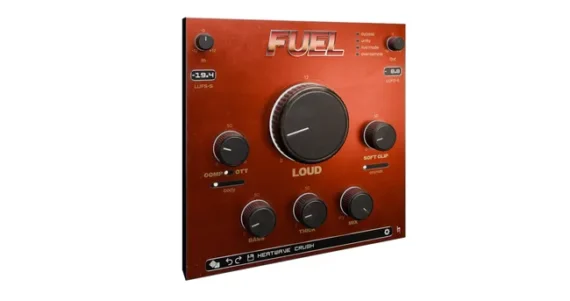
Musik Hack, the developers of the mastering-made-easy mega-suite, Master Plan – have recently released their second software tool: the low-end accentuating Fuel, which they’ll be showcasing at this year’s NAMM show.

Available now for immediate download via the company’s website (at the special introductory price of $59, at time of writing) this ‘ultimate sound enhancing’ plugin will be a major focus for the two-man team at their NAMM booth (#15900) this year.

Fuel is described as a way of balancing low-end power, dynamic range and effective limiting, simplifying processes that typically require the stacking of three or four additional plugins.

Harnessing Musik Hack’s proprietary maximiser algorithm, the plugin is ultra-low latency, which means its applicable in a live setting. The central one-knob compressor makes scaling compression types per-track relatively simple.

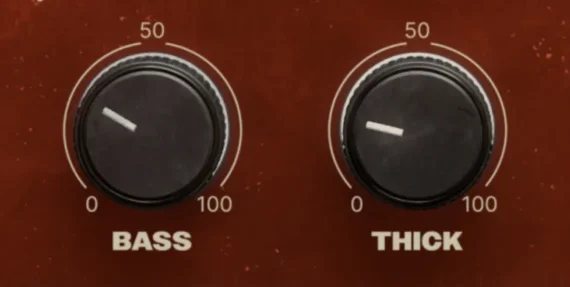
Some snarling saturation comes via the two ‘Bass’ and ‘Thick’ knobs, aimed at rectifying and adjusting issues with low-end and mid-range sounds respectively.

The company bullet point the plugin’s attributes and formats as follows:

  • Fine-tuned maximization & saturation toolkit
  • Combine the best of your favorite plugins in one simple tool: no stacking required
  • Works on any track: vocals, drums, bass, synths, mix bus, and more
  • Classic trap-inspired soft-clipping & analog crunch
  • High octane saturation & bass enhancement
  • The same unbeatable maximizer as Master Plan
  • AAX/AU/VST3 MacOS 10.15+, Windows 10+


Musik Hack, founded by Grammy-nominated producer Stan Greene and plugin developer Sam Fischmann.

Fischmann once said in an interview:

“Different camps behave in different ways. I think some people see a complicated plugin and say ‘yeah, forget this’ – they think the ‘quality’ aspect of music is not for them and they need to focus on something else. Others might lose the spirit of what they’re doing, and decide that getting technical is what’s important. This is sad to me because the most universally great thing about music is that we use it to move other people.”

Fuel can be purchased now at the introductory price of $59 (standard price is $79) while a rent-to-own model at $5 (typically $6.60) a month is also available.