Make Noise MultiMod Enables You Create ‘A Flock Of Related Modulations Signals’ From A Single Input
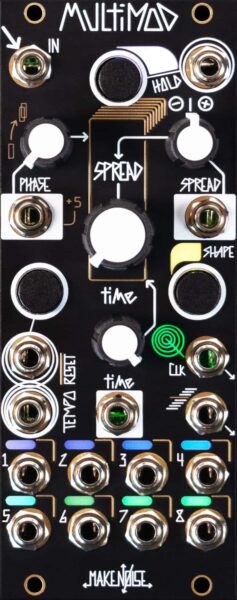


Make Noise let us know that they’ve introduced a new Eurorack Module, MultiMod, that enables you create 8 variations on a control signal, and control the relative phase and speed of the variations.

The result is “a flock of related modulation signals, all derived from the same single input.”

Here’s how it works:

  • Phase sets the spacing of the signal copies in time, weighted by channel, with each progressive channel getting more out of phase from the original signal and from each other.
  • Spread allows for vari-speeding the copies by different amounts, with each getting progressively faster or slower than the original signal.
  • Time determines the range of time captured at the input and therefore also the depth of modulation across copies of the input signal when Phase and Spread are manipulated.

MultiMod also includes Tempo, Hold, and Reset features, and a variety of Read Shapes for temporal rearrangement of input signals.

When the input is not patched, MultiMod generates an LFO that is copied eight times and manipulated in the same ways.

Features:

  • Generate vari-speeded, phase modulated copies of any modulation signal.
  • Control 8 CVs with 3 fully modulatable parameters.Multiple unique read shapes for varying traversal through copied signals
  • Tempo/Reset inputs and Clock output for temporal system integration
  • Hold feature for looping captured signals
  • Ultra-Wide 20V p-p I/O ranges approach analog maximums of the Eurorack system
  • “Full TechniColor, Maximum Blinkenlights”
  • Calibrated to accurately pass critical control signals such as quantized pitch CV
  • Internally generated signals for “LFO mode” when nothing is patched to the Signal Input.

The official into video:

A demo video, created by synthesist Sarah Belle Reid:

And here’s an overview and demo from Red Means Recording:

You can find out about the development of the module, and some new technology used in the module, in the latest issue of the Make Noise Zine.

MultiMod is available now for $349.

New Sounds For Old Samplers: The Pizzicato Pop Optigan Disc


Optigan has released Pizzicato Pop, a new sound disc for the ’70s lo-fi optical sample playback keyboard, the Optigan.

What they have to say about it:

“Pizzicato Pop is the latest in our series of excavations into the Optigan Archives in search of material that was left on the cutting room floor.

The working title for this disc was “Contemporary #107”. It was recorded in 1970 during the initial Optigan session in Cologne, Germany, with the pizzicato string overdubs being added sometime later. Previously only heard on the song “Hope In Your Eyes” by Optiganally Yours.

The keyboard sound is also from the Optigan Archives – an experiment that combines a Hammond B3 with a hand-played tremolo on an RMI Rocksichord.”

The official video demo:

Pizzicato Pop is available now for $89.

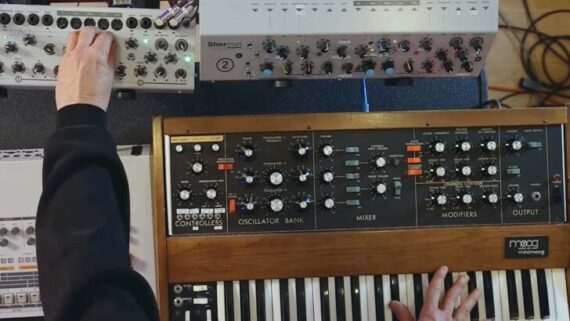
The Story Of Classic Sherman Filterbank With Creator Herman Gillis


Synthesist and composer Anthony Marinelli  – in his latest video – talks with Herman Gillis, creator of the classic Sherman Filterbank.

Gillis talks about how he got started with synth DIY and how it led to creating the Filterbank. And Marinelli demonstrates using the Sherman Filterbank with a Minimoog.

Video Summary:

“In this exclusive interview, Herman reveals how he employed Switched-Capacitor Filter (SCF) technology to create an analog powerhouse that shaped the sound of artists like The Orb, David Bowie, Human League, Ziggy Marley, and more…

Herman takes us through the evolution of his designs, from his teenage years building guitar pedals and drum machines to his legendary Filterbank 1, Quad Modular Filter, Filterbank Compact, and the latest 500 series module, the Rodec/Sherman Minirestyler.

I’ll be performing on a Minimoog and laying down grooves with a TR-909 drum machine throughout the video—bringing Herman’s filter madness to life with some face-melting musical examples! You won’t just hear us talk about this screaming filter—you’ll experience it in all its glorious, growling, and gut-punching sound!

If you’re into synths, sound design, and legendary instruments, this deep dive into one of the most extreme filters ever built is a must-watch!”

If you’ve used the Sherman Filterbank, leave a comment and share your thoughts on it!