Developer Momo Müller has announced a new Universal editor and controller for everyone.
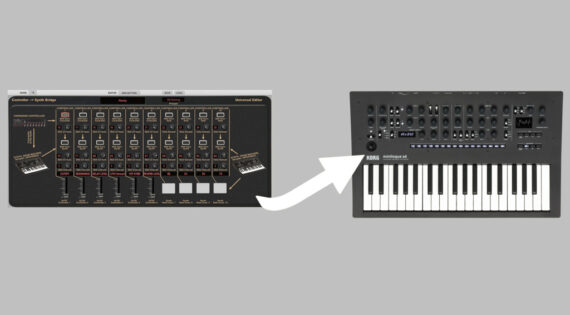
The ‘Universal Synth Editor and Controller – Synth Bridge’, can be used with any synth, sampler, drum machine or other device that can be controlled via MIDI Control Change data, aka MIDI CC.
Momo has ensured ease of use for even the most Luddite synth players because all you have to do to create your own special version of the controller is to use the built-in MIDI Learn function. Select the on-screen control, wiggle, press or slide the hardware controller you want to map to it and it’s captured.
You can then save that collection of settings for easy recall at any time. Now, as we all well know, anything that claims to be universal is rarely ever that but I suppose the word ‘universal’ is more compact than “Controller for most instruments”
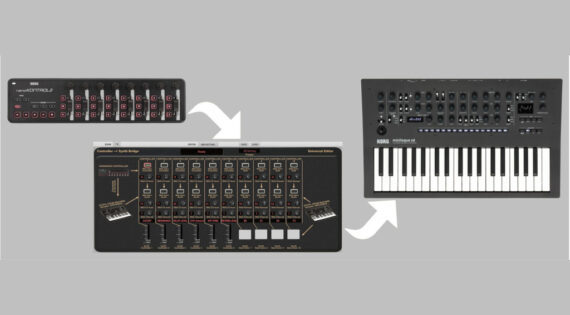
It can also function as a ‘Bridge’ between a hardware control surface, like a KORG nanoKONTROL, for example, and your favourite hardware synth across the studio. The software, as the name suggests, acts as a translation bridge between your controller and synth so that you can tinker with the synth settings using your desktop device.
Here’s the official Universal Synth Editor and Controller demo video:
The software has 10 controller ‘slots’ (six faders, four ‘pads’), each of which can be set to control specific functions of your choice using the settings in each ‘slot’. The software comes in a broad range of versions to suit all users.
The Universal Editor and Controller Synth Bridge is available for:
PC: As VST2 and Standalone for 32bit and VST2, VST3 and Standalone for 64bit Windows.
MAC: As VST2, VST3, AU and Standalone, compatible with MAC Intel and Silicon.
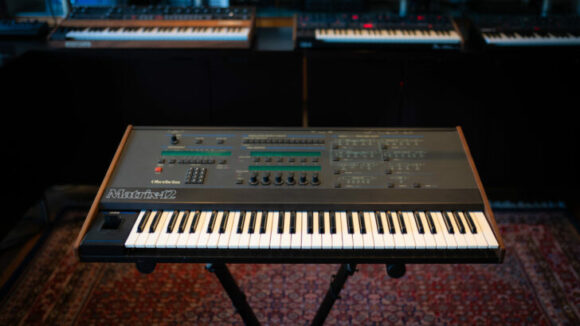
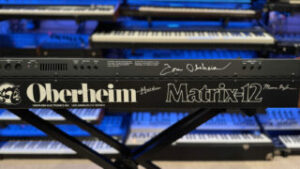
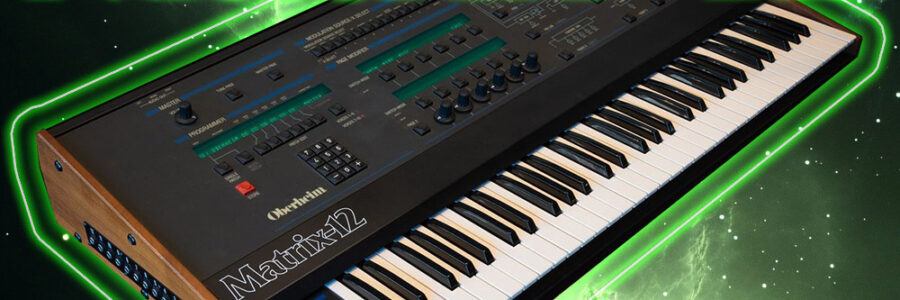
The Bob Moog Foundation is excited to announce its lead raffle for 2025, featuring a fully restored Oberheim Matrix-12 synthesizer signed by Tom Oberheim, Marcus Ryle, and Michel Doidic. Ryle and Doidic were the principal designers of the Matrix-12. This Matrix-12, valued at $20,000, has a unique provenance having been owned by Doug Curtis, inventor of the legendary Curtis chips. The synth was donated to the Bob Moog Foundation by Curtis’s widow, Mary Curtis.
This year, 2025, marks the 40th anniversary of the launch of the Oberheim Matrix-12, which continues to be one of the most respected and sought-after analog polyphonic synthesizers in the world today. Tickets for the raffle are $25 each, 5 for $100, 12 for $200, and 35 for $500, and are available here.
The raffle runs from February 17, 2025, at 7 am (ET) to March 10, 2025, at 11:59 (ET), and is open internationally. Participants who purchase five or more tickets will be invited to an exclusive group Zoom call with Marcus Ryle, to be held in early April.
This one-of-a-kind, American-made Oberheim Matrix-12 is in pristine condition and was restored by its co-creator, Marcus Ryle. It is serial number P53207 (the seventh unit built in the 32nd week, August 5th – 9th, 1985). The Matrix-12 was the final flagship synthesizer from Oberheim Electronics in the 1980s. The Oberheim Xpander was introduced in 1984 as a revolutionary multi-timbral six-voice synthesizer module, and the Matrix-12, launched in 1985, includes two Xpanders (for 12-voice polyphony) and a five-octave velocity and aftertouch keyboard.
The multi-timbral Matrix-12 pushed the limits of analog synthesis in ways that continue to be unrivaled today with 15 different analog filter modes, linear analog FM, and a matrix modulation system to route the 27 modulation sources to the 47 modulation destinations. Sonic possibilities previously only possible on modular systems were now available in a fully programmable polyphonic synthesizer.
“Forty years ago we developed the Xpander, and its big brother, the Matrix-12, with an uncompromising spirit to create the most versatile and amazing sounding instruments we could imagine,” recounts Marcus Ryle. “To this day, the Matrix-12 is still my favorite synthesizer to play.”
Doug Curtis is the legendary inventor whose company, Curtis Electromusic Specialties, offered specialized analog integrated circuits (ICs) that were used by virtually every major synthesizer manufacturer in the 1970s and 1980s, including Oberheim, Sequential Circuits, Moog, ARP, Roland, and PPG. His ICs revolutionized the way synthesizers were designed. Curtis was described in Keyboard Magazine as “one of the most important and least known synthesizer pioneers of the 20th century.
Curtis was directly involved in the development of the Oberheim Xpander and Matrix-12, with these synths being the first to use his new CEM3372 and CEM3374 chips, which were designed with these specific synthesizers in mind. The featured Matrix-12 is one of two from his personal collection.
“Doug appreciated the Matrix-12 so much that he had two, so our family had to think hard about donating this legendary instrument,” noted Mary Curtis. “At last we decided that Doug would have said yes to the idea out of a love for the Matrix-12 itself, a belief that it will raise money for the important work of the Bob Moog Foundation, and the wish for another musician who loves it to make glorious music.”
Proceeds from the raffle benefit the three hallmark projects of the Bob Moog Foundation: Dr. Bob’s SoundSchool, which has inspired over 35,000 elementary school students about the science of sound; the vast and growing Bob Moog Foundation Archives, which includes over 15,000 historical items; and the Moogseum, located in downtown Asheville, NC. The Moogseum continues to navigate the financial aftermath of Hurricane Helene, which has resulted in a $65,000 loss of income since late September.
To find out more about The Bob Moog Foundation, and the Oberheim Matrix-12 raffle, go to The Bob Moog Foundation website.
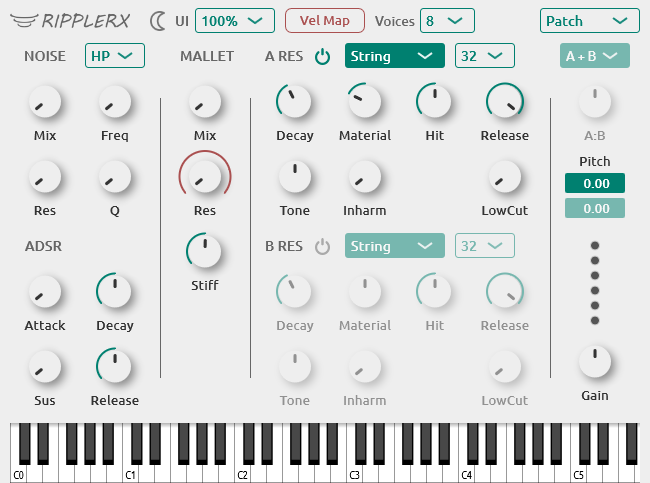
RipplerX is a free physical modeling synthesizer – for Linux, Windows + Mac – that the developer says is capable of sounds similar to AAS Chromaphone and Ableton Collision.
Features:
Cross-platform available on Windows, Linux and macOS.
Dual resonators with serial and parallel coupling.
9 Models of acoustic resonators: String, Beam, Squared, Membrane, Drumhead, Plate, Marimba, Open tube and Closed tube.
Inharmocity, Tone, Ratio and Material sliders to shape the timbre.
Noise and mallet generators.
Up to 64 partials per resonator.
Built with JUCE.
RipplerX is available as a free download via Github.