Annie Clark On The Retro Roland Groovebox She Used On All Born Screaming


Grammy-winning artist and producer Annie Clark – better known under the stage name St. Vincent – has invited Reverb into her studio space to show off some of her gear, discuss her recording ethos and witness a spontaneous jam session.

In the video, Clark describes how she went through a phase of “thrifting” gear on Reverb, deliberately seeking out unpopular pieces of equipment in the hopes of sticking it to the haters. “I had a period of time where I was [doing] the Reverb equivalent of thrifting,” Clark says. “I was like, ‘I know people think that these are terrible machines but I’m going to prove that they’re great!’”

The machine Clark is referring to is an MC-303, a Roland instrument released in the late ‘90s that was the first (and worst, according to some) to bear the name “groovebox”. Equipped with a sample-based sound engine, the MC-303 was packed with classic Roland sounds but earned its fair share of criticism thanks to an unintuitive interface and limited sonic tweakability.
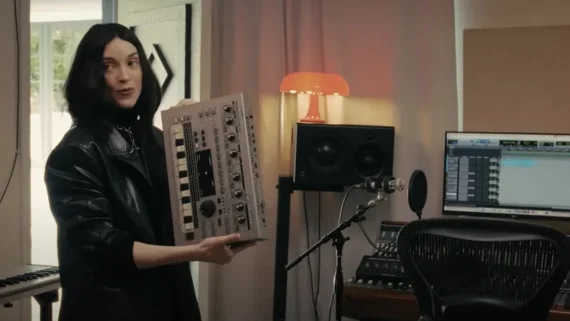
Clark admits that she ultimately came to the conclusion that the MC-303 actually “might be kind of terrible”, but that she still found a place for it on the track Big Time Nothing, from her 2024 album All Born Screaming, after spending hours scrolling through the machine’s presets. “I can’t show you [the sound] because it’s totally broken,” she says, “but it’s also not worth repairing”.

Another of Clark’s Reverb finds is a vintage Omnichord, the quirky chord-strumming Suzuki instrument released in the ‘80s. While the (also busted) Omnichord OM-37 shown in the video has no MIDI outputs, Clark says that she made use of a later, MIDI-equipped version of the instrument on several tracks from her 2009 album Actor, sending out “harp-like sweeps” via the Omnichord’s strum plate to trigger other synths in her studio.

Later in the video, Clark embarks on a spontaneous jam using some of her favourite synths and drum machines. Programming a pattern on her Arturia BeatStep Pro sequencer, Clark sends this out to the Vermona DRM1 MKIII drum machine and layers that with snare rolls produced by the Roland TR-8S, mixing the results live on a vintage Boss KM-60 mixer that Clark loves for its distortion.

Clark says that although she loves to jam as much as the rest of us, messing around in the studio can sometimes make her lose sight of her ultimate goal: writing songs. “Sometimes doing this stuff is a distraction from sitting down and writing the song I know I need to write,” she says. “My main passion is actually writing songs – that’s immensely harder than just dicking around in the studio all day”.
WMD Performance Mixer MKII Now Shipping


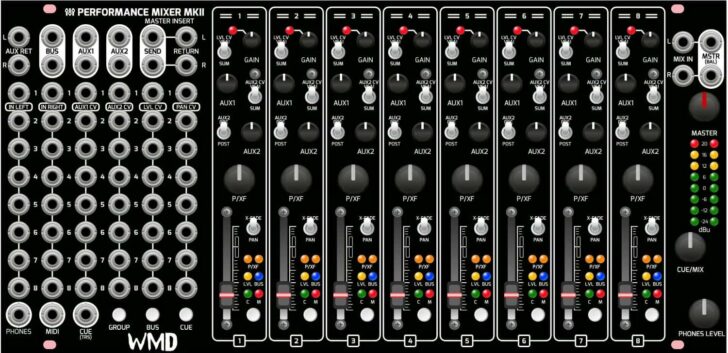
WMD let us know that their new Performance Mixer mkII for Eurorack systems is now shipping.

They say that they’ve shipped the first modules, and plan to ship a lot more in the the late February/early March 2025 timeframe.

Version 1 of the manual for the PM mkII is also available (pdf).

What’s new with the PM MKII and Channels MKII expander since their last update:

Group Recall – There are now two modes for grouped mute, cue, and bus actions.

The new default mode is Group Recall. This allows you to save 8 presets of mute, cue, and bus settings and then recall them by holding group and pressing a channel button. This adds a whole new level of control and the ability to plan changes ahead of time.

The classic mode is Combo Mode, which takes after the original PM. Hold Group, and make any selection you want to change, once you let go, all actions take place.

Channels Routing – The next addition has to do with the Channels MKII expander. It allows you to keep the Channels MKII expander module connected to the PM MKII and selectively route the AUX1, AUX2, and MAIN mix to the PM MKII. So you get independent (or not) submixes on Channels if you want.

For example, the master output can be sent over to the PM MKII’s master output, but then the auxes can be taken out of the PM MKII’s aux summing, so you get 2 independent stereo aux sends just for Channels MKII.

This setting is also digitally recallable with the Group Recall mode, allowing for even more dynamic mixing.

Features:

  • 8 Stereo or Dual Mono Inputs
  • 2x Stereo Auxes
  • Balanced (TRS) Main Outputs
  • Soft Mute Per Channel
  • Group Button for Simultaneous Cue/Mute/Bus routing Changes
  • Pan/Crossfade Switch for dual mono inputs per channel (panned center)
  • Second Bus for Submixing (and/or operation)
  • Stereo Cue Mix Bus (TRS Output Jack)
  • 5mm Headphone Jack with Cue/Mix pot
  • MIDI output sends CCs for Pan, Level, Aux1, Aux2 positions – Capture your mix in your DAW
  • Rear Headers for Pre and Post Fader/Pan outputs to DB25/3.5mm Jacks
  • Clip Indicator on Input Gain Pot
  • LEVEL and AUX2 CV can SUM or operate as VCAs
  • AUX2 can be Pre Fade or Post Fade
  • Channel strips are field replaceable if a pot or fader fails.
  • Expandable up to 24 Stereo Channels
  • Returns Expansion adds 3x AUX return stereo inputs
  • CV control over Pan, Level, Aux1, and Aux2
  • CV flows to MIDI
  • Channel Inserts: Rear cables per channel allow for future insertable effects
  • Firmware update via Memory Card
  • Integrated Soft Start on Power Up

The Performance Mixer MKII is available to pre-order, priced at $1499, with shipping expected in late Feb/early March 2025.

Pipo Interfaces Offer An Open Source Solution For Creative MIDI Control


Developer Rupert Renevier let us know about Pipo Interfaces, a new set of open source MIDI controllers that turn sensor data into wireless MIDI or OSC signals.

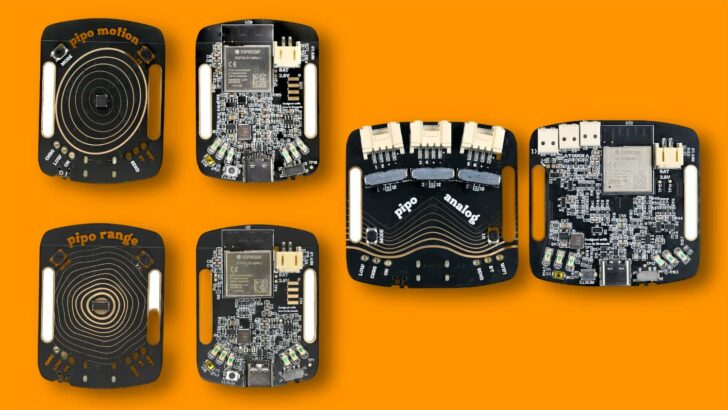
Pipo modules are plug-and-play, standalone boards that can be used independently or together, wired or wirelessly. They share many core features: an onboard lithium battery charger, Wi-Fi and Bluetooth LE connectivity, a USB Type-C port, and practical mounting holes.

There are currently three Pipo module designs:

  • Pipo Motion allows you to trigger actions using its spatial orientation, acceleration, taps, or vibrations.
  • Pipo Range can be used for distance sensing and object detection. It can sense hands (like a theremin) or detect bigger objects like walls, obstacles, or people up to a few meters away.
  • Pipo Analog is the ‘Swiss army knife’ of the family. Using standard Grove-type connectors, any signal between 3.3 and 12 V can be used with your Pipo-based project, making it compatible with a long list of existing sensors made for Arduino. The capacitive touch inputs let you create buttons using various common conductive materials or objects: wires, metallic tape, vegetables, conductive paint…or anything else you can imagine.

What Renevier has to say about Pipo:

“Pipo is a collection of three modules aimed at enabling dynamic, live interaction with audiovisual and music software. They turn sensors into standard input devices—in seconds.

Pipo supports MIDI, OSC, and USB HID protocols, ensuring compatibility with a wide range of computing platforms.

The Pipo ecosystem offers a versatile platform for exploring alternative inputs for everything from music to gaming. It provides a configurable open-source sensor solution with a simple browser-based interface.

Whether you’re a beginner or a pro, you’ll find a reason to love Pipo—it gives superpowers to creatives and is a time-saving, feature-rich solution for makers.”

Details on pricing and availability are to come. You can sign up for notifications on Renevier’s project page.