Cherry Audio Introduces Mercury-8 Soft Synth Inspired By Roland Jupiter-8
Cherry Audio has introduced Mercury-8, a new virtual instrument for Mac and Windows that’s based on the sound of the classic Roland Jupiter-8.
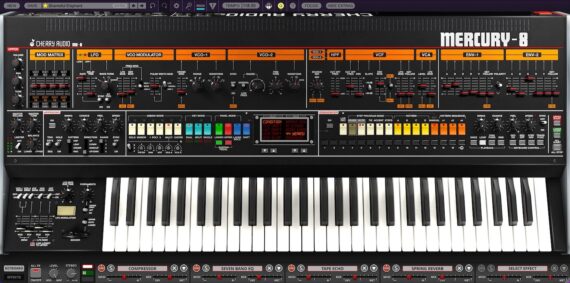
They say that Mercury-8‘s synth engine has been modeled to “capture the sound and behavior that made the JP-8 so legendary”. Mercury-8 also goes expands on the original’s design by offering expanded polyphony, versatile modulation options, studio-quality effects, and expressive performance capabilities.
Described as a “faithful replication” of the original hardware, Mercury-8 nonetheless implements a handful of modernized features that augment its creative potential. “Mercury-8 is not just another recreation of the legendary classic synthesizer,” reads a press release from Cherry Audio. “It transforms one of the greatest analogue synths of all time into a fresh and inspiring tool for today’s musicians and producers.”
Mercury-8’s virtual analogue synth engine leverages “advanced circuit and behavioural modelling” to deliver its take on the Jupiter-8 sound, integrating analogue drift and aging controls to more effectively capture the vintage vibes we all know and love. Multi-voice modes allow for per-voice variations in pitch, filtering, panning and envelopes to introduce additional analogue-style character.
Expanding the polyphony of the original, Mercury-8’s dual-layer architecture allows for 16 polyphonic voices per sound layer, each of which can be split or stacked across the keyboard. Analogue-modelled high- and low-pass filters imitate the curves of the original synth and offer a choice of 12dB and 24dB slopes in true Jupiter fashion, and modulation capabilities have been bolstered by a four-slot modulation matrix with 25 sources and 43 destinations.
In addition, Cherry Audio has implemented a powerful effects engine made up of three independent effects chains that can each host up to five effects from a selection of 20, including new chorus, pan and pulse effects alongside flanger, compressor, reverb, delay, distortion, ring mod and EQ. And there’s a syncable and transposable arpeggiator onboard, along with a 16×4 polyphonic step sequencer per layer.
Mercury-8 ships with a selection of 600 “out of this world” presets, including recreations of the Jupiter-8’s original bank of 64 factory patches. If you’re lucky enough to own a MIDI-modded Jupiter-8 retrofitted by Encore Electronics, you’re even able to import and export patch data via SysEx between software and hardware.
Features:
- The “ultimate JP-8 emulation”, based on circuit and behavior modeling techniques.
- Dual-layer voicing architecture, with 16 polyphonic voices per layer. Keyboard split and stacked layer modes allow two simultaneously playable layers, with separate per-layer controls for all parameters, including synthesis, modulation, patterns, and effects
- Two oscillators per voice for each layer deliver thick, vibrant tones with classic waveforms, sync, and accurate exponential FM cross-modulation
- Triangle, ramp, sine sawtooth, noise, and square or variable pulse waveforms with pulse width modulation
- High-pass and resonant low-pass filters for each layer faithfully recreate the legendary Jupiter curves, with 12 dB and 24 dB slope options
- Two full ADSR envelopes per layer with velocity, independently assignable to filter, amp, and modulation for expressive control and dynamic sound shaping
- Tempo-syncable LFO for each layer, with retrigger option
- Analog Drift and Condition Controls to fine-tune the “age” of the synth from pristine new to unstable vintage, with adjustable VCO, VCF, VCA drift, and envelope slop
- Solo, Unison, Poly-1 and Poly-2, Multi, and single-key Chord Memory assign modes
- Multi-voice mode that adds adjustable “mini synth” trimmers to provide subtle or extreme voice variation in pitch, panning, filter, and envelopes to tones and patterns
- Repurposed “digital display” interface with clickable access to extended features such as trigger and note priority, unison voices, multi-voice modes, condition, and drift
- Over 600 original presets, along with the recreation of the 64 original JP-8 factory patches (with enhanced versions) and the eight factory setups, all accessible in a convenient preset browser. Also included are template presets that serve as ideal starting points for sound design in Mercury-8, and a MIDI controller mapping compatible with the Jupiter-X hardware synthesizer
- Comprehensive modulation matrix with four slots and simple click-to-assign functionality: 25 sources and 43 destinations with optional “Via” controls, including Mercury-8’s integrated effects
- Syncable and transposable arpeggiator for each layer with Arp, Leap, Order, and Random modes, and Swing, Chance, and Feel to add degrees of randomness to arpeggiated patterns
- Syncable and transposable 16×4 polyphonic step sequencer for each layer with Start, Stop, Auto Start, and humanize options, with accurate DAW clock and step synchronization
- Three independent customizable chains of effects, one for each layer plus a global layer, with an individual effects modulator for each layer
- 20 studio-quality effects that can be arranged, saved, and recalled within their effects chains, which are compatible and can be shared with Cherry Audio’s Trident Mk III synthesizer:
- BBD Flanger, Compressor, Digital Delay, Digital Reverb, Distortion & EQ, Dual Delay, Dual Ensemble, Dual Phaser, Envelope Filter, Flanger & Chorus, Galactic Reverb, Lo-Fi, Lushverb, Ring Modulator, Seven Band EQ, Spring Reverb, and Tape Echo. New in Mercury-8 are DCO Chorus, Panner, and Pulser.
- Persistent mini UI Effects controls for on/off, solo, bipolar modulator amount slider, and dry/wet mix for each effect. Global FX on/off, level, and stereo expand
- Utility panels to easily copy, paste, swap, and move layers, effects chains, and sequencer data between presets
- Directly import original JP-8 patch bank SysEx data (Encore Electronics format) via drag-and-drop
- Export Mercury-8 preset data to SysEx data (Encore Electronics format)
- Standalone virtual instrument and plug-in versions included
- User-adjustable oversampling control
- Complete MIDI control and DAW automation for all controls, with easy-to-use MIDI learn and mapping (Preset and Global)
- Cherry Audio’s popular Focus zoom-in feature, as well as standard UI zoom and resize via drag
- Complete documentation available directly online from the instrument or in downloadable PDF format
Mercury-8 Audio Demo:
Mercury-8 Comprehensive Walkthrough:
Mercury-8 is available now for $69. It is also available as part of the company’s Synth Stack 6 collection, which bundles 36 instruments worth a combined $1,687 together for only $599.