Chompi Sampling Keyboard Firmware Meets End Of Road, But May Go Open Source


Chase Bliss has announced that they are no longer pursuing an v1.5 update to the CHOMPI sampling keyboard. The cute and colorful sampler launched by manufacturer Chompi Club in 2023 following a hugely successful Kickstarter campaign.

Effects pedal brand Chase Bliss acquired Chompi Club in 2025 with the intention of continuing product development and manufacturing Chompi itself, but has now made the decision to cease production of the instrument.

After merging with Chompi Club, Chase Bliss planned to produce a backwards-compatible Chompi with the same processor and slightly different hardware, meaning that owners of any Chompi would have access to the same firmware.

“That turned out to be a pretty bad idea,” Chase Bliss said, for reasons explained in a video shared on the company’s YouTube channel titled “We changed our mind”.

The announcement in the video is a little ambiguous, but what’s clear is that the company has shelved plans to develop and release a Chase Bliss-made Chompi or to work with Chompi Club on a second version.
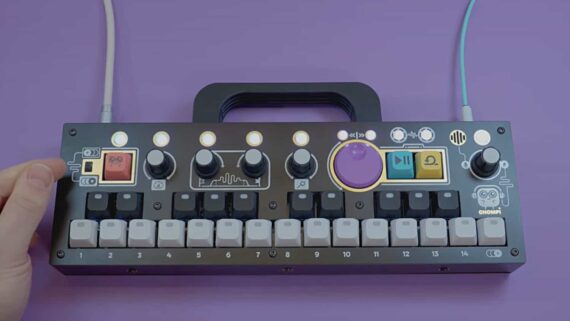
“We are not working on that Chompi thing we described in the other video, or Chompi V2,” Chase Bliss founder Joel Korte said. “We’ll do one firmware patch for Tempo to address a few minor bugs but beyond that, nothing else directly in Chompi world is planned,” he added in the comments.

Appearing alongside Chompi Club co-founder Tobias Hendrickson, Korte told viewers that Chompi’s Tempo firmware – an alternative version of Chompi’s firmware released in March that fundamentally changed how the instrument worked, adding an arpeggiator and sample-slicing functionality – took longer than expected to develop and caused the team to run into the limitations of the device’s hardware and processing power.

“The manufacturing process was also turning into a bit of a puzzle, and so we found ourselves in the position of essentially recreating an existing product that was already maxed out,” Korte explains in the video description. “It would have been time-consuming, expensive, and limiting for future ideas. It just didn’t make sense.”

“We just can’t really do what we would’ve wanted to do on the existing architecture,” Korte added in the comments.

“For me, this is not in any way a sad thing that we’re reaching this conclusion,” Hendrickson said. “As it is now, Chompi is complete. I don’t know how excited I am about making another one that has to stick to those same constraints.”

Chase Bliss will continue to provide support for those that already own a Chompi, and as of the video’s publication, the company has 250 units remaining and there is still stock available on the Chase Bliss website.

Though Chase Bliss has made it clear that Chompi as we know it is being discontinued, Chompi Club’s Chelsea and Tobias Hendrickson will be remaining with Chase Bliss, and Korte says the engineering team is currently working on more than 10 new projects.

The company says that it is exploring the possibility of making the firmware open source, saying that it’s ‘the right move’.
 

3D Print Custom Synth Stands, Pedal Boards + More


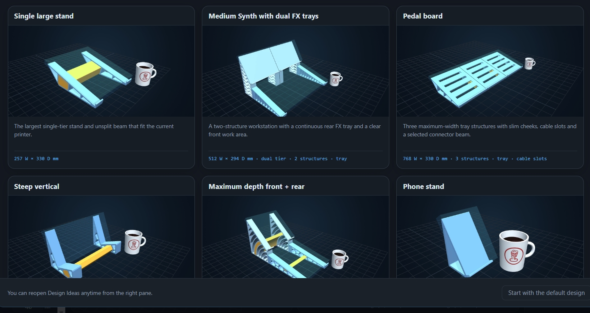
Host Ziv Eliraz – in his latest loopop video – introduces his new project, the Synth Stand and Pedal Board Synthesizer.

“It’s a free web app, that lets people design their own 3D-printable synth stand or pedalboard,” he told us. “If they don’t have a 3D printer, they can take the files and print them with a friend or an online service.”

Features:

  • Template library with various modifiable starting points
  • Adjustable synth depth, angle, width, cheek thickness, base height, lip length and lip offset.
  • Optional connecting rear stand with independent dimensions and angle.
  • Tray, pedalboard and multi-structure “Mega Tray” modes to create infinitely wide trays.
  • Automatically generated side cheeks, middle cheeks, beams, trays and connector parts.
  • Single-beam, split dovetail and middle-cheek solutions for beams longer than the print bed.
  • Custom infill patterns including waves, curves, hexagons, and user-supplied SVG artwork.
  • Optional tray debossing, repeating SVG patterns and cable passthrough slots.
  • Automatic plate packing, part rotation and multi-plate export.
  • Joint-fit test generation for printer calibration and filament use estimates.
  • Unique IDs printed in hidden locations in the part to help users locate the source file
  • 3D previews of assembled stand (with configurable choice of coffee!)

“There will always be a free version” of the tool, notes Eliraz. “Perhaps paid features will be added in the future, but not in the short term.”

Watch the video, and then let us know what you think of the Synth Stand and Pedal Board Synthesizer in the comments!

New Monster Synth, SinTH2, Combines 60-Voice Polyphony With 5 Sample Oscillators


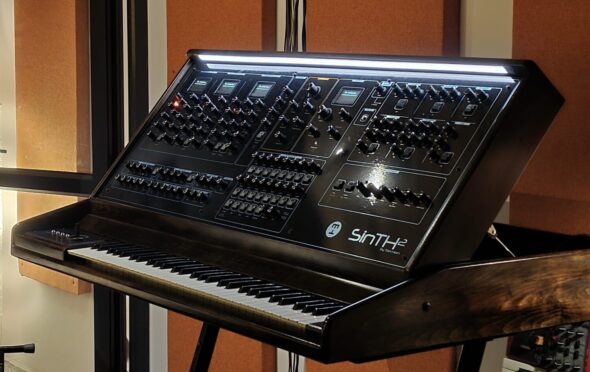
SinTH2 is a new hardware synthesizer built around five sample oscillators, a noise oscillator, 60-voice polyphony, four LFO generators, and two envelopes.

Its synthesis architecture includes 18 dB low-pass, band-pass, and high-pass filters, while an integrated effects DSP provides additional sound processing.

The instrument features motion recording for its controls, four OLED displays, 120 potentiometers, nine encoders, and 36 buttons. A 16-step polyphonic sequencer is included, along with 1,920 preset cells, a Fatar dynamic keyboard, symmetrical XLR audio output, and a stereo audio input routed to the effects processor.

Video Overview (in Polish):

Features:

  • 60-voice polyphony
  • Five sample oscillators
  • 3GB of waveforms
  • Noise oscillator
  • Four LFO generators
  • Two envelopes
  • 18 dB low-pass filter
  • 18 dB band-pass filter
  • 18 dB high-pass filter
  • Motion recording for all knobs
  • Integrated FX DSP
  • Four OLED displays
  • 16-step polyphonic sequencer
  • 120 potentiometers
  • Nine encoders
  • 36 buttons
  • 1,920 cells for presets
  • Symmetrical XLR audio output
  • Stereo audio input to the effects processor
  • Solid wood casing
  • Fatar dynamic keyboard
  • Available in folding-panel, fixed-panel, and desktop configurations

The manufacturer states that the SinTH2 is built to order, in the following form factors:

  • The folding-panel version is listed at €6,999 including VAT.
  • The fixed-panel version is listed at €6,799 including VAT.
  • The desktop version is listed at €5,800 including VAT.