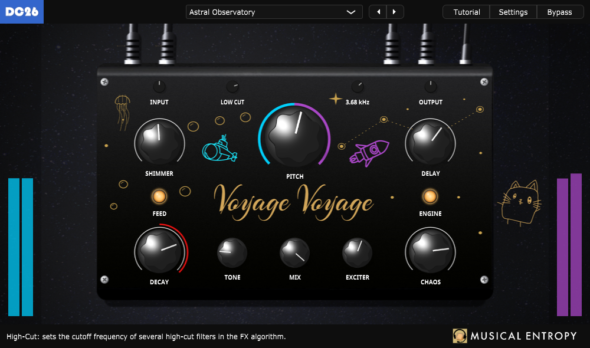
Its pitch-shifted tails run through a BBD-style delay emulation with dedicated time control, blending ethereal, rising harmonics with the grain and instability of analog bucket-brigade circuits.
But Voyage Voyage doesn’t stop at reverb, though. Push the decay up and it transforms into a true instrument — a parametric, evolving drone and texture generator.
Two controls take you deeper. The Chaos knob introduces modulation, diffusion and resonators, bending your tails into unpredictable, organic territory. The Exciter knob generates signals that re-trigger the reverb’s delay lines, keeping the sound alive indefinitely — no input required.
Summary:
classic decay, tone, mix, input, output, low cut and high cut controls, as expected in a reverb plug-in.
Shimmer amount & pitch control, with an additional delay time control featuring the BBD chip emulation.
innovative Exciter & Chaos parameters, useful when Voyage Voyage is in self-oscillation / resonator mode.
additional features such as resizing capabilities, integrated help, extra accessibility functionalities, mix lock control etc.
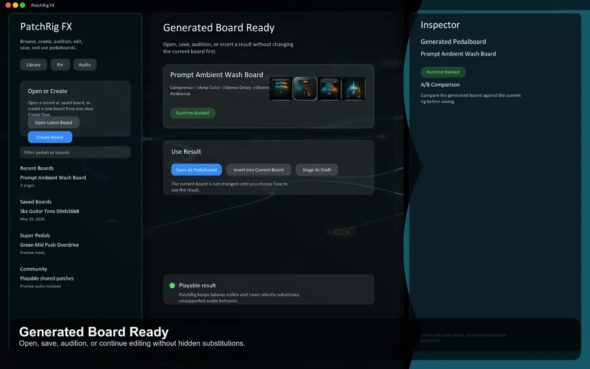
CodeFarmer developer Rob Rightmyer let us know about PatchRig FX, a new multi-effects app for iPhone, iPad, and Mac that lets you use and create custom effects boards.
Free users get curated boards, built-in audition sounds, prompt board preview, and basic reference analysis.
PatchRig Pro is optional and unlocks the full 500-board and 500-pedal library, 60 super-pedal style designs, pedal/amp/preamp/DSP designers, MIDI/instrument voices, unlimited saved boards/pedals/amps, export, iCloud sync, sharing, and community publishing.
Here’s how you can get a playable tone via prompts:
*Note: The app is not designed to be an exact artist, song, amp, cabinet, IR, recording, or preset clone tool. It creates original playable rigs from built-in audio blocks and keeps limitations visible.
PatchRig FX is available now for free with in-app purchases:
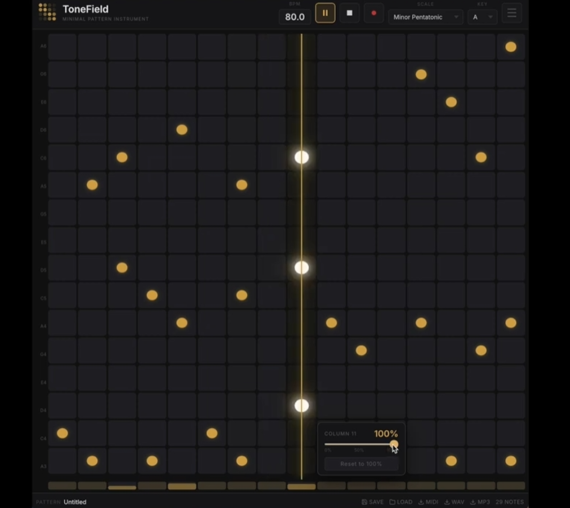
Developer and musician Matt Goodluck let us know that he’s introduced a new software instrument, ToneField.
Goodluck said that it’s inspired by an old app, TonePad Pro, that’s no longer available. Goodluck says he “rebuilt the concept from scratch, expanded it into a modern instrument and launched it as ToneField.”
ToneField keeps the minimalist pattern-based workflow that made TonePad addictive, but adds features including selectable scales and modes, probability for evolving generative patterns, live performance recording, MIDI export, audio export and pattern management.
Place dots on the grid, press play and let the music unfold. You can use the probability controls to make your patterns evolve with every loop.
Features
Original ToneField Classic sound engine — pure sine wave synthesis with precision decay
16×16 step sequencer with amber dot interface
Per-column probability for generative, evolving patterns
13 scales including all 7 modes and pentatonic variants
All 12 keys
BPM 40–180
Velocity and gate control
Delay with time, feedback, filter and mix
8 named pattern save slots
Record live performances as WAV — capture every probabilistic variation in real time
Export patterns as MIDI for Logic Pro, GarageBand and any DAW
Export audio as WAV or MP3
Live MIDI output to your DAW as the pattern plays
Transform tools — flip, rotate, shift and randomize your patterns