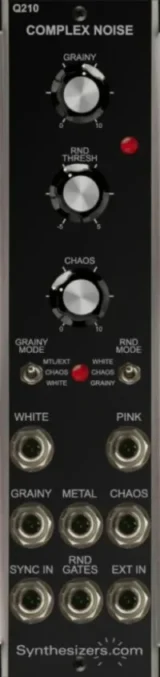
Synthesizers.com – the creator of the modern Moog format standard – has introduced the Q210 Complex Noise, a powerful new module that they describe as a “noisemaker’s playground”.
Beyond noise, the Q210 can also generate random gates. They say:
“Depending on how you approach the module, the Q210 can be a tame texture ready to mix in with a completed track. However if you push it, the Q210 can become the basis of an entire soundscape, especially when paired with filters, VCAS, and envelopes. Sounds both dramatic and explosive are quite easy to conjure.”
Key Functions:
Classic transistor noise
Audio rate chaotic signal output (a true analog non-linear oscillator based on Chua’s 1983 landmark circuit
XOX style metal signal output for hi-hat and cymbal generation
Grainy signal circuit — This section of the module provides sounds which can range sound effects like vinyl record simulator, to a campfire crackling, all the way onto the loud roar of bold a jet engine flying overhead. In other words, you can achieve delicate textures or create terrifying bold sounds.
Random gates with three selectable inputs
Distortion of external signals passed through the GRAINY section
External clock division / sub-sub-octave generation. — Feed in an external signal, set the GRAINY section to EXT, set RAND GATE switch to GRAINY and then take your signal output from the RAND GATES jack. Now, with the combination of the top two knobs, you can dial in a loud and low synth sound which will mix well with the original signal.’
The Synthesizers.com Q210 Complex Noise module is available now for $265 USD.
Sound designer Ian Dixon – in his latest video – takes a look at recreating the sound of classic ’70s string synths with the Korg multi/poly synthesizer.
Dixon walks through the sound design process, step-by-step, and caps the video off with a full audio demo.
Video Summary:
“In this tutorial, I build the complete performance from an initialized sound, creating a Solina-style string layer with multiple oscillators, filtering, ensemble modulation, phaser and stereo delay. I then add a detuned synth bass on Layer B and use key zones to create a playable strings-and-bass keyboard split.
Everything is programmed directly on the Multi/Poly — no software editor required.”
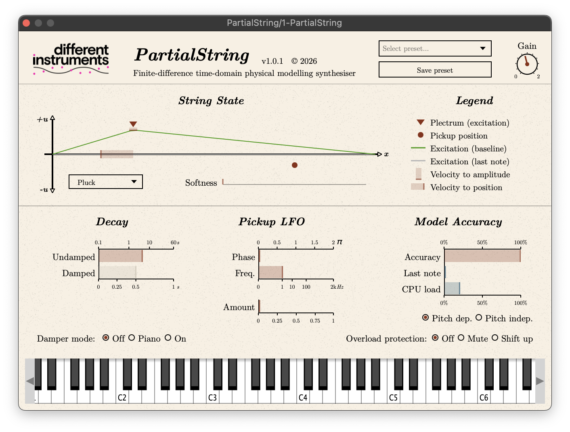
Different Instruments has introduced PartialString, a physical modeling synthesizer that generates sound by numerically solving the one-dimensional wave equation in real time.
Rather than relying on sampled sounds or traditional virtual analog oscillators, the instrument represents a vibrating string as a series of displacement points and computes the propagation of energy across the string. A virtual pickup measures the string displacement to generate the audio output.
The instrument supports up to 10 voices of polyphony, with the available voice count adapting dynamically according to CPU performance and the simulated string lengths.
Features:
Real-time numerical solution of the one-dimensional wave equation
Models the vibration of a plucked string as a displacement grid in memory
Virtual pickup generates audio by measuring string displacement
Supports up to 10-voice polyphony
Dynamic voice allocation adjusts polyphony based on available processing power and simulated string length
Adjustable excitation position along the string
Adjustable excitation shape
Velocity-sensitive excitation
Pickup position is continuously adjustable
Pickup position can be modulated by an LFO
Pickup LFO operates up to audio rates for AM-like sidebands
Adjustable string decay
Dampers can be enabled or disabled
Piano-style damper behavior can be enabled so damping occurs when notes are released
Long undamped decay supports sustained pad-like sounds
Available for macOS, Windows, and Linux
PartialString is available now as a free download, with an optional pay-what-you-want contribution. The instrument is available in Audio Unit and VST3 formats for macOS, VST3 for Windows, and VST3 for Linux.