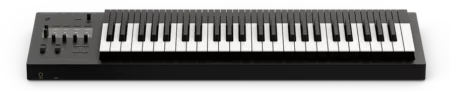
In the latest XNB video offers a complete guide to the Behringer Poly D synthesizer, a 4-note paraphonic keyboard that builds on the classic design of the Moog Minimoog.
While Behringer calls it a ‘Poly’ synth, it is a paraphonic design that lets you individually control the pitches of its oscillators. The rest of the audio path is essentially a monophonic design.
This video covers all the key features of the Behringer Poly D, including oscillators, filters, patch bay, LFO, envelopes, modulation, sequencer and arpeggiator. This is not a review, but is intended to be a complete in-depth guide to the Poly D.
Topics covered:
0:00 – Intro
0:50 – OSC’s
07:24 – Cutoff & Emphasis
10:13 – KBD control
13:45 – Contour & F.Env
19:46 – Loudness contour
24:22 – Modes
32:22 – Autodamp
37:02 – MultiTrigger
42:29 – Noise/LFO
48:58 – Filter EG/OSC4
01:00:14 – Glide
01:01:25 – EXT IN
01:04:49 – Chorus/Distortion
01:07:24 – SEQ:Recording
01:17:42 – Banks & Patterns
01:28:52 – Accents & Rests
01:33:42 – Editing pattern
01:36:37 – Tie & step Length
01:41:38 – Glide
01:45:54 – Ratchet
01:48:35 – Step mode
01:54:59 – Arp
Watch the video and share your thoughts on the Behringer Poly D!
Expressive E shared another sneak preview of their upcoming and long-delayed Osmose synthesizer.
The Expressive E Osmose was originally intended to be released in 2020, but the pandemic and global supply chain issues have delayed production.
The video features composer Tonnerre exploring the current state of some of the Osmose sounds that their in-house sound designers have created, using the EaganMatrix by Haken Audio, Osmose’s internal synth engine.
The sounds include subtractive synth sounds, FM keys, physical modeling pluck, and pads, all taking advantage of the expressive possibilities offered by the Osmose’s Augmented Keyboard Action.
The Osmose features the most expressive synth keyboard ever, supporting continuous pressure control per key, press & tap, left/right pitch vibrato and more.
Artistry Audio has released Monolith, a Kontakt instrument that they describe as “an infinite bass engine”.
Monolith features hundreds of presets that the developers say will “cut through your mix.” You can also dive deep into the parameters to sculpt custom bass tones, using any of the 85 groups of basses, subs, orchestral, and synth samples or import your own samples.