Moog Music brings back Minimoog Model D Analog Synthesizer
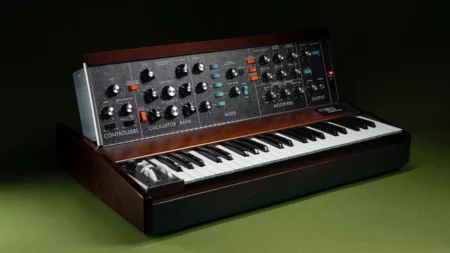
The iconic Moog Minimoog Model D synth is back in production and looking better than ever.

Moog Music today announced the return of the classic Minimoog Model D analog synthesizer.

Considered by many to be the greatest synth of all time, the original Minimoog Model D was released in 1970. It remained on sale for just over a decade, before production ceased in 1981.

We are assured that this new version has the same sound engine and signal path as the original, with a few modern updates, while also retaining the modifications that were made for the 2016 reissue.

These include a dedicated analogue LFO with triangle and square waveshapes, a Fatar keybed with velocity and after pressure available via top panel CV jacks with onboard trimpots, MIDI integration, improved pitch wheel calibration, and a mixer feedback modification that enables you to overdrive the Minimoog Model D and make it scream simply by turning a knob.

New features for 2022 include a spring-loaded pitchwheel that will centre itself when it’s released and updates to the MIDI functionality.
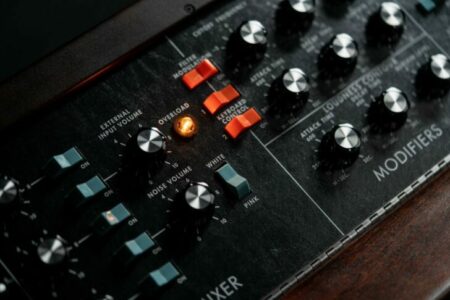
The Model D is built by hand inside the Moog factory in Asheville, North Carolina, and each instrument is housed in a locally sourced Appalachian cherry cabinet with a legacy-inspired walnut stain and hand-finished aluminium chassis.

Here’s a behind-the-scenes look at how the Model D is built, from our coverage of Moogfest 2016:

Here’s a look inside the Model D, and some background on what was involved in recreating the original design:

To celebrate the reissue, Moog shared this performance by the Will Gregory Moog Ensemble of Archimedes Screw, a live performance by 11 musicians—with each of the 10 keyboardists using a Model D to add layers of sound to the composition as it builds.

Utilizing MIDI integration for the 2016 and 2022 reissues, and MIDI-to-CV converters for the vintage units involved in this performance, the Moog Ensemble highlights the modern features alongside the classic sound. According to the group’s musical director and composer, Will Gregory, the instrument’s enhancements expand Model D’s realm of sonic possibility.

In addition to reintroducing the Minimoog Model D, Moog announced that the Minimoog Model D app for iOS and macOS is now 50% off for a limited time, and announced new Minimoog accessories. The Minimoog Model D is available to pre-order for about $5,000.


STG Soundlabs MooSonics makes Moog Modular Format Affordable

STG Soundlabs and Knobcon founder Suit & Tie Guy has launched a new synth module line, MooSonics, that promises to make Moog-format modules affordable.

One of the key appeals of the Eurorack format has always been its affordability, compared to the larger Moog format. MooSonics challenges that, with Moog-format modules starting at $75 for full DIY module kits.

The name ‘MooSonics’ is a play on ‘muSonics’, the company that bought out the original Moog in the early 1970’s. STG has also previewed an upcoming muSonics line, which promises to offer modern interpretations of classic Moog format modules.

Just as ‘MooSonics’ is a playful take on ‘muSonics’, Suit & Tie Guy is getting creative with the design of the MooSonics line, in order to make it more affordable. A key difference is that the panels are flat and made of printed PCB material. Front panels are the most expensive component of many module designs, so this, and the kit approach, go a long way towards making these modules affordable.

We purchased and assembled MooSonics’ first two module designs – Attenuators and Multiples. They’re both easy DIY projects.

Once installed in a MU system, the panels look and perform comparably to modules from other manufacturers:

The MooSonics modules use modern PCB design, so the assembled modules are only 1″ deep.

Suit and Tie Guy hasn’t shared specs for the line – it may be too early in the process – but it looks like the modules will be very ‘skiff-friendly’, compared to traditional Moog designs and Synthesizers.com designs.

The MooSonics line currently features three modules:

  • Attenuators consists of three passive circuits that can be used to reduce the amplitude of any audio or control signal. The signal input to the top attenuator is chained to the bottom two in series. Introduction of a phone plug into middle or bottom input breaks the normalling system: 1 to 1-2-3, 1-2 to 2-3, 1-2-3 to 1-2-3.
  • Multiples consists of three sets of four phone jacks. The top left input of the bottom two groups of jacks is normalled to the tips of the group above it, so you can send one signal to a maximum of 9 destinations from this panel.
  • The Vanilla Mixer is based on the output mixer of “a certain American two voice synthesizer from the 1970s. If you need a second hint, think of vanilla ice cream.” Suit has added a third channel, an inverted output, and normalised DC offsets, to allow for a variety of voltage processing and tone shaping operations. The DIY build is very flexible, because you can choose which op amps, gain staging, and ac/dc coupling options, to make two completely different mixers. These options are documented on the PCB itself.

The kits should be easy projects for experienced builders, but MooSonics currently does not provide build documentation. PCBs are labeled with all component values and build options, which is all that many experienced DIYers will need.

“There is an assumption that buyers have some experience in building electronic devices,” they note. “If you have no experience, this would be a great place to start, but you will need to do some research on basic assembly techniques.”

Suit and Tie Guy plans to eventually offer all the modules needed to create a complete MooSonics system. Once this is done, he hopes to hold weekend build workshops, where you could build a complete modular system. MooSonics modules are now available in limited quantities, with prices starting at $75 for the kits and $95 for assembled modules.


Denon DJ releases SC Live 2, SC Live 4 DJ Controllers


Denon DJ drops SC Live controllers: DJ without a laptop and mix tracks direct from Amazon Music Unlimited.

Denon DJ has just launched the new free-roaming SC Live DJ controllers – the SC Live 4 and SC Live 2 – both of which enable you to mix tracks direct from Amazon Music Unlimited. The standalone, WiFi-enabled devices also have built-in speakers.

These controllers are the first to offer integration with the Jeff Bezos empire’s music streaming service, and feature an “exclusive secure chipset to meet Amazon’s music streaming requirements”. Cloak and dagger stuff; Denon could tell us how it works, but then it would have to kill us.

Both the SC Live 4 and SC Live 2 enable you to access a library of more than 100 million lossless songs (providing you have an Amazon Music Unlimited subscription and a Wi-Fi connection). Song analysis is said to be speedy, so selecting and playing tracks mid-set would not be a problem.

The SC Live 4 and SC Live 2 inherit their “club-standard” layout and workflow from Denon’s flagship SC6000 Prime media players and mixers, with each offering a seven-inch multi-gesture touchscreen, SD and USB media slots and performance FX. You can use a combination of songs stored on physical media and from a streaming service during the same performance.

To ensure completely standalone operation, both SC Live controllers have a set of built-in speakers. And, you can turn these off when you are hooked up to a bigger system.

The SC Live 2 and SC Live 4 available now cost $1,099 and $1,299 respectively. Find out more on the Denon DJ website.

Specifications for both controllers are below.