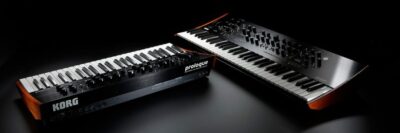
Sinevibes has released Dipole 2, a Multi-Engine effect that they call “the tastiest flanger effect” for Korg synthesizers; Korg Prologue, Minilogue XD, NTS-1
Dipole is a through-zero flanger plugin for the Korg prologue, minilogue xd and NTS-1. It combines two delay lines, with one able to run earlier or later in time relatively to the other, plus a switching feedback signal routing. Right around the zero time difference between the delays, this algorithm produces a “jet fly-by” effect with positive feedback – or full sound cancellation with negative feedback.
Dipole With Elektron Digitakt:
Dipole With Roland SP 404 mkII:
Features:
Studio-grade DSP algorithms, calibrated specifically for KORG’s hardware platform.
IBuilt-in lag filters for noise-free, ultra-smooth parameter adjustment.
Optimized for maximum performance and stability on each individual device type.
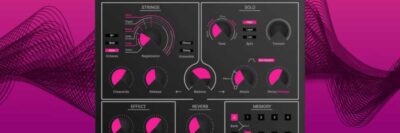
Waldorf today introduced Streichfett String Synthesizer in plug-in format.
The Streichfett was introduced as a hardware module in 2014. At the time, Waldorf said that it sounded ‘how adult movies sounded thirty years ago’.
Waldorf’s Streichfett features a fully polyphonic String Section and an eight voice Solo Section. The Ensemble Effect provides depth and movement to the String Section, while the Effects Section adds adjustable Phaser and Reverb effects. Additionally, the Animate Effect can be used to modulate the Strings Registration.
The Solo Section offers presets named Bass, E-Piano or Clavi, and just like with a typical String Machine, the sound has little to do with that name. Instead, these are shimmering and slightly percussive sounds that blend well with the String Section. The plugin also includes 16 programmable presets.
Features:
128 voice fully polyphonic Strings section
Continuous morphing of Violin, Viola, Cello, Brass, Organ, Choir and more
Registrations
Animate Effect for Modulation of Strings Registration
Ensemble Effect for Strings
Eight voice polyphonic Solo section
Layer/Split for Solo section
Continuous morphing of Bass, E-Piano, Clavi, Synth, and Pluto for Solo Tone
Tremolo for Solo section
Phaser
Reverb
Poly and Channel Aftertouch
Sustain Pedal and Modulation Wheel support
Choice of velocity-sensitive or fixed velocity
Tuning and transpose
16 programmable presets
The Streichfett String Synthesizer is available now, with introductory pricing for Waldorf Music’s 33rd anniversary of €33 for a limited time, with standard pricing of € 99 (incl. VAT).
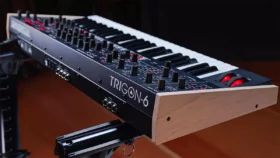
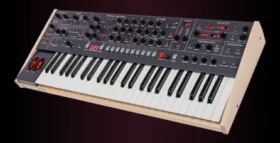
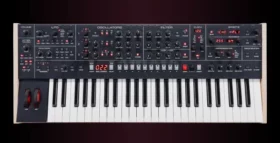
Sequential unveils the Trigon-6, Dave Smith’s final synth: “We believe it continues his legacy”. The Six-voice analogue polysynth is designed to be “an ideal mix of portability and power”
When he demised earlier this year, Sequential’s Dave Smith was mourned both in the synth community and beyond. However, it turns out that he had one final design to share with us: the Trigon-6.
Sequential has introduced the Trigon-6, a new 6-voice analog synth that features the company’s take on the classic Moog 3-VCO-plus-ladder-filter tone, in a modern polyphonic instrument design.
“Dave Smith was very excited about the Trigon-6 and we believe it continues his legacy as a synth creator,” says Sequential CEO David Gibbons, confirming that this was the last synth that Smith contributed to.
The six-voice Trigon-6 offers three newly-designed discrete voltage-controlled oscillators per voice, and simultaneously selectable waveshapes (triangle, sawtooth, reverse sawtooth, and variable-width pulse). Beyond this there’s a two- and four-pole ladder filter design with feedback and drive, and analogue voltage-controlled amplifiers.
“Our new VCOs and filters give the Trigon-6 a tremendous amount of warmth and presence,” notes Gibbons. “The classic, big, punchy analog ladder filter tone is all here — but with some unique enhancements of our own. The addition of drive and feedback allow for a wider palette of sounds than is typical, while still retaining the ability to dial back the aggression to achieve sweet, creamy tones just as easily.”
With the Trigon-6, Sequential has created a trio of 6-voice polysynths, each inspired by the work of a different ’70s/’80s synth maker:
The Prophet-6 is Sequential’s modern take on the classic Prophet-5 sound, combining the Prophet-5 synth voice with modern effects and performance features.
The OB-6 takes the classic Tom Oberheim sound — with its true voltage-controlled oscillators, 2-pole filter, and amplifiers — and adds modern enhancements, such as studio-quality effects, a polyphonic step sequencer, an arpeggiator, and more; and
The Trigon-6 is Sequential’s take on the classic Moog sound, featuring a 4-pole ladder filter design, with feedback and drive, along with a dual effects section, polyphonic step sequencer, arpeggiator and more.
Modulation sources include filter envelope and oscillator 3 (both with bi-polar control), while destinations include oscillator 1, 2, and 3 frequency, oscillator 1, 2, and 3 pulse width, low-pass filter cutoff and feedback.
There’s also a 24-bit/48kHz dual digital effects section that features reverbs, modelled digital and analogue delays, chorus, flanger, phase shifter and ring modulation. If you want to maintain a fully analogue signal path, true bypass is your friend, and you can also make use of the fully analogue stereo distortion.
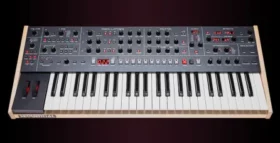
Other features include a multimode arpeggiator and a polyphonic step sequencer that offers up to 64 steps and up to six notes per step. The full-size, four-octave Fatar semi-weighted keyboard is velocity-sensitive and responds to aftertouch.
To ensure a truly intuitive programming experience, the Trigon-6 has a knob-per-function design and keeps you away from any menu diving. You can toggle between preset and live panel modes, the latter of which switches the synth into a ‘what you see is what you hear’ configuration.