Arturia Pigments 4 plugin enables you “explore every shade of synthesis”.
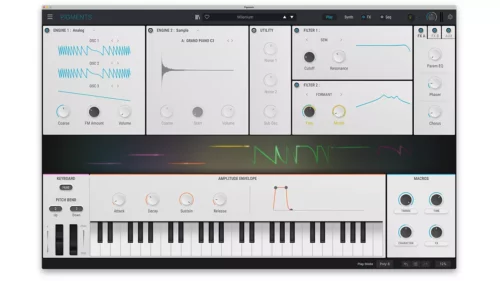
 

Arturia Pigments already rank high in the soft synth pecking order, but the free update to version 4 might help it to rise even higher. Pigments 4 promises “an infinite spectrum of sound” and to enable you to “explore every shade of synthesis”.

If you are an existing user, you will instantly notice some graphical changes. The interface has been made easier to navigate, the Play mode gives you an overview of your entire sound (it offers stripped-back modules and tweak-friendly macros) and you can brighten things up with a new Light mode.

Beyond this, there are more tangible workflow improvements. Modulation editing has been speeded up (you can now click and drag any modulation source to its destination and adjust its depth by hovering over it) and left-right buttons enable you to flick between options in the multimode modules.

Other features, the LFOs now have six waveform presets, and if you want to focus on the synth engine alone, the FX and Seq sections can now be bypassed in both the Synth and Play Mode views.

New sync modes, enable you to experiment with different rhythmic ideas, and there’s fresh compatibility with the MTS-ESP microtuning software.
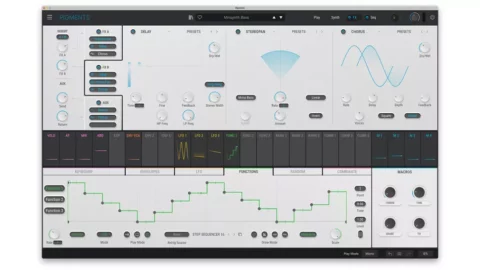
 

Other enhancement include Pigments’ voice engines, starting with a new Ring Mod feature for the wavetable engine and a Pulse Width mode for said engine’s Phase Transformation section. The Harmonic engine gets Phase Modulation, there are more unison options and, for those who want to dive deep, the Modulator Oscillator now has ratio options and an extended hertz range.

On the effects front, Pigments now has an MS-20-style filter, while the new Shimmer reverb promises “cathedral-in-outer-space ambience and cinematic detail”. Super Unison can be used to add extreme levels of width to a single voice, and improvements have been made to the Bitcrusher, Jup-8 filter, Multi Filter and Distortion.

Finally, the sound library has been expanded with new factory presets, wavetables, samples and noise types. There are also four new sound banks on the Arturia Sound Store (these are free for new users).

It runs on PC and Mac in VST/AU/AAX and standalone formats.

Pigments 4 is a free update for existing users. Newcomers can currently purchase it for the introductory price of $99 (regular price $199), and you can also download a demo.

Find out more on the Arturia website.


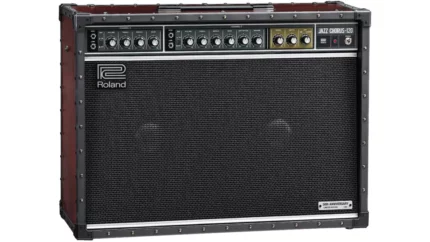
Roland Celebrates its 50th anniversary with Limited Edition JC-120 Jazz Chorus.


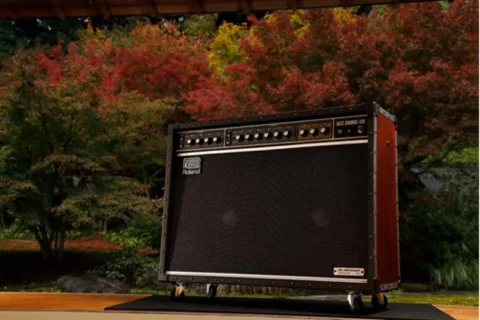
Roland celebrates its 50th anniversary with limited edition JC-120 Jazz Chorus, refinishing the ‘King of Clean’ in a cherry wood finish.

Roland has released a special edition of its longest-running product, the JC-120 Jazz Chorus guitar amp, to mark its 50th anniversary, giving the iconic amp a super-smart new look and turning a studio stalwart into a collector’s item.

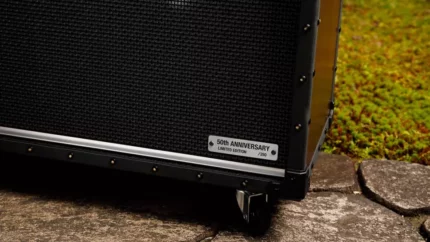
Limited to just 350 amps only will be made. Each amp arrives with a natural cherry wood veneer, classing up the utilitarian aesthetic that we know and love, with a hand-engraved serial number and commemorative badge on the front of a dark gray grille cloth.

Otherwise, this is a JC-120, which having been in production since 1975, making it officially Roland’s longest-running product, will be familiar to most guitar players, having made its name with some of the finest clean electric guitar tones on the planet.

And that’s before you get to the chorus effect. With the stereo spread of the onboard chorus, the JC-120 is one of those amps that brings up words such as “lush” and “immersive”, and all the familiar tasting notes that you might have for industry standard chorus effects.

It is the amplifier that helped Duffy find his signature sound, pairing the Roland’s solid-state sound with a tube amp – typically a Marshall – with both sounds blended together.

“The signature sound of the first two Cult albums was the Gretsch and a Roland JC120,” said Duffy on his website. “That amp had a very nice, clean chorus sound. Looking at pictures of me live from around this time, I went for a double amp setup – there was always a valve amp to give everything some balls. The Roland is great for the early, chimey stuff, because of that chorus sound – which I can really only get out of the combos. Some guys get a great sound with just one amp, but I’ve never been able to do it.

“Basically has an amazing clean tone – a great chorus sound. It’s unbeatable. It’s become kind of a signature. You can definitely hear it on Dream Time and Love a lot. If you listen to Sonic Temple, it’s featured there as one of the layers of the sound.”


The JC-120 is a Class D solid-state combo with 120-watts driving a pair of 12” Silver Cone speakers. It has two channels, with Hi/Lo inputs for each, and each channel has its own three-band EQ and a Bright switch. Channel 2 has controls for Distortion and Reverb. It has an onboard vibrato and chorus, a section controlled by Speed and Depth knobs, and a three-way rotary dial for selecting vibrato, chorus or neither.

The 50th Anniversary JC-120 Jazz Chorus is available to pre-order and will hit gear stores in February, priced $1,999. Find out more on the Roland website.


Copperhead, New iOS Synth, Inspired by Vintage Synthesizers of The ’80s.


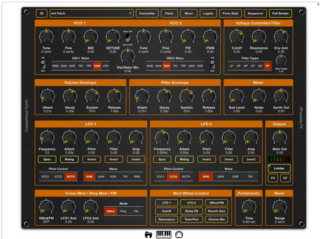
Developer 4Pockets has introduced Copperhead, an AUv3 digital subtractive synthesizer plugin that’s inspired by the vintage synthesizers of the early ’80s.

But Copperhead offers features that were rare or unavailable in the early ’80s, like 16-voice polyphony, a built-in arpeggiator and a host of integrated effects.

Copperhead’s synth engine features custom waveforms, oscillator sync and various cross modulation modes.

At the heart of Copperhead are its two oscillators, which support basic waveforms (including sine, square, saw & triangle), as well as SuperSaw, Trapezium, and a user definable type. The Voltage Controller Filter section features LP, HP, BP and Notch filters, as well as some less common ones, like Formant, which can be used to create vocal-like sounds.

Additionally, Copperhead features twin LFO’s, with random and one shot functionality. It also supports Cross, Ring and FM modulators, in addition to low and high shelf filters.

Copperhead is ‘designed for iPad’, but also compatible with iPhone and MacOS.


Features:


  • AUv3 compatible.
  • Up to 16 note polyphony.
  • 7 Oscillator wave types.
  • Sub Oscillator.
  • PW/PWM on SQR and TRP waveforms.
  • Supports SuperSaw with MIX and DETUNE.
  • XMod / Ring and FM modulations.
  • Osc Sync.
  • 6 types of VCF filter.
  • Low and High shelf on output.
  • Built in compressor.
  • Chorus, Delay, Overdrive, Reverb and Auto Pan effects.
  • Built in Audio Gate.
  • Preset Manager with Bank/Group/Preset section.
  • Supports drag and drop to import/export presets, groups and banks.
  • Supports web transfer of presets.
  • 32 step arpeggiator.


Copperhead is available now for $11.99.