Sonible takes AI to the limit with its quick and easy dynamics processing plugin. The AI-powered limiter plug-in is for creators. ‘Smart’ and affordable limiting that promises one-click results.
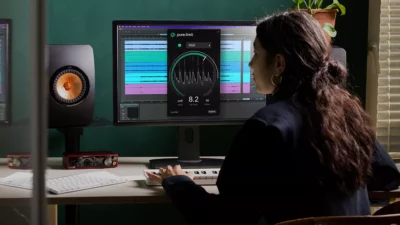
AI-powered plugins aren’t going away, and we’d expect to see more of them in 2023. Before we get there, though, we have sonible’s pure:limit, a smart limiter that promises to tame peaks, balance dynamics and find the right levels at the touch of a single button.
pure:limit is designed for people who want fast results and don’t want to worry about tweaking multiple parameters. In fact, we’re told that it offers “automatic parametrization”, along with genre-based profiles and a visual interface that shows you what’s happening to your signal.
You do have some control over the sound, though. The style selector enables you to determine how forcefully the limiting is applied, and the inflate parameter increases vibrancy.
Klevgrand’s audio-powered Tomofon synth plugin is based on its “boldest and most versatile concept so far”
Swedish developer Klevgrand has released what might well be its most ambitious plugin, a new ‘real audio’ synth by the name of Tomofon.
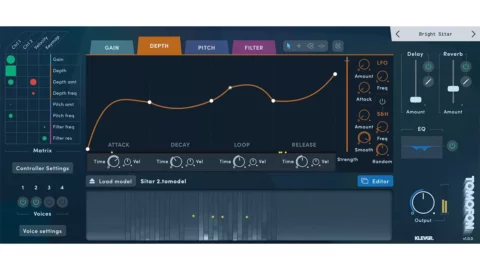
Tomofon is based on a new Audio Model format that can process large numbers of waves that are extracted from audio files – either the ones that come included or your own.
Klevgrand is keen to stress that Tomofon isn’t a sampler. Instead, it converts audio files into oscillating waves that are then mapped to pitch zones, with each wave representing one layer. The synth engine can then seamlessly and continuously morph between both layers and zones, with the complete structure of the organised wavetables being known as the aforementioned Audio Model.
When you import your own audio (monophonic material is said to be best) you can choose to distribute this into the different pitch zones either automatically or manually. The former option is close to a one-click process that generates an instantly playable Audio Model, while the latter gives you complete control over what goes where. Audio Models can also be shared with other users.
Before you get to that, you can have a play with the 124 Audio Models that come included. These are used as the basis for 180 presets, and Klevgrand says that it plans to release more Audio Model packs and presets in the future.
Other features include multiple LFOs, a modulation matrix, a filter and effects.
Find out more and download a demo on the Klevgrand website. Tomofon runs on PC and Mac in VST/AU/AAX formats and is available now for the introductory price of $100 (regular price $130).
Developer Taylor Holliday let us know that, after over four years of development, Audulus LLC has released Audulus 4, a massive update to the modular synthesis app for iOS and MacOS.
Audulus 4 offers many new features, is free to try out and now lets you share patches that anyone can play.
“Audulus 4 represents a massive step forward for Audulus, which required a tremendous re-working of the code,” says Taylor Holliday. “The user interface is now more pro, while still being immediate and approachable.”
Audulus 4 now lets users build patches using Eurorack-style modules, and features a rebuilt module library to showcase the new features. And you can build your own modules, using the platforms large library of pre-built ‘nodes’.
“Audulus is unique in seamlessly combining Eurorack-style patching with lower level signal graphs.” said Audulus sound designer Jerry Smith. “You can build advanced modules in Audulus, without needing to know programming languages such as C++.”
New in Audulus 4:
Full multitouch on iPadOS: Turn on performance mode and interact with multiple controls at once. Create multitouch performance surfaces.
Custom UI for math expressions.
Knob colors and icons.
New UI nodes like sliders and X-Y pads.
Modules can now be recursively exposed. Build front-panels out of other front panels.
Improved search experience in the module browser.
MIDI output via a MIDI Send node.
Pinch to zoom while dragging a connection or moving a module.
AUv3 versions on both iPadOS and macOS.
Canvas Node: Build custom user interfaces using the Lua programming language.
GLSL Shader node: Make advanced shadertoy-style graphics.
The video above offers a preview of Audulus 4 on iOS. Here’s a preview of it running on MacOS:
The application is cross-platform and supports iCloud sync between devices. So you can start a patch on your Mac, edit on-the-go with your iPad or iPhone, and then use your patch across all your devices.
Audulus 4 is available now as a free download on the Mac and iPad App Stores. Patch editing is enabled via an in-app purchase upgrade for $19.99