UDO has announced the “Welcome Spring” patch series, a new collection of free sound libraries for the Super 6 synthesizer:
“The days are growing longer, the trees are awakening from wintertide, and the optimism for the changing of season feels tangible. What better way to celebrate spring than some fresh Super 6 patches?!
Over the next 2 weeks, in the countdown to British Summer Time, we’ll be releasing free patches from an array of different sound designers, including the likes of Drew Neumann, Benny Bock, Elijah Fox, VOOO and Nick Sarazen.
The patches vary in style and genre, and we hope there is something in there which will pique everyone’s interest. Keep an eye on our socials where we’ll be regularly posting these patches over the next 2 weeks.”
The first collection features sounds created by composer & synthesist Drew Neumann, (Aeon Flux, The Wild Thornberrys), who has contributed sounds for synths from DSI/Sequential, Tom Oberheim, Studio Electronics, Waldorf, Ensoniq, Moog Music, Arturia and others.
Chompi is a super-cute sampler that was inspired by the Casio SK-1.
The creators of CHOMPI – a new sampling keyboard that’s designed to make musique concrète style audio manipulation fast and fun – shared this sneak preview of the portable sampler.
As the video demonstrates, CHOMPI is designed to make it easy to sample sounds and play them back, using the built-in keyboard.
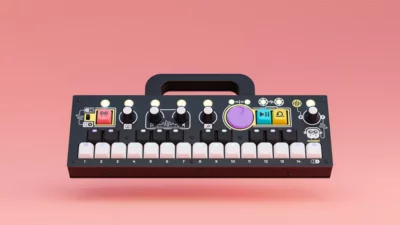
Chompi is a new “magical” hardware sampler and looper that looks to prioritise personality and playability over a lengthy spec list. With its cute carry handle and big-buttoned interface, it is giving us strong ‘My First Electronic Instrument’ vibes, but might also be capable of charming more mature and experienced musicians, as well.
Built on the open-source Electro-Smith Daisy platform, Chompi puts the focus on a simple sample-based workflow that is designed to encourage experimentation. Hit the record button and you can immediately capture a sound via the built-in mic, and this is automatically mapped across the two-octave mechanical keyboard.
The interface provides big, dedicated controls for sampling, pitch, sample editing and effects. CHOMPI also features a looper, so you can record phrases and play over them, and even overdub layers.
Chompi offers seven voices of polyphony and gives you 14 preset slots. You can adjust the sample start/end point, there’s an AD envelope, and the playback speed and direction of the sample can be controlled, as well. The multi-FX section is all on one knob, and provides a multimode filter, lo-fi saturation, a granular delay-reverb and more.
Recordings can be made using the tape-style stereo looper, which enables you to overdub sounds as many times as you like. The transport knob controls tape scrubbing, loop playback speed/direction and other features that are apparently waiting to be discovered.
As you can see, Chompi has no screen, but RGB LED indicators and endless switching encoders give you multi-page parameter control. The MX Cherry switches on the hot-swap enabled keyboard can be replaced and customised as you wish, and the Chompi is said to be built to last.
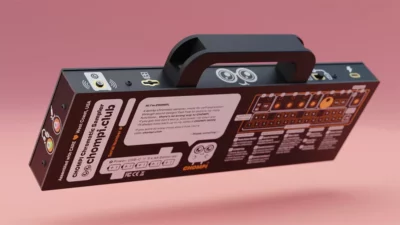
USB-C powering means that it is also portable – assuming you have a power bank – while other connectivity includes stereo aux I/O, a headphone socket and MIDI I/O (all on 3.5mm jacks). Your samples are stored on a micro SD card.
Features:
Flexible hardware platform
Built on the powerful Daisy platform (by Electro-Smith) unlocking easy firmware updates, and flexible programmability options.
Screenless workflow, w/ RGB LED indicators & endless switching encoders for multi-page parameter controls
Utilizes the widely popular MX Cherry switches for its Hot-Swap enabled, two octave keyboard (switches & keycaps are infinitely customizable)
Custom Panel Enclosure allows for limited edition colorways (artist series already in the works)
Custom made BOBO Keycaps
Quirky sampling Engine
Unique Sampling Workflow Encourages User Exploration
7 Voice Polyphony
14 Slots to Save/Recall Presets
Sample Playback Speed & Direction Controls
Sample Start & End Point Controls (w/ Additional Attack + Decay Envelope)
Transport knob provides control over: Manual Tape Scrubbing, Loop Playback Speed / Direction, as well as other additional ‘easter eggs’ to be found by advanced users
Chompi is said to have been inspired by portable old-school keyboards such as the Casio SK-1.
The developers will be making CHOMPI available via a Kickstarter project launching later this month, priced at $499 for backers (normally $599). Find out more info on the CHOMPI website.
Chase Bliss puts us in a good MOOD by unveiling the sequel to its beloved multi-effects pedal.
“MOOD MKII is a more polished, flexible, and ultimately professional pedal, but it’s the same goofball at heart”
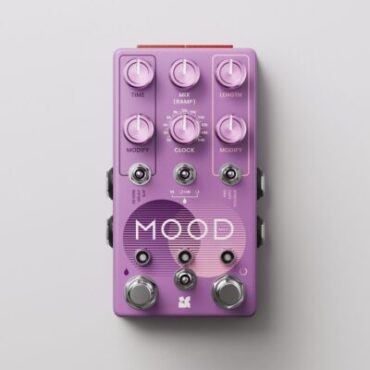
Chase Bliss has announced the sequel to its MOOD multi-effects pedal, a micro-looper and delay with a unique sonic architecture made in collaboration with Drolo FX and Old Blood Noise Endeavours.
The original MOOD offered two channels: one is a granular looper that samples, repeats and layers snippets of incoming audio, while the other is a spatial effects processor with reverb and delay. Both channels are interlinked and can work in tandem to produce complex ambient effects that can be time-stretched and pitch-shifted.
MOOD MKII does the same thing but takes the idea much further and includes a host of new features. The pedal has been bolstered with stereo processing, overdubbing, and freeze mode, while the overall loop length has been doubled.
MIDI integration has been significantly improved: all parameters can now be controlled externally via MIDI, and both channels can be synced to a MIDI clock. Even better, MOOD’s transposition function can now be controlled with a MIDI keyboard: this means the pedal can essentially function as a granular synthesizer.
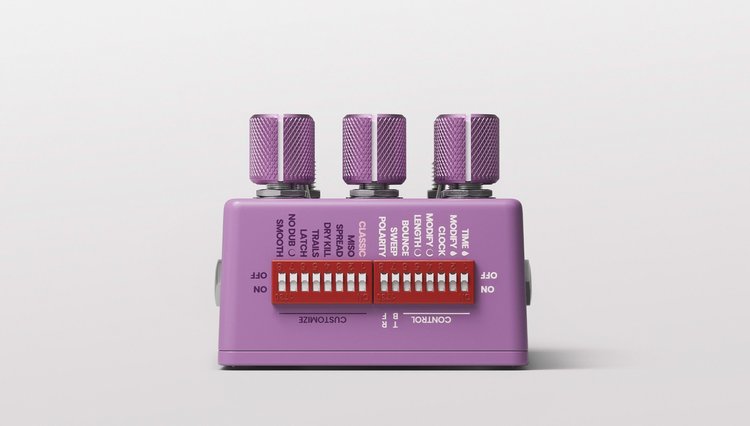
A number of finer details in MOOD’s workflow have been modified in the update and the overall sound is said to be much cleaner. However, those yearning for the sonic quirks of the old version can engage MKII’s Classic Mode to switch between the pedal’s iterations.
In a statement announcing the release of MOOD MKII, Chase Bliss say that their goal in developing the pedal was to include every feature request and improvement that they possibly could while still making it “feel like good ol’ MOOD”.
“This thing has been a joy to make, but we were also careful,” the statement continues. “MOOD was this surprise success and its greatest strength is that it’s just fun. It’s instant gratification and I didn’t want to overstuff it and lose that.”
“On the surface it will feel instantly familiar, but you now have the ability to go so much further. Just about everything in the pedal is doubled, roughly speaking. The loops can be twice as long, it’s full stereo, and both channels now have a powerful hold function. You can overdub, you can sync, you can freeze, you can even use the looper like a live effect.”
MOOD MKII is in the late stages of beta testing, but is available to pre-order now , price at $399 with the first units set to ship at the end of April. Find out more and pre-order MOOD MKII on Chase Bliss website.